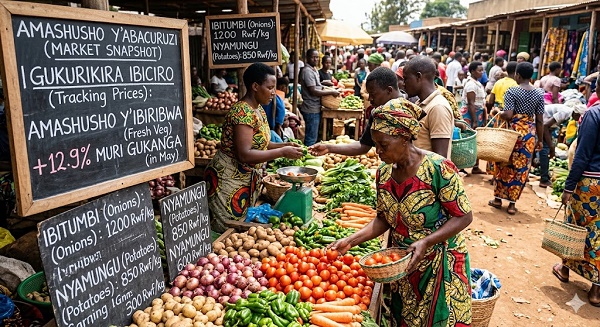
Consumers in Rwanda continue to face significant financial pressure as the cost of living remains high.
Fresh data from the National Institute of Statistics Rwanda (NISR) indicates that annual headline inflation stood at 12.3 per cent for the year ending in May 2026.
While the rate shows a very subtle cooling from the 13 per cent peak recorded in April, the underlying reality for shoppers at the market remains a challenge.
According to the latest Consumer Price Index (CPI) report, the main driver of inflation on a monthly basis for May was the sharp surge in fresh produce prices.
The statistics agency states that on a monthly basis, headline inflation for May 2026 has recorded an increase from the rise recorded in April. The main driver was the monthly increase in the “Food and non-alcoholic beverages” category, which rose by 0.9 per cent from April to May.
Within that crucial food basket, it was fresh vegetables that caused the primary inflation strain. Vegetable prices rose 0.9 per cent month-over-month. To illustrate the impact on overall numbers, this single category was responsible for increasing the total monthly CPI change by 0.3 percentage points.
A deeper sector-by-sector analysis reveals mixed results, with some major outliers showing dramatic cost spikes.
While overall numbers stabilized slightly, the cost of “Energy” surged by a staggering 44.4 per cent year-over-year. NISR states this massive increase in energy costs directly influences transportation, production, and the overall cost of basic services.
Similarly, “Housing, water, electricity, gas and other fuels” costs rose by 19.4 per cent annually. The sector with the highest inflation rate, however, is “Health,” which skyrocketed by 71.6 per cent on an annual basis, emphasizing a persistent and severe affordability crisis in critical care access.
When comparing costs from April to May 2026, a slight downward trend emerged in certain areas, providing brief relief: Housing, water, electricity, gas and other fuels decreased by 0.9 per cent from April to May, and “Energy” itself saw a 0.5 per cent monthly decrease during the increase in fuel prices caused by global shocks in supply chain.
Costs for transport and restaurants and hotels continued to creep up, rising 1.1 per cent and 0.1 per cent monthly, respectively.
In discretionary spending, alcoholic beverages, tobacco and narcotics saw a substantial 16.1 per cent increase on an annual basis, even though monthly growth was a minimal 0.2 per cent.
The final balance between local production and imports reveals where the financial strain is originating. Prices of local products increased by 13.7 per cent annually. Conversely, imported product increased by 10.5 per cent on an annual basis.
While local products show a steeper annual jump, they only recorded a 0.3 per cent monthly increase. However, the prices of imported products jumped 1.1 per cent monthly, suggesting that international pressures, such as transport and global supply costs, are now directly driving the immediate cost increase on the ground in Rwanda.