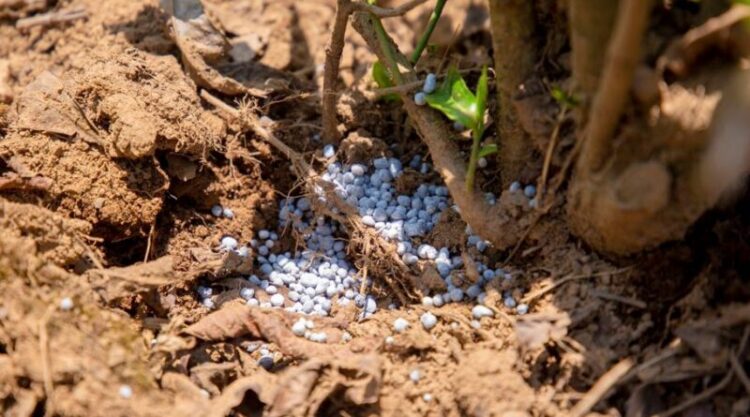
Government has increased fertilizer subsidies from Rwf39 billion to Rwf64 billion, but many smallholder farmers say rising global prices continue to put fertilizer beyond their reach.
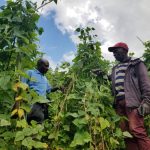
Under the morning sun in Simbwa Cell, Kabarore Sector in Gatsibo District, Ishimwe Dusabeyezu walks slowly through rows of maize that barely reach his knees.
At this stage of the season, the crop should be taller, with dark green leaves signaling a healthy harvest. Instead, patches of yellow break across the field and many of the stalks appear stunted.
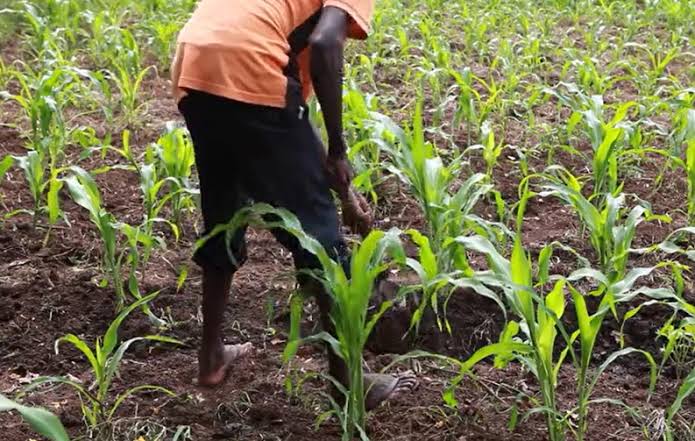
Farmers like Ishimwe who don’t apply enough inputs face loses during harvest.
Standing at the edge of his 15-hectare farm, Ishimwe points to sections where he deliberately reduced fertilizer application this season. At planting, he used six bags of Diammonium Phosphate (DAP), followed by five bags of Urea for top dressing. In previous seasons, he would have applied considerably more, but rising fertilizer prices forced him to cut back.
“A few years ago, I could buy enough fertilizer to cover my entire field,” he says. “Now I buy only what I can afford. Sometimes I delay purchasing fertilizer, and sometimes I simply apply less than required.
For Ishimwe, rising fertilizer prices have changed more than his spending habits. They now determine how much land he cultivates, how much fertilizer each hectare receives and, ultimately, how much maize he expects to harvest.
Other farmers are rethinking their plans
Louise Niyosenga, a smallholder farmer from Nyagitabire Cell in Kayonza District, says fertilizer has become increasingly difficult to afford despite government subsidies. Consumers are going to higher food prices come in after the 2027A season harvest.
“We are selling our maize and beans at very low prices, yet fertilizer keeps becoming more expensive,” she says. “If prices continue like this, I may have no option but to rely more on organic manure because buying enough inorganic fertilizer is becoming impossible. It’s like changing from a fuel to an electric car,”
For Jeannette Ngabire, another farmer in Gatsibo District, the challenge extends beyond rising prices.
“I still have an outstanding loan of Rwf245, 000 with Tubura from the previous season,” she said. “Until I clear that debt, I don’t know whether I’ll be able to buy enough fertilizer or even plant the same acreage again.”
Pascal Hategekimana, a farmer from Karembo Sector, Ngoma District also said that, Fertilizer is available locally, but for many smallholder farmers in his sectors, it is becoming increasingly difficult to afford in the quantities needed to sustain production yields.
Agricultural extension officers say these experiences show a wider trend that has emerged since global fertilizer markets were disrupted since 2021.
Harora Hubert Harerimana, an agricultural extension officer in Kayonza District, said “Farmers produce different crops which rely heavily on fertilizers, they can spend around a third of their operating costs on fertilizers alone,”
“Farmers could previously plan their seasons because fertilizer prices were relatively stable,” he says. “Since global supply disruptions pushed prices upward, many have started buying smaller quantities, delaying purchases or applying fertilizer below the recommended rate.”
According to Harerimana, applying less fertilizer than recommended can significantly reduce crop productivity over time, at times; seeds supplied might also not be the best quality for planting.
“Every increase in diesel prices raises my operating costs,” he says. “When fuel and fertilizer become more expensive at the same time, it becomes hard,” said Alex Nzeyimana, a farmer from Ngoma District who also owns agricultural machinery.
” Rising fertilizer and fuel prices have increased production costs across the farming season” He noted
“Even with tractors and equipment, every increase in diesel prices raises my operating costs,” he says. “When fuel and fertilizer become expensive at the same time, it becomes harder to maintain production.”
Agronomists warn that if farmers continue reducing fertilizer application, the impact will extend beyond individual farms to overall agricultural output and household incomes.
The rising cost of fertilizer is already affecting decisions farmers make before the harvest season begins. Across farming communities, some producers say they are applying less fertilizer, buying fewer bags than recommended or delaying purchases until they have enough money.
Harora Hubert Harerimana, an agricultural extension officer in Kayonza District, says the changes are becoming increasingly common among farmers he works with.
“Farmers could previously plan their seasons because fertilizer prices were more stable,” he says. “But after global disruptions pushed prices upward, many have started buying smaller quantities, delaying purchases or applying fertilizer below the recommended rates.”
He said these changes can have long-term consequences because fertilizer application directly affects crop growth and productivity.
For farmers, reducing fertilizer use is often not a decision based on preference, but a response to rising production costs.
Alex Nzeyimana, a farmer from Ngoma District who owns agricultural machinery, says increasing fuel prices have added another layer of pressure. “Even with tractors and equipment, every increase in diesel prices raises my operating costs,” he says. “When fuel and fertilizer become more expensive at the same time, it becomes harder to maintain the same level of production.”
He said that higher costs are forcing farmers to rethink how much they plant, how much fertilizer they apply and whether production remains profitable.
Why fertilizer prices keep rising
The challenge facing farmers does not begin in local markets. Rwanda imports nearly all of its chemical fertilizers, making domestic prices closely connected to international supply chains.
The country sources fertilizer from major global producers, including suppliers in the Middle East such as Saudi Arabia and Qatar, as well as Eastern Europe. Some raw materials are also processed through regional facilities, including OCP Africa operations and the Bugesera fertilizer blending plant, where products are prepared to match local farming needs.
When the war between U.S.A and Iran started, one of the main economic concerns globally was the closure of oil shipments. Besides that, Fertilizer got stuck in the region. Before the war, one-third of global fertilizer transported by sea passed through the Strait of Hormuz.
Because Rwanda is landlocked, fertilizer must travel long distances before reaching farmers.
Most shipments enter the region through major ports, including the Port of Dar es Salaam in Tanzania and the Port of Mombasa in Kenya. From Dar es Salaam, fertilizer moves by road and partly by rail through Tanzania before entering Rwanda through the Rusumo border by trucks. From Mombasa, supplies pass through Uganda before entering through border points such as Gatuna and Kagitumba.
Truck fuel costs accumulate heavily along these two corridors, driving up the baseline price of imported fertilizers, analyst said.
This dependence on long supply routes means any disruption in global trade can quickly affect prices at the farm level. Once the fertilizer clears these corridors, it enters Smart Nkunganire Systems (SNS), the system ensures that government subsidies directly absorb these heavy corridor transit costs, keeping the final price affordable for the village farmers.
“Recent tensions in the Middle have added more uncertainty to global shipping routes, according to Prime Minister Justin Nsengiyumva.
“Disruptions around major maritime routes, including the Strait of Hormuz, have increased transport costs and added pressure to already expensive agricultural inputs,” He warned.
Andrew Mold, Director of the Sub-Regional Office for Eastern Africa at the United Nations Economic Commission for Africa (UNECA), says Rwanda’s reliance on imported fertilizer leaves farmers exposed to international market changes.
“Fuel prices, transport and logistics costs, exchange rate movements, and the value of the Rwandan franc against the U.S. dollar all influence the final price farmers pay for fertilizer,” he says.
When global markets shift, Mold explains, farmers often have limited options.
“Many respond by buying smaller quantities of fertilizer, reducing application rates, or accepting lower production expectations,” he says.
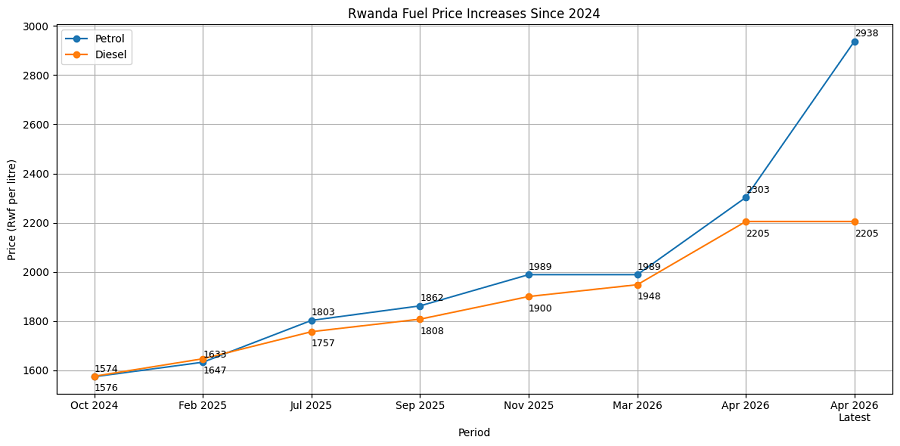
Source: RURA The regulatory body, recently revised the prices of fuel in Rwanda, and this is mostly likely to alter the prices of fertilizers experts have warned.
Mold’s assessment is supported by research from the World Bank and the International Food Policy Research Institute (IFPRI), which found that landlocked and import-dependent African countries experience larger fertilizer price shocks because of transport challenges, high logistics costs and currency pressures.
IFPRI notes that during global crises, fertilizer prices can double, while retail prices paid by smallholder farmers may rise by 100% to 170%.
For farmers in Sub-Saharan Africa, where fertilizer use is already relatively low, higher prices often mean using less fertilizer, which can reduce productivity and threaten future harvests.
Why farmers feel the pressure
The pressure on farmers is not only coming from fertilizer prices, but from a wider increase in the cost of imported agricultural inputs.
Dr. Rusa Bagirishya, an economist, said the rise in fertilizer prices show broader global market pressures affecting many imported goods.
“Not only fertilizers, generally imported goods are becoming more expensive because of shipping delays, high energy costs and changes in global markets,” he said. “These costs eventually reach consumers and farmers through higher prices.”
He noted countries that depend heavily on imports remain vulnerable to external shocks, including changes in transport costs, fuel prices and currency movements.
For agro-dealers, the impact is already visible in farmers’ purchasing decisions.
Ngabo Vedaste from Plant Agro Dealers says fertilizer price increases have changed how smallholder farmers plan their production.
“Since 2021, prices have been climbing, and smallholder farmers have been among those most affected,” he says. “Many farmers are trying different ways to maintain production because they cannot always afford the recommended amount of inputs.”
He said that some farmers are combining subsidized fertilizer with other inputs as they look for ways to improve yields while managing costs.
For agricultural experts, the biggest concern is what happens when farmers continue reducing fertilizer application.
According to Emmanuel Mwizerwa, an agronomist and consultant in Kayonza, reducing fertilizer application may provide short-term financial relief for farmers, but it can affect crop performance and productivity over time. He says farmers who consistently apply less than recommended risk lower yields, which may affect household income and food supply.
“Lower yield means a farmer has less surplus crop to sell, heavily reducing their household cash reserves. This means, they find it harder to afford the digital top up payment on SNS’s required for the next season inputs trapping them in a cycle of low input use and declining yields,” he added
Can subsidies keep farmers protected?
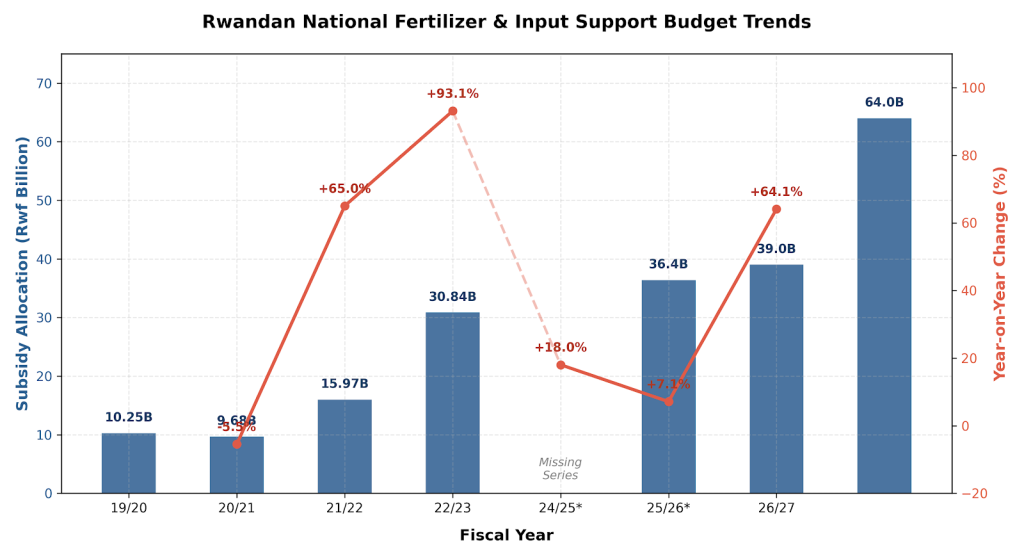
To reduce the impact of rising global fertilizer prices, the Government of Rwanda has increased fertilizer subsidies in the 2026/27 national budget by 18.1%, from Rwf39 billion to Rwf64 billion.
Finance Minister Yusuf Murangwa said the additional support aims to ensure farmers continue accessing agricultural inputs despite international pressures.
According to Agriculture Minister Telesphore Ndabamenye, goverment has secured about 60,000 tonnes of fertilizer for the 2027A planting season, with roughly 25,000 tonnes expected to come from local production under the government’s agricultural input subsidy programme.
Rwanda’s annual fertilizer demand is estimated at between 90,000 and 100,000 tonnes. According to the Rwanda Agriculture Board (RAB), about 16,000 tonnes of locally blended fertilizer were used during the 2025/26 fiscal year, accounting for roughly 16% of the country’s total fertilizer consumption over the same period.
“The push for local production comes at a time when global fertilizer prices remain under pressure,” the minister said. He added that the government’s long-term goal is for at least 50% of the fertilizer used in Rwanda to be produced locally, while expanding the range of locally formulated fertilizer blends from the current four to nine varieties.
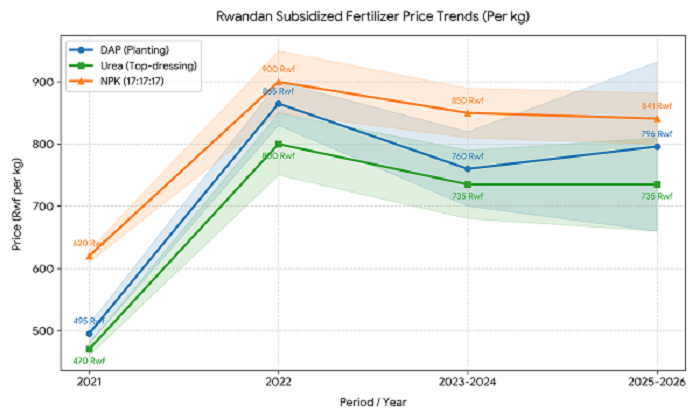
Heading into this cycle, the agriculture sector carries roughly Rwf 25.4 billion in unpaid fertilizer subsidy arrears.
While the agriculture budget was increased for 2026/2027, policy makers are worried, it is projected to decline in subsequent fiscal years, from around Rwf350 billion to Rwf 246 billion in 2027/2028 and Rwf 255 billion in 2028/2029.
Hon. Odette Uwamariya, Chairperson of the Parliamentary Committee on State Budget and Patrimony, said continued investment in agriculture remains critical.
“We must keep putting enough money in agriculture,” she said. “That is the only way to support steady farming growth and achieve the government’s NST2 targets.”
In Rwanda the Ministry of Agriculture, determines seasonal fertilizer requirements, distribution targets, and production priorities, while RAB supports implementation through agricultural programs and extension services.
Farmers access subsidized inputs through the Smart Nkunganire platform (SNS), a government system that allows registered farmers to purchase fertilizers and other agricultural inputs at reduced prices.
Alongside government programs, Tubura, run by One Acre Fund Rwanda, provides farmers with fertilizer and improved seeds through credit, training, and market support. Farmers repay after harvest, allowing them to access inputs without paying the full cost upfront.
Jean De Dieu Habishuti, a Tubura field officer in Kayonza, said more farmers are depending on seasonal credit because fertilizer costs have increased.
“Farmers still need inputs to maintain production, but the money required to purchase inputs has increased considerably, because cost of manufacturing these fertilizers has increased, besides that, the price of what farmers produce and sell on the market has also increased.” he said.
RAB said increased fertilizer support has contributed to higher fertilizer application rates nationwide. However, the lawyers think otherwise
Egide Gatari, RAB Inputs Program Manager, said the objective is to ensure that every farmer, whether in Kigali, the provinces, or institutions such as schools and correctional facilities, has access to seeds and fertilizers,”
“This is part of a broader strategy to strengthen food security and increase the national food basket.” He added.
The fertilizer subsidy program forms part of Rwanda’s wider agricultural transformation agenda, which targets annual agricultural growth of 8% under the Strategic Plan for Agricultural Transformation (PSTA 5).
Furthermore, the strategy seeks to increase private investment in agriculture, and expand exports over the next five years.
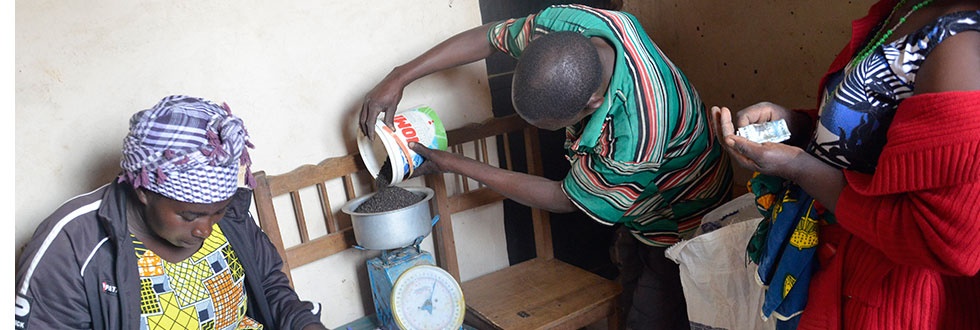
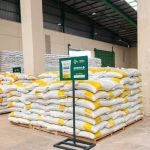
Farmer accessing fertilizer through a cooperative/agro-dealer OR fertilizer distribution activity.
Why challenges remain
Fabien Ayindigira, a sector agronomist in Kabarore Sector, said the subsidy has helped keep fertilizer available, but affordability, delays and transportation costs remains a challenge.
“We still see farmers reducing the amount of fertilizer they apply because they cannot afford the recommended quantities, Subsidies system started last year in some of the remote sectors of Gatsibo.” he said.
“Farmers say they face delays, poor quality seeds, and transport costs on top of higher prices hence many are still making difficult decisions about how much fertilizer to buy.”
The Auditor General’s 2023 audit found that gaps within the input support system continue to affect how effectively inputs reach farmers.
The report pointed to weaknesses in Nkunganire system such as limited availability of soil-specific fertilizer recommendations, poor seed quality, pests and disease outbreak and gaps in ensuring farmers receive inputs that match their production needs.
For instance, national production figures have indicated a shortfall, with maize yields reaching 2.0 tonnes per/ hectare against the government’s target of 2.26 tonnes per/ hectare.
The findings also highlighted shortcomings affecting other strategic crops. Potato seed was found to be scarce and poorly suited to local soil conditions, for example.
RAB’s supply of certified rice seed was also found to be insufficient, in addition to some seed varieties being distributed in areas where climatic conditions were unsuitable.
Also, the AOG reported weaknesses in tracking farmers’ cultivated land and monitoring the distribution of subsidized fertilizer, raising concerns about whether support consistently reaches farmers based on their actual needs.
AOG findings suggested that while subsidies help reduce pressure on farmers; their impact depends on how well the system works from national planning to the farm level.
While civil society organizations welcome the increase on agriculture budget subsidies, they argue that the success of the subsidy should ultimately be measured at the farm gate.
CLADHO, (Collectif des Ligues et Associations de Défense des Droits de l’Homme au Rwanda), a watchdog on national budget spending, said that the key question is whether farmers are paying less and whether production is improving.
Evariste Murwanashyaka, an analyst from CLADHO said the success of the program should not be measured by the amount of money allocated, but by whether farmers see a reduction in the price they pay for fertilizer.
He notes that tracking the fertilizer supply chain, from importation and transport costs to storage and retail prices, is necessary to determine whether the subsidy is reaching smallholder farmers.
Mugwanyashaka adds that monitoring should focus on fertilizer availability, distribution, farmer access, crop productivity and food prices to measure whether public investment is delivering results.
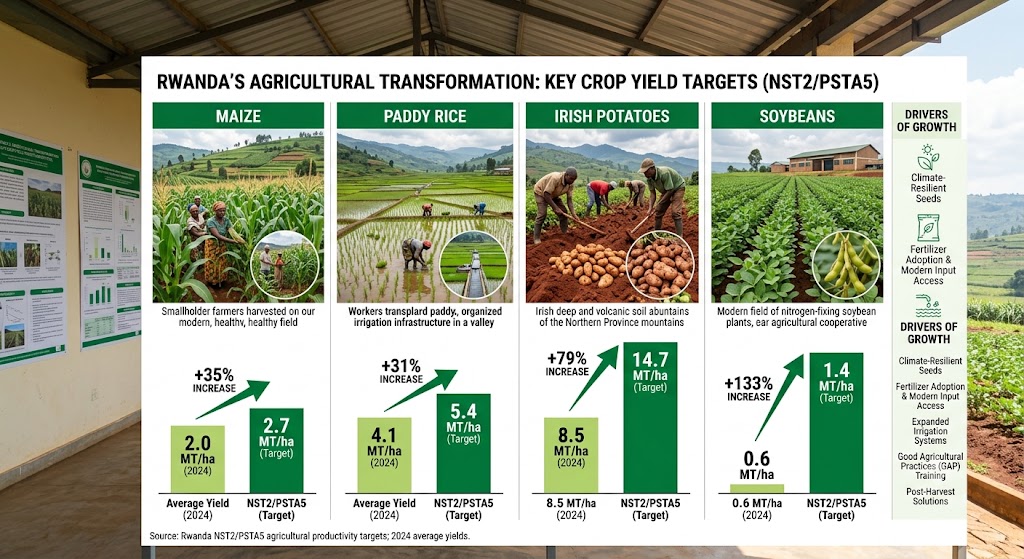
Data Source: RAB
Though fertilizer application increased from 32 kilograms per hectare to 73.2 kilograms per hectare, the Chamber of Deputies isn’t entirely sold on the optimism.
MPs have demanded immediate accountability from line ministers, signaling that rising input numbers mean very little if underperforming seed varieties and climate bottlenecks keep capping actual farm yields.
Read More: MPs Summon Ministers Over Agriculture gaps as Farmers Struggle with Inputs And Yields
Additionally, Mwizerwa the agronomist explained that they’re advising rural farmers who can’t afford the rising prices to turn to other crops, from potatoes to maize since potatoes are expensive.
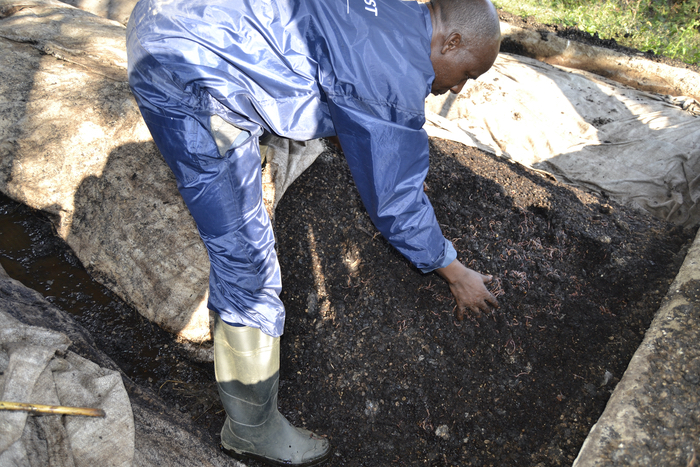
“We also advise farmers to turn to animal manure or trench compost to increase crop yields, farmers have also been urged to register with ‘SNSs,” he said.
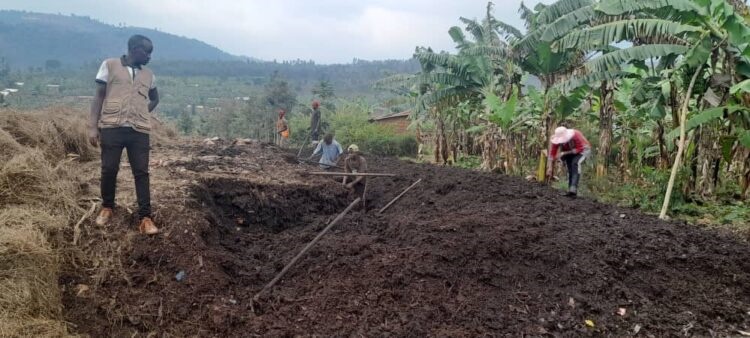
Mwizerwa in Kayonza helping smallholder farmers how to prepare organic fertilizers. He has warned that the rising prices and shortage of fertilizers will have consequences on vulnerable community farmers.
The bigger question:
Kevin Donovan, an Assistant Professor of Economics at Yale School of Management who studied Rwanda’s experience during the global fertilizer price shock, said policymakers face a difficult balance between protecting farmers and managing the rising cost of subsidies.
“tHEY face a central trade-off between insurance and production efficiency,” Donovan said.
Despite increased government support, farmers remain exposed to global market forces beyond Rwanda’s control.
For Ishimwe, the decision is simple but difficult: how much fertilizer can he afford, how much land can he plant, and whether the harvest will justify the investment.
While Rwanda, has increased spending to protect farmers from global shocks. The challenge now is ensuring that support reaches farms quickly enough, and goes far enough, to keep food production on track.
The answer will be measured in the next harvest.