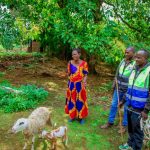
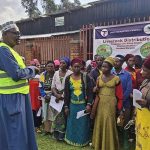
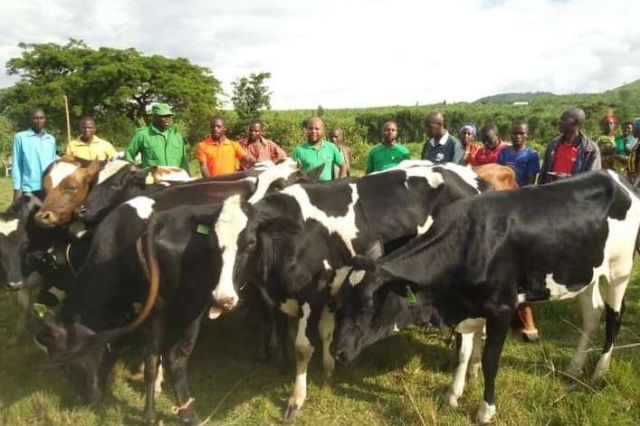
When Emmanuel Tuyambaze received two sheep from Zakat Foundation of America through Abdallah Kiromba Foundation (AKF), he saw more than an animal. He saw an opportunity.
Today, standing beside a young cow in a cow shed next to his house in Rugi Village, Kampanga Cell, Kinigi Sector in Musanze District, the father of two proudly reflects on how a single sheep helped him take a significant step toward securing his family’s future.
“I was very happy to get support in the form of a sheep,” he recalls. “The sheep significantly supported me.”
Tuyambaze and his wife, Nyiramahirwe Tasiyana, are raising two young children aged three years and eighteen months. Like many rural families, they rely primarily on farming to survive. He also supplements the household income through part-time ceiling installation whenever opportunities arise.
The family grows Irish potatoes and other crops, but income remains unpredictable. To improve their situation, Tuyambaze joined a village savings group where members contribute at least Rwf500 each day. When his turn came to receive the pooled savings, he was given Rwf400,000—just short of the amount he needed to buy a cow.
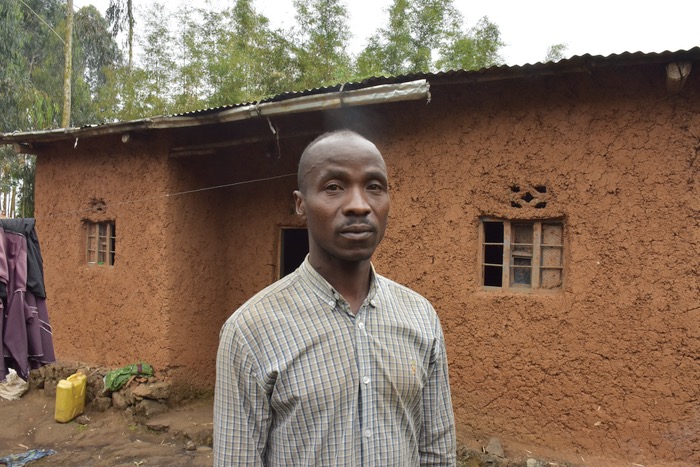
Emmanuel Tuyambaze standing infront of his home in Rugi Village, Musanze District
Rather than miss the opportunity, he made a difficult but strategic decision.
“I sold the sheep and added the money to what I had saved so that I could buy a cow,” he explains. “If I had kept the cash, it would have been easy to spend it. Buying the cow was a better investment.”
His plan is ambitious but practical. He intends to rear the male cow for about a year, sell it at a profit and eventually purchase a dairy cow that can provide milk for his children and generate additional income.
Meanwhile, he continues to rear the remaining sheep.
“When it produces its first offspring, I will donate it to another family,” he says. “That is what we were encouraged to do.”
Beyond income, Tuyambaze sees livestock as a pathway to improved agricultural productivity. Using animal manure, he reduced fertiliser costs and hopes to increase yields in his potato fields.
“Livestock will continue to benefit us,” he says. “We will have manure for our crops and we expect better harvests.”
Challenges remain. Finding fodder for the animals requires time and effort, and the family’s limited income often makes it difficult to meet basic household needs. Yet Tuyambaze remains optimistic.
“My daughter has started school and it is not easy to cover all the costs,” he says. “But I believe the livestock will continue supporting us.”
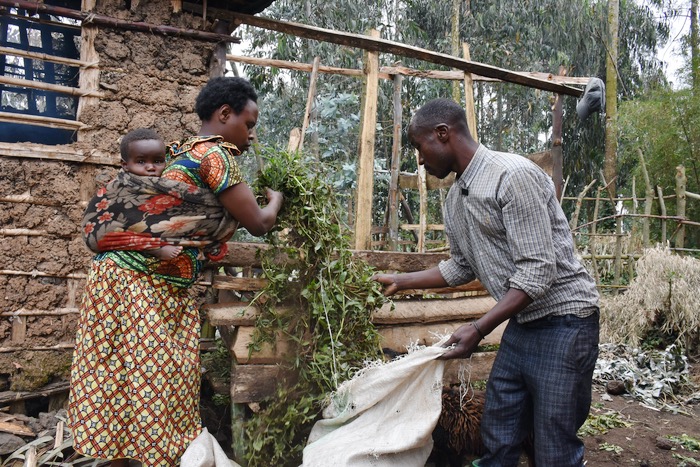
While he cares for the animals and pursues side jobs, his wife manages household chores, a kitchen garden and the family’s farming activities.
Several hundred kilometres away in Gatoki Village, Kabarore Sector of Gatsibo District, Jannet Gatesi has witnessed a similar transformation.
Three years ago, Gatesi and her husband received two goats through the AKF livestock program. Although one of the animals later died, the surviving goat multiplied and its offspring also reproduced.
Jannet Gatesi is a farmer from Gatoki Village, Kabarore Sector of Gatsibo District
Today, the family owns seven goats.
“The goats have been a blessing to our family,” Gatesi says.
As small-scale farmers growing maize, beans, and vegetables, the family has used proceeds from goat sales to cover their children’s school expenses.
“Whenever schools reopen, we can sell a goat and get the money we need,” she explains.
The program’s impact extends beyond individual households. As part of the initiative, beneficiaries are encouraged to pass on the first female offspring to another vulnerable family. Gatesi says her family fulfilled that commitment.
“We gave the first female offspring to another beneficiary, and that goat also produced,” she says proudly.
For Bigirimana Issa, another beneficiary from Gatoki Village in Kabeza Cell, the goats have become a dependable safety net.
The 65-year-old has eight children, with two still in school. Bigirimana received two goats more than two years ago. Although disease claimed some of the animals during the early stages, the herd gradually recovered and expanded.
He has since sold four goats and used the proceeds to repair his house.
“The goats have been a blessing,” he says.
Even after selling several animals, he still owns eight goats today.
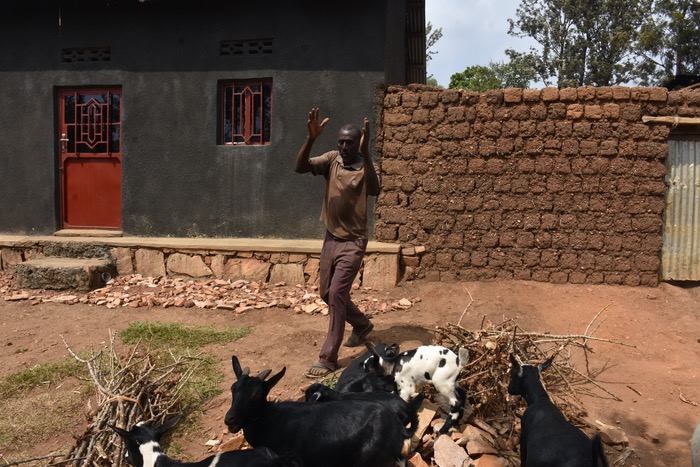
Bigirimana Issa looking after his goats next to his house in Gatoki Village, Gatsibo District
As a farmer, Bigirimana values the flexibility livestock provide.
“Whenever I have a problem, I can sell a goat and solve it,” he explains.
His long-term goal is to continue growing the herd until he can afford to buy a cow—an asset that many rural families view as a major step toward economic stability.
The relatively small intervention to support Tuyambaze, Gatesi and Bigirimana is gradually showing a lasting change. What began as a gift of the sheep or goats has evolved into a source of income, improved agricultural production, school fees, home improvements and renewed hope.
For many families, livestock is more than property. It is savings, insurance, fertiliser, income and opportunity rolled into one. With support from the Zakat Foundation of America and the Abdallah Kiromba Foundation, hundreds of vulnerable households are discovering that, with the right support, a single animal can become the foundation for a more secure and self-reliant future.