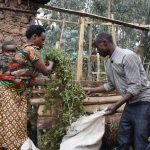
As the rooster crows loudly in the early morning, Moses Mugisha wakes his wife to begin the day’s work. He carefully removes his goats from their pen and ties them behind the kitchen house, ensuring they have enough grass before he heads to the farm. His wife has already prepared a small breakfast, and after a quick meal, he sets off.
Three years ago, Mugisha’s mornings looked very different. Instead of tending to livestock, he would wake up anxious, wondering where he might find work in construction for the day. His concerns stretched beyond employment—he worried about the harsh sun beating down on his small farm in this semi-arid region, where dwindling rainfall and depleted soils made agriculture an uphill battle.
Feeding his growing family was a daily struggle.
His fortunes changed when he received two goats from the Abdullah Kiromba Foundation (AKF) through support from the Zakat Foundation of America (ZFA). This gift set him on a path to self-reliance.
AKF launched a livestock program in 2022 to uplift livelihoods and combat poverty by promoting sustainable agricultural practices. The initiative began with the distribution of 1,000 livestock—including 600 goats and 400 sheeps, aimed at improving agricultural productivity, increasing income, and enhancing food security. By addressing socio-economic needs, the program is transforming lives, just as it did for Mugisha.

Moses Mugisha have a stroll around his village in Gatoki
The initiative has since distributed more small livestock and and two cows to some families in the same communities that did not receive the livestock, all intended to meet socio-economic needs and improve overall well-being.
Issa Higiro, the Guardian and Founder of the Abdallah Kiromba Foundation, emphasizes that the livestock distribution initiative aims to empower families and communities by promoting financial independence, improving health, and ensuring sustainable nutrition.
During the program’s launch, at least 500 households benefited, each receiving two goats or sheep. The distribution was conducted equitably between Muslims and non-Muslims, covering various regions: Kabarole Sector in Gatsibo District (100 families), Kabuga in Gasabo District (100 families), Runda in Kamonyi District (100 families), Nyange in Musanze District (100 families) and Busasamana in Rubavu District (100 families).
AKF collaborated with local authorities at the village and sector levels to select beneficiaries. Priority was given to vulnerable families, particularly those willing and capable of caring for the livestock and providing adequate pasture.
Sustainability and Community Sharing
To ensure the program’s sustainability, only female livestock were distributed. The first female offspring born is required to be passed on to another family in the community, continuing the cycle of support. The remaining offspring remain with the original beneficiary, allowing them to build a stable livelihood.
Mugisha, one of the beneficiaries from Gatoki in Gatsibo District, saw his two goats multiply to 12 within three years. He honored the initiative’s principle by donating the first female offspring to a neighbor. As his herd grew, he gained access to manure, which improved soil fertility and boosted his crop yields.
“The goats were a blessing to me. Each of them produced twins, and my herd grew to 12 goats. I gave the first offspring to my neighbor, as required, and later gifted another to a friend who had previously supported me,” Mugisha shared.
The goats became a stepping stone to financial independence. When he wanted to expand his agricultural activities, he sold eight goats, leased one hectare of land, and planted maize. The harvest yielded 23 bags (over 3.5 tonnes), providing enough income to build a small kitchen and storage facility. Additionally, proceeds from goat sales helped cover medical expenses and other basic household needs.

Hassan Bonane standing besides his goat house. Bonane received the goat from a neighbor who had originally benefited from AKF livestock distribution
Hassan Bonane, a father of three, received a goat from a neighbor who had originally benefited from AKF livestock distribution. He was overjoyed upon learning from the mosque in Gatoki that he had been selected as a recipient, expressing deep gratitude for the life-changing gesture.
Bonane received a call from the mosque in Gatoki that he had been selected to receive a goat. “I was overjoyed by this act of generosity and very grateful,” he said with a smile.
However, he sold the goat cheaply for Rwf.10,000 when it got sick but Bonane was determined to replace it as a symbol of the gift he had been given. With the money he sold his goat and some savings, he bought another goat.
Abdu Ashiraf, a resident of Gatoki Village, was the lucky one to receive a cow. Though not the initial recipient, he obtained it from a beneficiary who struggled to provide for it. His cow has since given birth to a calf, and he now enjoys a steady supply of five liters of milk daily. With surplus milk available, he is considering selling some to generate extra income.

Abdu Ashiraf, a resident of Gatoki Village, was the lucky one to receive a cow.
The cow comes with more benefits than other livestock. Since receiving the cow, Ashiraf dug a hole behind his house to dump in the manure and make compost fertilizers. He is more optimistic now for more crop yields because he has enough fertizers.
Going by the initiative’s principle of donating the first female offspring, which also fosters bonds and unity as enshrined in Rwandan tradition, Ashiraf is ready to donate to another beneficiary. He says that when the calf is weaned, he will pass it on to another family, continuing the cycle of generosity and support.
The Abdallah Kiromba Foundation’s livestock initiative has proven to be a transformative program, fostering financial resilience and food security within communities. By encouraging a culture of giving and sustainability, the initiative not only uplifts individual households but also strengthens communal ties, ensuring a lasting impact for generations to come.