The labour market has remained largely unchanged over the past year, with unemployment holding steady despite continued economic growth. But beneath the stable headline figures lies a more complicated picture, one in which many people have jobs, yet still struggle to earn a reliable living.
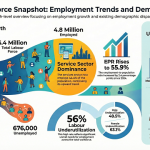
New data released by the National Institute of Statistics of Rwanda (NISR) shows that the country’s unemployment rate stood at 13.4% in the second quarter of 2026, virtually unchanged from the same period last year.
Out of Rwanda’s 8.7 million working-age population, about 4.7 million people are employed. That means roughly one in every seven people actively looking for work is still unable to find a job.
The labour force participation rate also remained stable at 62.1%, suggesting that the overall labour market has neither expanded nor contracted significantly over the past 12 months.
While that stability may be viewed as encouraging amid an uncertain global economy, economists say the figures mask a deeper challenge.
The bigger problem isn’t unemployment, it’s underemployment
The latest survey points to a growing number of Rwandans who may technically have jobs but are not working enough hours or earning enough income.
NISR’s data shows the country’s labour underutilisation rate rose to 59.7% in the second quarter of 2026, up 2.6 percentage points from a year earlier.
The indicator combines people who are unemployed, those working fewer hours than they would like, and others who have stopped actively looking for work but remain available if opportunities arise.
The increase suggests that while employment levels have remained broadly stable, many jobs are failing to provide sufficient or consistent work.
In other words, Rwanda’s labour market is creating employment, but not always the kind of employment that offers financial security.
Women and young people continue to face the biggest barriers
The survey also highlights persistent inequalities across the labour market.
Men continue to participate in the workforce at significantly higher rates than women. The employment-to-population ratio for men stands at 61.9%, compared with 46.6% for women—a gender gap of more than 15 percentage points that has shown little improvement over the past year.
Women are also disproportionately affected by underemployment.
According to the survey, the labour underutilisation rate among women reached 66.1%, well above the national average.
Young people also continue to face greater challenges entering the labour market.
Among Rwandans aged 16 to 30, unemployment stands at 15.7%, compared with 11.9% among older workers.
Contrary to expectations that cities offer more employment opportunities, unemployment remains slightly higher in urban areas.
The survey found an urban unemployment rate of 14.1%, compared with 13.1% in rural communities.
The figures suggest that while cities continue to attract job seekers, employment opportunities have not kept pace with demand.
Agriculture remains Rwanda’s largest employer, accounting for 46.9% of total employment.
Other important sectors include manufacturing, education, mining and quarrying, although these employ significantly smaller shares of the workforce. Mining, for example, represents less than one per cent of total employment despite its growing contribution to exports.
The figures underline Rwanda’s continued reliance on agriculture, even as the government pushes to diversify the economy through industrialisation, services and value-added manufacturing.
Economists say the latest survey paints the picture of an economy that has maintained its footing but is yet to generate enough high-quality employment to meet growing demand.
For policymakers, the challenge is shifting from simply creating jobs to creating better-paying, more productive and more secure employment, particularly for women and young people entering the workforce.
The latest data suggests Rwanda’s labour market is stable, but stability alone will not be enough to absorb a growing workforce or improve household incomes.