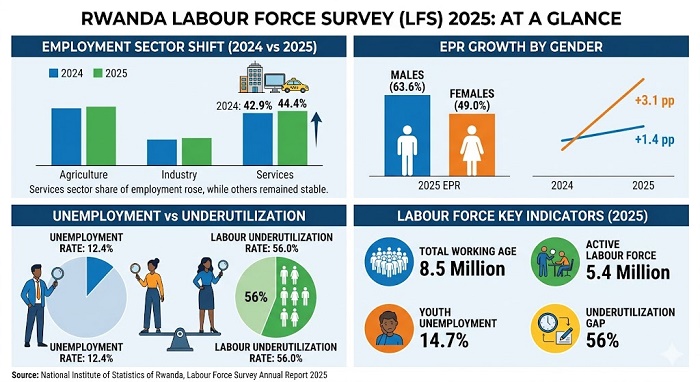
Rwanda’s unemployment rate has eased to 12.4% in 2025, a decrease of 2.5 percentage points from the 14.9% in the previous year.
According to the report released on Thursday March 25 by the National Institute of Statistics (NISR), interestingly, unemployment is now almost identical in urban and rural areas, both hovering around 12%.
The data by the statistics agency attributes the easy to a recovering job market with significant shifts in sector employment and a narrowing gender gap, but also points to underlying challenges in labor quality.
The decline marks a relief in Rwanda’s prolonged unemployment crises since COVID pandemic in 2020, but roughly one out of eight people (estimated at 676,000) in the labour force is currently unemployed.
The NISR report indicates where Rwandan’s work, the service sector is reported to have become the dominant employer in the country, now accounting for 44.4% of all employment, up from 42.9% in 2024.
While the service sector grew, employment levels in the agriculture and industry sectors remained stable, suggesting that new jobs are primarily being created in service related fields.
Stats Rwanda also shows a positive trend in closing the economic gap between men and women, the gender gap in labour participation shrank by 1.2 percentage points compared to 2024 at 14.3 percentage points.
The employment-to population Ratio (FPR) for women saw a significant jump increasing by 3.1 percentage points (to 40%), which was a sharper increase than that of their male counterparts who increased by 1.4 points to 63.6%.
Overall, Rwanda’s labour force has reached 5.4 million persons, with the EPR rising to 55.95 from 53.6 in 2024, according to the Stat agency.
Further, the gender gap in the unemployment rate declined by 1.7 percentage points, however the challenge remains in labour underutilization, where there “met and unmet” need of workforce.
In a notable shift, the unemployment rate is virtually the same in both rural and urban, sitting at approximately 12% for both.
Despite the drop in the official unemployment rate, experts have noted that labour underutilization actually increased to 56% in 2025, up 1.8 points from 2024. “This figure suggests that many Rwandans are “underutilized”, meaning they may be time related, underemployed, working fewer hours than they want like in farms per hours, or part of the potential labour force,”
The report further shows, youth at 14.75 and women at 14, 2 percentage points still face higher unemployment rates than adults and men both at 10.8%. The nderulization rate for women is particularly high at 63.1%.