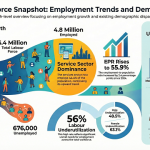
Rwanda’s employment rate rose to 53.8% in May 2025, up from 52.0% during the same period last year, according to new data from the National Institute of Statistics of Rwanda (NISR). The findings, released Tuesday, highlight progress in job creation as the country continues its economic recovery.
The report shows that of the 8.5 million Rwandans aged 16 and above who are eligible to work, approximately 4.5 million were employed. Around 710,000 were unemployed, while another 3.2 million people were classified as outside the labor force. This category includes individuals who are not seeking work due to reasons such as being in school, retirement, incarceration, disability, or personal choice.
The share of those outside the labor force rose slightly to 37.8% in May 2025, up from 37.5% the previous year. Many in this group are involved in non-commercial, subsistence agriculture, which remains common in rural areas.
Men continued to have higher employment rates than women, at 61.7% compared to 46.8%. However, both groups saw gains, with male employment increasing by 1.3% and female employment rising by 2.2% from May 2024. The gender employment gap narrowed to 14.9%, down nearly one percentage point over the same period.
Adults aged 31 and older were more likely to be employed, with an employment rate of 57.4%. Younger people aged 16 to 30 had a lower employment rate of 49.1%, reflecting ongoing challenges in youth job access.
The services sector remains Rwanda’s largest employer, accounting for 45.6% of all jobs as of May 2025. That figure is up from 44% the previous year. Agriculture employed 38% of workers, down from 39.3% in 2024, while the industrial sector saw a marginal decline in workforce share.
Among specific job categories, wholesale and retail trade, along with small-scale mechanics and sales, made up 15.6% of the workforce. Construction accounted for 8.3%, followed by transportation at 6.7% and manufacturing at 5.7%. Education sector workers comprised 4.2%, while domestic workers made up 4.1%. Those employed in hospitality, including accommodation and restaurants, represented 4% of the employed population.
Rwanda’s national unemployment rate dropped to 13.4% in May 2025, down from 16.8% in May 2024. This marks a significant year-on-year decline of 3.4 percentage points. Compared to May 2019, when the country was still recovering from the effects of COVID-19, the unemployment rate has dropped by about 15 percentage points.
Despite the positive trend, unemployment remains more pronounced among women and youth. The rate among women was 15.3%, compared to 11.8% among men. Youth unemployment, defined as individuals between 16 and 30 years old, stood at 15.4%, while it was lower among older age groups at 12.1%.
The unemployment rate in rural areas was recorded at 13.3%, slightly below the 13.7% seen in urban areas, suggesting that employment challenges remain widespread across both settings.
Officials say the findings reflect gradual progress in Rwanda’s labor market, with increased opportunities in services and other sectors. However, they acknowledged that efforts must continue to close the gender gap and address persistent youth unemployment.