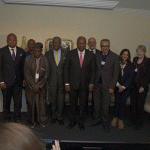
Heads of state and international leaders gathered in New York on Monday to mark the first anniversary of the Accra Reset, using the occasion to launch a sweeping set of proposals aimed at overhauling how global health is funded and governed.
The centerpiece of the event was the Principal Report from the Accra Reset High-Level Panel, a document more than a year in the making that argues global health priorities should be set by the countries the system serves, not dictated from outside. The report traces its roots to a “health sovereignty summit” that Ghanaian President John Mahama convened in Accra in August 2025, at a moment when steep cuts to international aid were pushing governments to take more control of their own health systems.
Alongside the report, organizers unveiled two supporting mechanisms: HINGE, a financing vehicle meant to turn strategy into action, and RIO, an accountability system designed to track whether promises are actually kept. Together, the three pieces form what the Accra Reset is billing as both a roadmap and the machinery to follow through on it.
The gathering, held at the New York Marriott Marquis and titled “Full Circle: Resetting Global Development,” drew a heavyweight guest list: sitting and former heads of state from four continents, plus the leaders of the World Health Organization, the OECD, the Commonwealth, the AfCFTA Secretariat, and the International Finance Corporation, along with the chair of the Group of 77 and China.
The event also launched the Global Reset Dialogues, described as a standing platform for economic cooperation between the Global South and Global North. Migration, critical minerals, and trade finance are expected to top its early agenda, giving governments a venue to negotiate around shared interests rather than through traditional aid frameworks.
Leaders separately discussed a concept called Sovereign Prosperity Spheres, an early-stage model for governments and private companies to jointly direct investment toward development priorities that countries set themselves, rather than ones designed by outside donors.
The event also launched the Global Reset Dialogues, described as a standing platform for economic cooperation between the Global South and Global North. Migration, critical minerals, and trade finance are expected to top its early agenda, giving governments a venue to negotiate around shared interests rather than through traditional aid frameworks.
Leaders separately discussed a concept called Sovereign Prosperity Spheres, an early-stage model for governments and private companies to jointly direct investment toward development priorities that countries set themselves, rather than ones designed by outside donors.
In Kigali, organizers marked the opening of SIGN, a new institute for training sovereign negotiators, launched in partnership with the G7’s CONNEX initiative and the African School of Governance.
Maternal and child health emerged as one of the first practical applications of the Accra Reset’s approach. Tanzanian President Samia Suluhu Hassan led the launch of Mother Africa, a call to action paired with a new business-sector covenant on maternal health in the workplace. The stakes are steep: roughly 260,000 women die each year worldwide from pregnancy and childbirth-related causes, and about seven in ten of those deaths occur in sub-Saharan Africa.
The council also introduced Masterkey, a digital initiative spearheaded by Kenyan President William Ruto to reduce barriers that keep skilled workers from moving to where their expertise is needed most, part of a broader push to link human capital with economic opportunity across the continent.
In Kigali, organizers marked the opening of SIGN, a new institute for training sovereign negotiators, built in partnership with the G7’s CONNEX initiative and the African School of Governance.
The High-Level Panel’s report, co-chaired by Priscila Ferraz Soares, Budi Gunadi Sadikin, Peter Piot, and Elhadj As Sy, lays out ten core recommendations, including:
A single country compact, one plan, one budget, one platform, within 12 months
A shift toward domestic financing, with external funds redirected to support it
Stronger regional health institutions with pooled, member-financed mandates
Regional manufacturing investment and full technology transfer
Procurement coalitions to convert fragmented demand into real market leverage
National health emergency operations centers within 12 months
Public, independent accountability scoring within six months
Organizers framed the day’s announcements as evidence that the Accra Reset is moving past rhetoric, arguing that a genuinely sovereign-led development model needs functioning institutions, financing tools, and negotiating capacity, not just a change in tone.