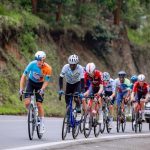
Thin air, rugged cobbles, and endless climbs—everything about Rwanda’s terrain promises that the 2025 UCI Road World Championships will be unlike any before. From September 21–28, the race comes to Kigali, the capital City of Rwanda, marking the first time in a century that the event unfolds on African soil.
Famed as the “land of a thousand hills,” Rwanda offers a backdrop as beautiful as it is a brutal terrain. The routes will favor riders who can climb with ease, accelerate with punch, and handle technical challenges, seemingly leaving little chance for surprises.
The first of the two major climbs on the smaller c ircuit, from the golf course in the valley between the Nyarutarama and Kacyiru neighbourhood up to the “embassy row” and the office of the president.
Yet, cycling rarely follows a fixed script. Team dynamics, rider selection, course recon, adaptation to altitude, and familiarity with Kigali’s twisting roads could dramatically reshape the outcome—setting the stage for one of the most unpredictable championships in history.
For riders navigating Rwanda’s terrain for the first time, the courses are a true test of climbing ability, designed for those who can power up steep gradients with skill and precision. What adds to the challenge for both men’s and women’s elite races is not just the relentless ascents, but also the high altitude and the technical complexity of the roads.
The elite women’s race will challenge riders over 11 laps of a 15.1km city circuit, covering a total of 164.4km and climbing 3,350 metres in elevation, with the highest point reaching 1,493 metres. The course features two key climbs: the Côte de Kigali Golf, an 800-metre stretch averaging 8.1%, positioned halfway through each lap, and the decisive Côte de Kimihurura, a 1.3-kilometre climb at 6.3%, cobbled and located close to the finish—sure to test strength, strategy, and resilience.
The final stretch to the KCC is more than a false flat, with the ultimate 500 meters topping out at 8%
The elite men’s race will take on the same 15.1km city circuit, with riders completing nine laps at the start and six to finish, but adds a mid-race extension loop packed with three extra climbs.
The Côte de Péage rises 1.8km at 5.9%, Mont Kigali is the longest at 5.9km averaging 6.9% and reaching 1,771 metres, while the iconic Mur de Kigali is a punishing 400 metres of steep, cobbled challenge, averaging 11%.
Over the course of 267.5km and 5,475 metres of elevation gain, the peloton will face one of the toughest tests in recent memory, demanding power, endurance, and technical precision.
There are two notable cobblestone sections incorporated into the course design, The is positioned along the Kimihurura ascent featured on both the elite women’s and elite men’s races at the end of the city circuit, which has the potential to make for a captivating finale to both races.
Kimihurura, will be the final climb before the finish, the men will also contest with the Kimihurura cobbled ascent on each lap of the circuit, but they also face another set at the Mount of Kigali, which is among of the roughest.
The courses in Kigali will test riders at their highest points: 1,493 metres for the women and 1,771 metres for the men. Rwanda’s rolling hills and mid-altitude landscapes provide perfect training grounds, and many teams and athletes have likely used these areas to prepare, acclimatize, and sharpen their skills ahead of the World Championships.
These natural advantages, combined with Rwanda’s technical roads and challenging climbs, mean that preparation here is as much about mastering the terrain as it is about building endurance—setting the stage for a truly competitive and unpredictable event.
Kigali’s challenging circuits—with steep climbs, cobbled sections, and high-altitude stretches will favor riders who can endure sustained efforts while seizing tactical opportunities. On such selective terrain, early breakaways are more than just a gamble; they could shape the race from the start.
African teams, many of whom have already faced Rwanda’s hills during the Tour du Rwanda, will see this demanding course as an opportunity to make their mark. On a circuit this challenging, savvy tactics and opportunistic moves could ultimately decide the outcome of this historic World Championship.