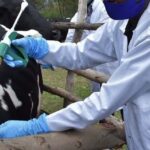
What comes to mind when you think about public health threats? Perhaps you picture hospital wards, busy emergency rooms, or doctors treating patients. However, most diseases that threaten human health do not begin in hospitals, they often start quietly in animals with first warning signs often seen on farms, in livestock markets, abattoirs or in communities where humans and animals interact closely everyday. Yet, in African countries, the professionals best positioned to detect these threats early– the veterinarians remain underutilized in the design and implementation of our public health systems.
As the world marks World Veterinary Day, under the theme “Veterinarians: Guardians of Food and Health,” we are reminded of the critical role veterinarians play not only in animal health but also in protecting our health, our food, and national resilience. In Africa, this role is important as millions of families depend on livestock for food, and income.
Veterinarians are uniquely positioned at the frontline of zoonotic disease detection (diseases that pass from animals to human beings). They are our first line of defense. Diseases such as rabies and brucellosis clearly illustrate the close biological link between animal and human health. In many cases, the first smoke signals of a pandemic aren’t coughs in humans, they are sick animals, meaning, if veterinarians can detect a disease early in animals, communities can be warned, and response becomes faster enabling prevention of the disease in good time before people start falling ill.
Although African countries have made commendable progress in establishing human and animal health reporting platforms, including digital tools that have improved data capture and transmission, these systems still operate largely in silos. Animal health officers may detect unusual illness patterns in livestock while hospitals begin seeing unexplained symptoms in people, yet the two sets of information are not always connected quickly enough. As a result, valuable information remains underutilized and opportunities for coordinated responses are often missed. Evidence from Kenya national surveillance data shows that animal health data has not yet reached its full potential as an early warning system for human disease. This is not because there is no link between animal and human health, but because of persistent systemic challenges, including fragmented surveillance systems, under-reporting, inconsistent data quality, weak diagnostic capacity, and uneven reporting across regions. In some areas, disease events may go unreported altogether, while in others, limited diagnostic capacity affects accuracy. Together, these gaps hinder animal health data from serving as a reliable and timely early warning signal.
Climate change further complicates this challenge. Changes in rainfall patterns, rising temperatures, floods, droughts and wildlife interactions are altering how diseases spread. Drought may force people and animals to share water sources more closely increasing the risk of disease transmission. Wildlife may move into new locations bringing pathogens into contact with livestock and humans. That is why environmental information matters too.
To truly stay ahead of disease threats, African countries need systems that connect the dots between animal health, human health, and the environment. This is the essence of the One Health approach, which recognizes that the health of people, animals, and the environment is interconnected and must be addressed collectively. A strong One Health system would allow veterinarians, doctors, environmental experts, laboratories, and county officials to share information in real time, analyse risks together and respond faster.
When disease risks are not detected early in animals, outbreaks are often identified only after they have spread to humans. This leads to higher healthcare costs, disruption of livelihoods, and increased pressure on already strained health systems. Food safety is also compromised, as undetected animal diseases can threaten the safety and quality of animal-source foods. Ultimately, weak early warning systems result in avoidable human suffering and economic losses.
We cannot afford to wait until diseases reach hospital wards before we act. African governments must prioritize the operational integration of surveillance systems by establishing platforms that enable real-time data sharing and joint analysis across animal, human and environmental sectors. At both the national and county levels, One Health coordination mechanisms should be strengthened to support routine joint surveillance, risk assessment, and response planning.
Veterinarians must be integrated into public health decision-making and not only called upon when livestock are sick. They should participate in disease surveillance, early warning, and outbreak response. Investments are needed to improve data quality, enhance diagnostic capacity, and strengthen frontline reporting systems.
Development partners also have a role to play. They should align their support toward integrated, sustainable systems instead of fragmented, disease-specific programs. Building strong, interconnected systems will yield greater returns than uncoordinated efforts.
To effectively detect and respond to health threats, we must stop treating animal, human and environmental health as separate issues. Evidence from a national surveillance study conducted in Kenya shows the weak links between these sectors continue to limit our ability to identify and respond to emerging risks. Interconnected systems enable stronger data sharing, interoperability, and joint analysis turning fragmented systems into powerful early warning tools, enabling faster and more coordinated responses.
Safeguarding human health begins with interconnected systems that integrate animal, human, and environmental signals, and at the center of these efforts must be veterinarians, the often overlooked but essential first line of defense.
Dr. Samuel Kahariri is a PhD Fellow at the Center for Epidemiological Modelling and Analysis (CEMA), University of Nairobi, Kenya, a veterinary epidemiologist and national practitioner working at the intersection of animal health, public health, and policy in Kenya and an agri-food systems expert.