WASHINGTON’S MOVE REVIVES A TRADE DISPUTE THAT BEGAN OVER USED CLOTHES
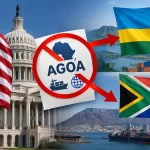
Kigali: Rwanda is set to lose duty-free access to the US market on 1 January 2027, after President Donald Trump notified Congress and the Rwandan government of his intention to remove it, together with South Africa, from the African Growth and Opportunity Act (AGOA).
AGOA allows eligible sub-Saharan African countries to export thousands of products to the United States without paying import duties.
In a statement on 2 November, US Trade Representative Jamieson Greer said an annual review found that both governments were “engaging in practices that are inconsistent with AGOA’s eligibility criteria.” He said the administration was working to ensure African partners take the steps needed to meet them.
For Rwanda, Washington listed concerns about trade and investment barriers, the rule of law, political pluralism, internationally recognised workers’ rights, human rights, and threats to US national security and foreign policy interests.
The decision follows US Treasury sanctions on 28 October against Rwanda’s Ministry of Defence and the Zigama Credit and Savings Society, which Washington accuses of supporting the M23 armed group in eastern DR Congo. Rwanda denies backing M23.
Foreign Minister Olivier Nduhungirehe told AFP in Moscow, on the sidelines of the Russia-Africa summit, that the situation in the DRC is mainly a Congolese issue and that Rwanda should not be made a “scapegoat for what is happening in Congo”.
The Rwandan government had not publicly responded to the AGOA decision at the time of publication. Efforts to reach the Ministry of Trade and Industry (MINICOM) were unsuccessful.
At the diplomatic luncheon in Kigali 16, January 2025, President Kagame said:
“As Rwanda, we made a mistake of saying that we have found some way of growing our textile industry because we wanted to reduce and even get rid of what we call ‘Caguwa’. These are second-hand clothes.”
He continued: “The next day we were being struck off the list of those countries who benefited from AGOA just because of Rwanda’s ‘stubbornness’: ‘How dare you refuse caguwa? How did you refuse caguwa to enter your country?'”
US goods imports from Rwanda totalled $43.3 million in 2025, up 43.3 percent from 2024, according to the US Trade Representative. The figure covers all goods, not only those entering under AGOA.
UN Comtrade data show that coffee, tea, maté and spices are Rwanda’s largest export category to the US: $19.2 million of the $31 million in goods the US imported from Rwanda in 2024, or about 62 percent. In 2022 the group was $10.6 million of $23.7 million, or 45 percent. The next largest categories in 2024 were lac, gums and resins ($4.1 million), tin ($3.7 million) and leather articles ($1.2 million).
Exporters had welcomed AGOA’s extension earlier this year. “Americans consume a lot of our coffee, and tariff-free access makes our prices competitive,” Simeon Ngendahayo, managing director of Wealth Hill Coffee Roasters. He said his company plans to scale up green coffee exports while gradually adding value.
The row echoes 2018, when Washington suspended Rwanda’s AGOA benefits for apparel only, after Kigali raised tariffs on imported used clothing to protect its garment industry. Rwanda stayed eligible for other products.
Then Trade Minister Prudence Sebahizi said in a statement to Rwanda Dispatch in April 2025 that “industrial policy takes precedence over AGOA opportunities”. He said garment exports to the US had fallen from $1.2 million to $172,000, even as total garment exports grew from $3 million in 2016 to $12.1 million in 2023. Sebahizi was replaced by Antoine-Marie Kajangwe in a June 2026 reshuffle.
Used clothing is not among the reasons Washington gives this time.
Second-hand clothes are still sold in Rwanda. As Rwanda Dispatch reported, they are widely available in markets from Kayonza to Kigali, much of it reaching Rwanda through Uganda, Tanzania and DR Congo. The stock comes from Western thrift stores and Chinese recycling plants. Economist Aida Kibirige Nattabi of the Economic Policy Research Centre said new imports, especially from China and the United Arab Emirates, also remain dominant.
AGOA has been extended to the end of 2028, but each country’s eligibility is reviewed annually, so Rwanda could return by meeting the criteria. Rwanda has several options: The ministry said in April 2025 that it welcomed diplomatic engagement with the United States. Washington has linked the sanctions to Rwanda’s commitments under the Washington Accords.
Rwanda has already turned to the African Continental Free Trade Area, the European Union, China and East African Community neighbors, in addition, Rwanda coffee expoerters are now roasting and processing coffee and tea, rather than shipping raw product, would make exports less dependent on preferential access.
The removal takes effect on 1 January 2027 unless conditions change before then.