His acquittal on the treason charge marks a major development in a high-profile trial that has attracted national and international attention.
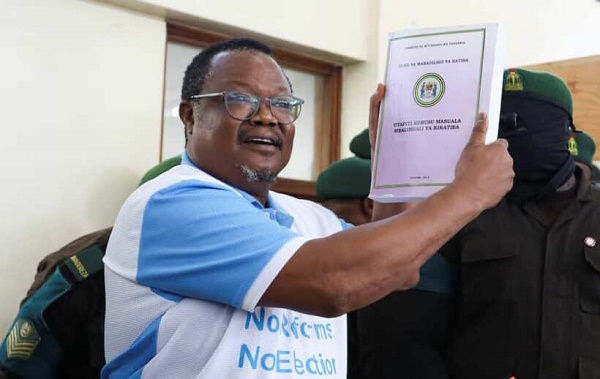
Tanzania’s High Court on Friday acquitted opposition leader Tundu Lissu of treason but found him guilty of the lesser offence of incitement.
Lissu, the chairperson of Tanzania’s main opposition party, CHADEMA, was arrested in April 2025 and charged with treason in a case that helped fuel the worst political unrest in the country’s history during the October 2025 elections.
The charge related to a speech Lissu gave in which prosecutors said he told supporters that the opposition would “block the election” and “mobilise rebellion”.
He had pleaded not guilty, arguing during the trial that his speech did not violate any law and that the charges were politically motivated.
Lissu’s arrest, along with alleged abductions of government critics and CHADEMA’s disqualification from the vote, was a key driver of protests that broke out during last year’s elections.
Hundreds died as police opened fire on protesters in multiple cities, undermining the country’s longstanding reputation for stability.
A commission appointed by President Samia Suluhu Hassan said in April that at least 518 people were killed in the violence, which it blamed on protesters. Her government denied allegations by human rights groups that security services used excessive force.
His acquittal on the treason charge marks a major development in a high-profile trial that has attracted national and international attention.
Reading the judgment, Justice Ndunguru invoked Section 319 of the Criminal Procedure Act, which allows a court to convict an accused person of a lesser offence where the evidence establishes that offence, even if it was not separately included in the original charge sheet.
The court said evidence presented during the trial demonstrated that Lissu’s remarks had influenced some individuals to participate in activities aimed at disrupting the election.
Prosecutors had argued that his statements constituted treason under Section 39(2)(d) of the Penal Code.
The opposition leader maintained that the prosecution had failed to prove the charges against him.
The treason charge carried the possibility of the death penalty, making the proceedings particularly consequential for Lissu, who has remained in detention since his arrest.
The case unfolded against a tense political backdrop following Tanzania’s October 2025 general election, which was accompanied by deadly unrest, protests and international criticism over the authorities’ handling of the political crisis.
The conviction for incitement, however, means Lissu has not been fully cleared of criminal liability, despite his acquittal on the treason charge.
The verdict now shifts attention to the next stage of the proceedings, including the sentence to be imposed for the incitement conviction.