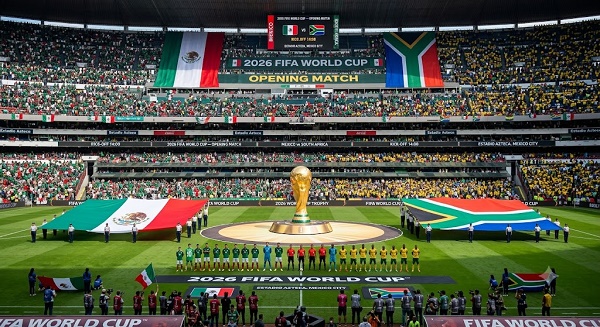
The biggest football show, the World Cup has finally arrived in North America, and the global soccer community is buzzing. From Mexico City to Toronto, and New York, millions of fans draped in their national colors are gearing up for a tournament unlike any before it. For the first time since 1998, the competition is breaking away from its traditional 32-team format, expanding to a massive 48-nation field. It is also a historic logistical feat, marking the first time three countries have shared hosting duties.
Because matches are scattered across 11 cities in the United States, Mexico, and Canada, fans are being treated to a trio of distinct opening ceremonies.
The spectacle begins on Thursday at the iconic Estadio Azteca in Mexico City. Before Mexico takes the pitch for the inaugural Group A match, pop icon Shakira and Burna Boy will headline the stadium with “Dai Dai,” the tournament’s official anthem. FIFA’s lineup for the afternoon reads like a festival billing, featuring artists from the tournament’s first-ever official album, including J Balvin, Maná, Alejandro Fernández, and Tyla.
By Friday, the party shifts north. Canada kicks off its home campaign against Bosnia and Herzegovina at a freshly transformed BMO Field in Toronto, which aggressively scaled up its capacity from 28,000 to 45,000 seats for the occasion. Ninety minutes before kickoff, a distinctly Canadian musical showcase will feature Alanis Morissette, Michael Bublé, Alessia Cara, and Jessie Reyez.
Later that evening, the United States takes center stage in Los Angeles as the Men’s National Team squares off against Paraguay. The American opener draws on an eclectic, star-studded lineup including Katy Perry, Future, Anitta, LISA, and Rema. As FIFA President Gianni Infantino noted, the selection intentionally mirrors the cultural diversity and vibrant diaspora communities that define the country.
The opening match on Thursday between Mexico and South Africa carries a distinct sense of nostalgia. The two countries famously opened the 2010 World Cup in Johannesburg, battling to a 1-1 draw. This time around, El Tri holds a glaring home-field advantage at the Azteca. Later that evening, Group A action continues near Guadalajara, where South Korea faces Czechia.
On Friday, Canada’s clash with Bosnia and Herzegovina marks a historic milestone—the country’s first time ever hosting a World Cup match on home soil.
Meanwhile, the U.S. matchup against Paraguay at SoFi Stadium stirs up its own history. The last time the American men played a World Cup match on home turf was nearly 32 years ago—a painful 1-0 Round of 16 exit against Brazil on July 4, 1994. Nodding to that history, the Americans will take the field in brand-new Nike kits inspired by those exact classic 1990s stripes.
With historic crowds descending on American cities, the FBI has deployed tactical teams and crisis response experts across all 12 U.S. host venues, from Boston to Seattle. Security officials are warning fans to arrive early—frequently more than an hour before kickoff—to navigate the intensive checkpoints.
The build-up hasn’t been without friction. The tournament follows a year of tightened U.S. border policies, which already impacted the officiating lineup; a Somali referee slated for the tournament was denied entry over the weekend due to “vetting concerns.” Meanwhile, immigration officials clarified that ICE’s presence at the matches will focus strictly on overarching national security rather than routine immigration enforcement.
Inside the stadiums, fans will have to navigate strict rules. FIFA initially faced significant backlash for banning all reusable water bottles despite the punishing summer heat. In response, World Cup COO Heimo Schirgi clarified that spectators can bring in a single, factory-sealed plastic water bottle up to 20 ounces. Anything sturdier remains strictly prohibited, leaving stadium concessions—exclusively supplied by longtime FIFA sponsor Coca-Cola—to handle the rest.
While more fans than ever have a chance to see a match live, ticket inflation has cast a shadow over the excitement. Die-hard supporters are feeling the pinch, with group-stage tickets climbing well into the hundreds and thousands of dollars on the secondary market. Even organized fan clubs, like the 30,000-member American Outlaws, have found themselves priced out of prime seats and relegated to the upper decks.
Yet, the high costs haven’t dampened the appetite for action—or gambling. The 2026 tournament is projected to shatter sports betting records, with online wagers in the U.S. expected to top $3.1 billion, up from $1.8 billion in 2022. Prediction markets are slated to handle billions more.
As for who will lift the trophy, German economist Joachim Klement—who correctly predicted the last three World Cup winners—is bypassing sportsbooks’ heavy favorites like France and Brazil. Instead, he points to the Netherlands as his dark horse. Klement argues that the Dutch squad’s lack of a singular, dominant superstar is actually their greatest strength, offering a remarkably balanced roster backed by a flawless defense.
For the U.S., the outlook is cautiously optimistic. Placed in Group D alongside Paraguay, Australia, and Turkey, the Americans have a highly viable path to the knockout rounds and potentially a quarterfinal run. The real hurdle, Klement notes, remains America’s fractured sporting landscape, where soccer must constantly compete with domestic giants for the country’s top athletic talent. But for the next 39 days, the eyes of the continent—and the world—will be squarely on the pitch.