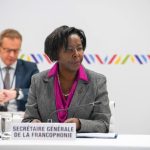
The world cannot thrive or develop while ignoring women, who make up half of the global population, Louise Mushikiwabo, Secretary-General of the International Organization of La Francophonie (OIF), said Wednesday.
Mushikiwabo made the remarks at the opening of the 46th Conference of Foreign Ministers of OIF member countries, held in Kigali. The meeting focused on the role of women in the political, social, and economic development of member states over the past three decades.
“In different periods, OIF member countries have faced issues of gender inequality,” Mushikiwabo said. “Have we ever considered the role a woman should play in uniting society so that people live together peacefully? Rwanda knows this. It astonishes me how often we fail to recognize that the world cannot survive while ignoring half of its population.”
Louise Mushikiwabo, Secretary-General of the International Organization of La Francophonie
Globally, more than 8.06 billion people live on Earth, with women numbering over 4.05 billion. In Rwanda, women account for more than 51.5% of the population, according to the 2022 census.
Mushikiwabo urged ministers to adopt inclusive policies that recognize women’s capacities in all aspects of life, including conflict prevention and resolution, as well as social and household welfare.
“For a woman to succeed requires your cooperation, men,” she said. “Without your support, the necessary elements would not be complete, and actions taken would not be effective.”
Domitilla Mukantaganzwa, president of Rwanda’s Supreme Court, said Rwanda has made significant strides in promoting women, driven by a national commitment to prioritize their role in post-genocide reconstruction.
“Thanks to these reforms, we have seen the benefits of women’s participation in all areas of life,” Mukantaganzwa said. “Rwanda is the first country in the world where women make up 63.7% of the members of parliament.”
Women also make up nearly half of the judiciary. Mukantaganzwa highlighted the key role female judges played in delivering justice and rebuilding families after the 1994 genocide, noting that women continue to hold a substantial presence among local mediators, known as abunzi.
She added that in many countries, programs promoting women remain on paper, calling for stronger efforts to turn policies into practical action.
The conference was attended by representatives from 65 countries. It marks the first high-level OIF meeting hosted by Rwanda since the organization’s founding, reflecting the country’s growing leadership role within the Francophone community.