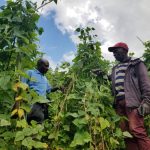
On a warm July morning in Huye District, the scent of fresh earth mingled with quiet excitement as trainees gathered beneath a simple canopy at the China-Rwanda Agriculture Technology Demonstration Center. Standing at the front was Chinese expert Chen Xiaobin, holding a handful of finely crushed grass — not just any grass, but Juncao — a miraculous innovation turning heads in Rwanda’s agricultural scene.
“This,” he said, raising his hand slightly, “can feed your livestock, grow your mushrooms, and protect your soil. And it grows faster than maize or bananas.”
Behind his soft-spoken words lay decades of research by Chinese scientist Professor Lin Zhanxi, who first developed the Juncao technology — literally meaning “mushroom grass” — as a sustainable, low-cost alternative to using wood for mushroom cultivation. Today, that same invention is changing the lives of hundreds of smallholder farmers in Rwanda.
One of them is Claudine Uwamariya, a 47-year-old mother of four from Nyanza District.
“Before I adopted this technology, life was hard,” she says, her hands dusty from sorting fresh oyster mushrooms. “Now I sell mushrooms every week at the market. I can pay school fees and buy clothes for my children.”
Like Uwamariya, over 600 Rwandans have undergone training at the demonstration center since it was launched in 2021 under the Forum on China-Africa Cooperation (FOCAC) framework. The center has become a center for practical knowledge transfer — where locals learn not only how to grow mushrooms using Juncao but also how to process the grass into livestock feed, mulch, and even bioenergy material.
“Juncao grass grows fast, retains water, and can be harvested up to four times a year,” explained Zhang Yi, one of the Chinese agronomists stationed at the center. “It’s a multi-purpose crop. That’s why it’s so powerful in areas with limited resources.”
The innovation is finding its way into public systems too. As part of Rwanda’s national nutrition efforts, mushrooms grown through Juncao methods are being introduced into school feeding programs across several districts. It’s a strategic move — combining food security with local empowerment.
“The mushrooms are rich in nutrients, and the income supports families,” said Telesphore Ndabamenye, Director General of the Rwanda Agriculture and Animal Resources Development Board (RAB). Speaking at the recent Juncao technology workshop in Kigali, he called it “a comprehensive solution” that advances environmental protection, food production, and livelihoods all at once.
For Professor Lin Zhanxi, who led the Chinese delegation to Rwanda, the impact is deeply personal.
“Juncao is not just a technique,” he said. “It is a gift from China to the world — a way of building friendship through shared growth.”
Since its invention, Juncao has been introduced in over 100 countries under China’s Belt and Road Initiative. Rwanda is now eyeing a nationwide rollout, hoping to use the grass to diversify food production, reduce dependence on imports, and boost resilience to climate change.
The Chinese government has pledged continued support — including free distribution of seedlings and ongoing technical training for local farmers.
In rural fields across the country, where arid winds once dried up hope, rows of green Juncao grass now sway gently under the Rwandan sun. And from that grass, mushrooms sprout — small, humble, but powerful symbols of a growing partnership and a greener future.