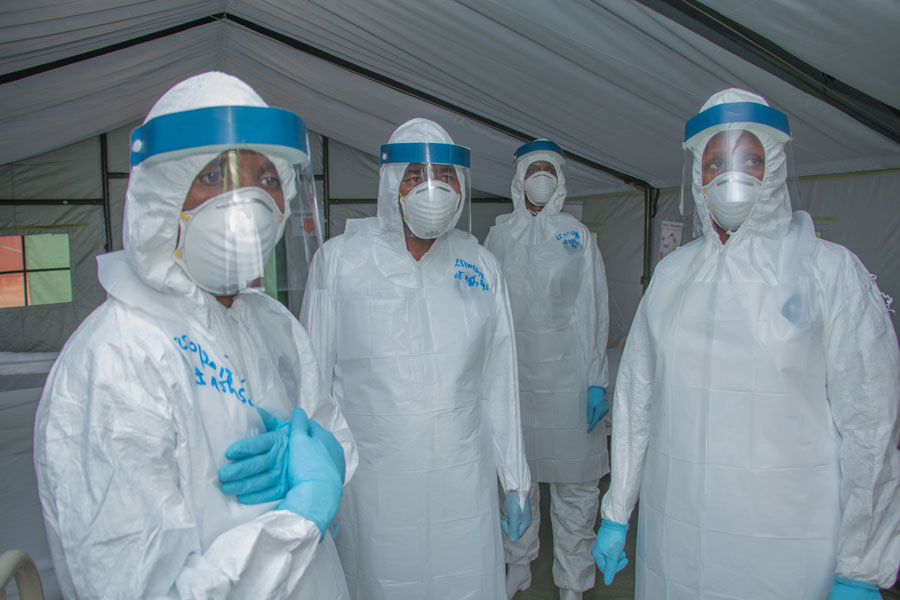
The Democratic Republic of Congo has deployed nine Ebola treatment centres and expanded laboratory testing capacity as health authorities race to contain a growing outbreak that has infected nearly 900 people.
Officials say the treatment facilities, which have a combined capacity of 500 beds, have been set up in affected areas to improve patient care and strengthen the country’s response to the epidemic.
Several mobile laboratories capable of processing up to 2,000 samples a day have also been deployed to speed up the detection of suspected cases.
The measures were announced on Thursday during a briefing in Bunia by Public Health Minister Samuel Roger Famba and other senior government officials.
Thirty-three days after the outbreak was officially declared, the country has recorded 896 confirmed cases and 232 deaths, according to health authorities. Seventy-eight people have recovered.
The eastern province of Ituri remains the centre of the outbreak, accounting for nearly 91% of all reported cases. Of the 33 health zones affected nationwide, 20 are located in Ituri.
More than 6,000 people identified as contacts of confirmed cases are currently being monitored.
Health Minister Famba said the government, with support from international partners, had mobilised $50m (£37m) for the response.
The funding has been used to establish treatment centres, deploy mobile laboratories and support surveillance teams working to trace infections and care for patients.
Despite the expanded response, officials acknowledge that significant challenges remain.
In some communities, health workers continue to encounter resistance to prevention measures and treatment programmes, making it more difficult to contain the virus.
Authorities say greater cooperation from local communities will be crucial if the outbreak is to be brought under control.
As part of wider efforts to prevent the disease from spreading, the government has also tightened health screening measures at borders.
From now on, all passengers arriving at or departing from Kinshasa’s N’djili International Airport will be required to complete a digital health declaration before travelling.
Once the form has been submitted, travellers will receive a QR code that must be presented during health checks at the airport.
The National Border Hygiene Programme said the system is intended to improve traveller monitoring, strengthen disease surveillance and speed up screening procedures.
Additional measures, including temperature checks, hand hygiene requirements and health screenings, remain in place for both domestic and international travellers.
The latest outbreak is the 17th Ebola epidemic recorded in the DRC, a country that has faced repeated outbreaks of the deadly disease over the past several decades.
Health officials hope that expanded treatment capacity, faster testing and tighter border controls will help limit transmission and prevent the outbreak from spreading further.