The national civil registration system has become highly effective at one thing, capturing births. Nearly every newborn is counted in the national system.
But when it comes to deaths, the picture is far less complete.
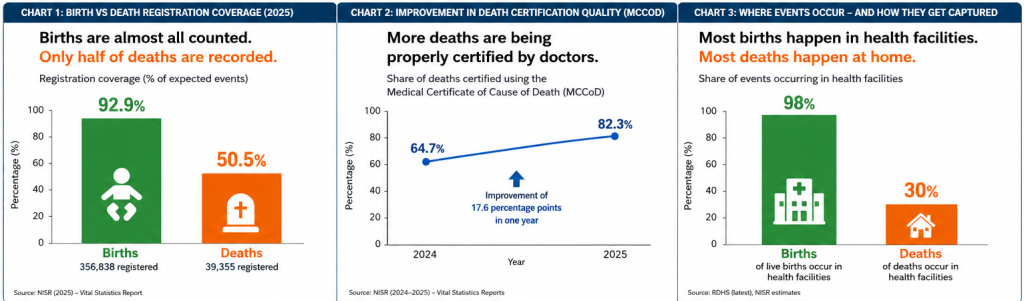
According to the latest report from the National Institute of Statistics of Rwanda (NISR 2025), 356,838 births were registered in 2025, covering 92.9% of expected births. In contrast, only 39,355 deaths were recorded, representing just 50.5% coverage.
That gap is not just statistical, it points to a deeper imbalance in how life and death moves in the country’s vital statistics system.
Births are usually recorded quickly and systematically, often in hospitals or maternity facilities. Deaths, however, are far less predictable. Many occur at home, sometimes suddenly, and without medical staff present to document them.
According to the United Nations Children’s Fund (UNICEF), Rwanda’s civil registration system operates through a web-based CRVS platform at sector level, linking local registration offices directly to the national statistical system. These offices also handle related administrative processes such as health insurance and vaccination records. However, reporting is not always consistent across all sectors, which affects the completeness of national data.
But the system is only as strong as its reporting chain,. Not all sectors submit data consistently, creating gaps that widen when events happen outside formal health settings.
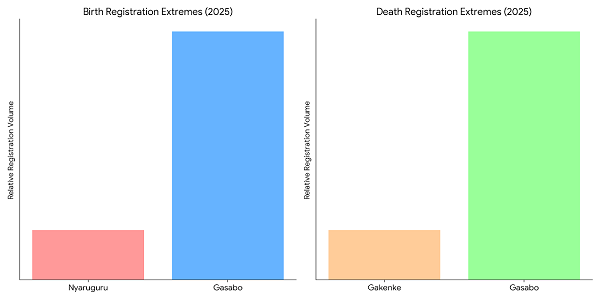
Based on the NISF Vital Statistics Report 2025, Gasabo District recorded the highest figures, mainly due to its large population, urban settings, and the presence of major referral hospitals where many births occur.
Nyaruguru District had the lowest registrations in 2025. In general, areas with more health facilities, especially Kigali City, report higher numbers because the NCI-CRVS system is implemented directly in hospitals, making registration easier and more consistent.
There signs of improvement, in how deaths are medically recorded.
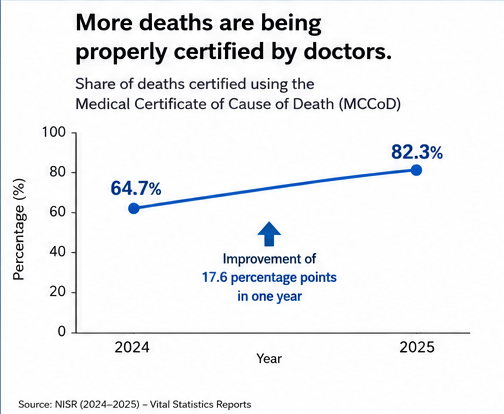
The share of death properly certified using the MCCoD increased from 64.7% in 2024 to 82.3% in 2025.
According to NISR, understanding what people are dying from depends more on the quality of cause-of-death reporting than the total number of deaths recorded, especially when regions report deaths at similar rates.
The 2025 Vital Statistics Report shows that more than 80% of reported causes of death, both in health facilities and communities, are considered reliable enough to guide policy and health planning. The statistical agency said that despite low overall completeness, the available cause-of-death data can still be used with a relatively low margin of error.
A significant shift is noted in where deaths occur and what the primary drivers of mortality are, with non-communicable diseases (NCDs) leading in all settings.
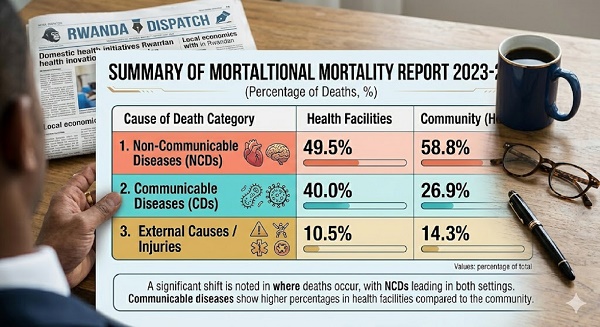
Officials say this reflects improving data quality within health facilities, even if overall registration coverage still lags behind.
But improved quality does not fully solve the problem missing records.
When deaths are not registered at all, they disappear entirely from official statistics, affecting mortality rates, disease tracking, health planning, and resource allocation.
Patrick Nshimiyimana, head of civil registration at NISR, notes there has been no specific research explaining the full reasons behind the gap. However, existing data provides useful clues.
He points to finding from the most recent Rwanda Demographic and Health Survey (RDHS), which show that 98% of live births from women aged 15-49 occurred at health facilities over 2 years preceding the survey.
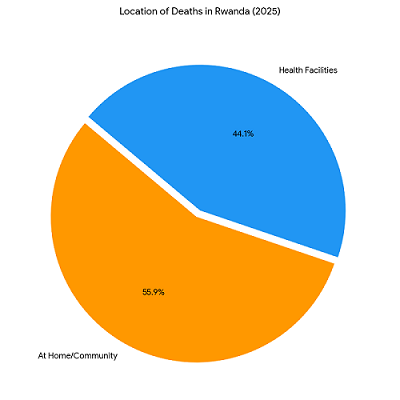
Death, however, follows a very different pattern: only about 30% of deaths are estimated to occur in health facilities.
That difference is central to understanding the gap in registration.
“Health facilities are among the official registration points for both births and deaths. Events occurring in health facilities are easier to capture because they are visible in the system, unlike those happening in communities,” Nshimiyimana noted.
Mutesi Estheri, a Community Health Worker (CHW) in Nyagitabire Cell, Gahini Sector, Kayonza District, says it’s actually rare for deaths not to be registered in rural communities. She explains that most households are aware of the process, when someone dies at home, even after being sick for a while, the family reports it to cell or sector authorities before the burial takes place.
She adds that if a death happens suddenly, the body is taken to the nearest health facility for examination to determine the cause. While it’s hard to say exactly why some cases still go unrecorded, she believes the gap may be at the sector level rather than the community. In her view, people understand the rules well, especially because unregistered deaths often come up later when families try to access services like Mutuelle de Santé.
Deaths occurring in health facilities are certified by medical doctors. For deaths occurring outside hospitals, officials rely on verbal autopsies, where family members are asked structured questions about the symptoms and conditions experienced before death. The information is then used to determine the most probable cause of death.
Authorities in the Ministry of Local Government (MINALOC) say efforts are now focused on improving death registration at community level.
One of the latest initiatives involves a mobile-phone-based notification system allowing village leaders to report deaths before burial takes place. Officials say the electronic notification platform, rolled out nationwide last year, is expected to improve real-time reporting of deaths occurring in communities.
Enhanced public awareness, strengthened local government engagement and creating incentives for registration are among the other key steps to raise death registration completeness,” NISR head of civil registration adds.
The role out of the digital civil registration system has significantly improved birth registration, now exceeding 90% completeness and widely integrated into health facilities and local administration. However, death registration still lags behind, especially for community deaths, with only about 50.5% of expected deaths captured in 2025.
As one NISR report notes, “death registration remains lower due to challenges in capturing events occurring outside health facilities.” Overall, the system is in place and functioning nationwide, but gaps remain in fully capturing deaths at the community level.