Rwanda is looking to countries with strong records in international education assessments, as well as those that have made major improvements, for lessons as it seeks to raise the quality of its education system.
Education Minister Joseph Nsengimana said Rwanda wants to study reforms adopted by countries that have used education to support economic development, while adapting relevant lessons to its own needs.
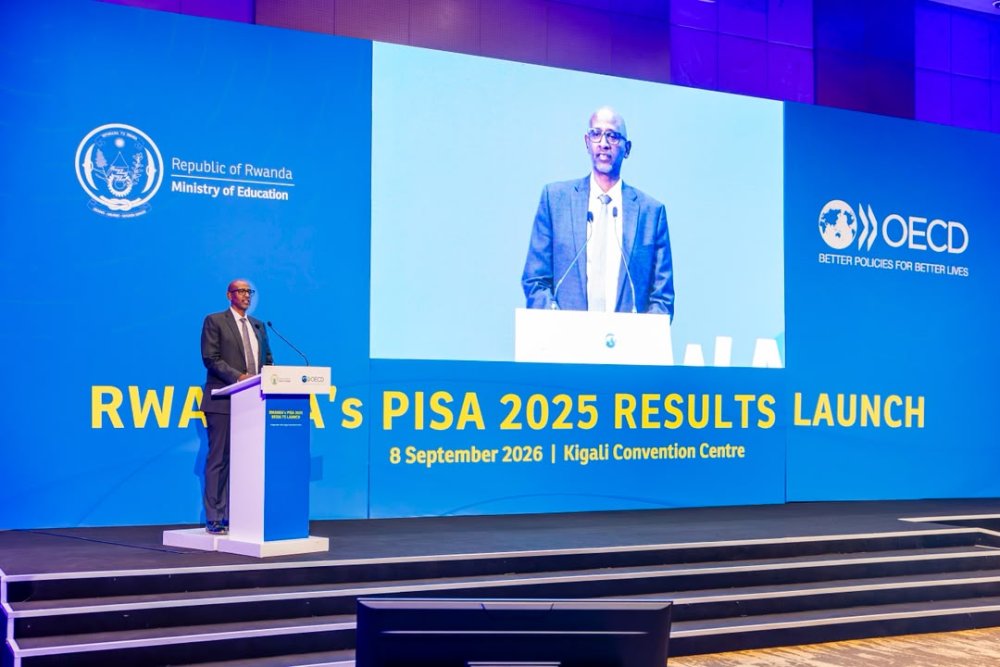
He was speaking in Kigali on Thursday at a knowledge-sharing meeting bringing together representatives from countries that performed strongly in the 2025 Programme for International Student Assessment (PISA), which Rwanda joined for the first time last year.
Singapore was among the countries highlighted for its strong performance, while Cambodia was cited as an example of a country that had previously struggled but later improved its position.
“We invited countries that performed poorly and then improved so that we can learn from them,” Nsengimana said, referring to Cambodia. He added that representatives from Cambodia, Vietnam and Singapore would share their experiences, while other African countries were also invited to take part in the discussions.
Rwanda’s first PISA results, released on Sept. 8, showed that its students scored an average of 317 points in science, 312 in mathematics and 301 in reading. The assessment covered 91 countries and economies, with more than 760,000 students taking part globally.
Nsengimana said Rwanda joined PISA partly to assess its education system against international standards and identify areas for improvement.
“We knew that we were not at the level of other countries, but we wanted to compare ourselves with them and see where they are ahead of us, where we are similar and what they did to improve,” he said.
PISA is organised by the Organisation for Economic Co-operation and Development and assesses 15-year-old students’ ability to apply knowledge and skills in reading, mathematics and science.
Nsengimana said improving education was central to Rwanda’s ambition of building a knowledge-based economy under its Vision 2050 strategy.
The assessment also highlighted challenges in Rwanda, including limited parental engagement with children’s school experiences and difficulties in applying classroom learning to everyday situations.