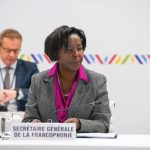
The International Organisation of La Francophonie (OIF) has postponed the election of its next secretary-general for a year, leaving Rwanda’s Louise Mushikiwabo in office until a new vote can be held after member states failed to agree on a successor at their summit in Cambodia.
The decision was reached on Monday, November 16, during the organisation’s 20th Summit of Heads of State and Government in Phnom Penh. The election had been expected to select a leader for the 2027–2030 term.
Mushikiwabo, who has led the OIF since 2018 and was re-elected in 2022, was seeking a third consecutive term. The other candidates were former Mauritanian minister Coumba Bâ, former Romanian prime minister Dacian Cioloș and former Democratic Republic of Congo minister Juliana Amato Lumumba.
DR Congo had indicated its willingness to withdraw Lumumba’s candidacy in favour of a possible consensus around Cioloș. However, negotiations failed to produce an agreement on a successor. Member states instead opted to postpone the election, giving themselves another year to reach an agreement.
The impasse came amid strained relations between Rwanda and DR Congo. Kinshasa opposed Mushikiwabo’s bid and had threatened to reconsider its membership if she secured another term. The dispute is linked to wider tensions between the neighbouring countries, including the conflict in eastern DR Congo. Kinshasa accuses Rwanda of supporting the M23 armed group, an allegation Kigali denies.
The postponement marks the first time the OIF has delayed the selection of its secretary-general since the position was created in 1997. Previous leaders, including Boutros Boutros-Ghali, Abdou Diouf and Michaëlle Jean, were selected through consensus, as was Mushikiwabo in 2018.
Speaking to TV5Monde after the decision, Mushikiwabo described the outcome as a victory for Africa, highlighting the continent’s importance within the organisation. She noted that 27 African countries are among the OIF’s 53 full members.
“Personally, I think so,” she said when asked whether the decision represented a victory for Africa.
The OIF has 90 member states and governments, comprising 53 full members, five associate members and 32 observers. Only full members have voting rights in the selection of the secretary-general.
Mushikiwabo said she would use the additional year to advance reforms and strengthen the organisation’s international role. She also identified artificial intelligence as an area offering opportunities for new projects and cooperation.
The next election is expected to take place in 2027. The postponement gives member states more time to find a candidate acceptable to the organisation’s diverse membership and avoid a deeper division within the French-speaking bloc.