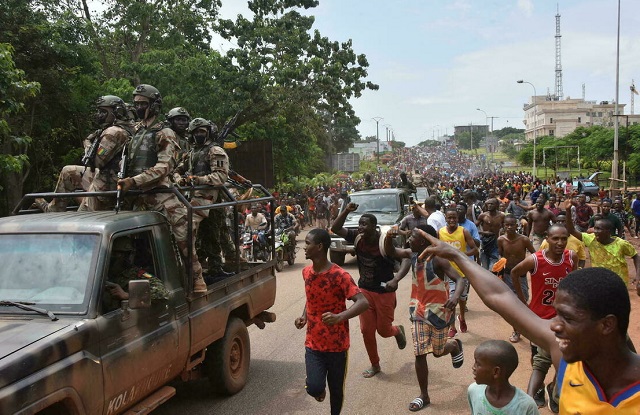
The African Union on Wednesday suspended Madagascar “with immediate effect” after an elite army unit seized power following the impeachment of President Andry Rajoelina, plunging the Indian Ocean nation into its worst political crisis in years.
AU Commission Chair Mahamoud Ali Youssouf announced the suspension shortly after Madagascar’s top court confirmed Colonel Michael Randrianirina as the country’s new leader.
“The country is suspended with immediate effect,” Youssouf said, calling for a swift return to constitutional order.
Randrianirina, commander of the elite CAPSAT military unit, assumed power on Tuesday moments after parliament voted to impeach Rajoelina, who has led the country since a 2009 coup. The 51-year-old president appeared to have fled the country as mass protests and unrest swept the capital.
The new military leadership said it would oversee a transition to civilian rule within two years. In a statement signed by Randrianirina and issued under the banner of the “Presidential Council for the Refoundation of the Republic of Madagascar,” the colonel said he would be sworn in as transitional president during a “solemn hearing” of the constitutional court on Friday.
“It wasn’t a coup, it was a case of taking responsibility because the country was on the brink of collapse,” Randrianirina said on national television. He pledged to hold elections in 18 to 24 months and said consultations were under way to appoint a prime minister and form a new government.
The takeover makes Madagascar the latest in a string of African nations — including Mali, Burkina Faso, Niger, Guinea and Gabon — to fall under military control since 2020, many of them former French colonies.
The United Nations and other international partners swiftly condemned the power grab.
“We are deeply concerned by the unconstitutional change of power,” a UN spokesperson said.
The AU’s suspension follows its established practice of penalizing member states where leaders are ousted by force.
Randrianirina, who has been a vocal critic of Rajoelina’s administration, was imprisoned in 2023 for allegedly plotting a coup. His sudden return to prominence drew concern from diplomats and rights groups urging restraint and dialogue.
Despite fears of instability, the capital Antananarivo remained calm on Wednesday. Thousands gathered at the historic Place du 13 Mai square — the symbolic heart of political protest — where a concert replaced the violent clashes that erupted days earlier between demonstrators and security forces.
The youth-led “Gen Z” movement, which launched nationwide protests on September 25 over water and energy shortages, welcomed Randrianirina’s intervention.
“The colonel said he is ready to talk to the youth and we are ready to answer the call,” the group said in a Facebook post, reiterating demands for “systemic change.”
“We’re worried about what comes next, but we’re savoring this first victory that gave us hope,” said Fenitra Razafindramanga, 26, captain of Madagascar’s national rugby team.
In the northern city of Antsiranana, business owner Muriella, who declined to give her full name, said Rajoelina’s removal brought relief. “It feels like we’ve just been released from prison,” she said. “This is also a message to his successor: learn from this and don’t make the same mistakes.”
President’s Whereabouts Unclear
Rajoelina’s office condemned the court’s decision as illegal and “riddled with procedural irregularities,” accusing it of destabilizing the country.
“This decision, tainted by multiple defects in both substance and form, is illegal, irregular and unconstitutional,” the statement said.
Rajoelina first rose to power in a 2009 military-backed coup before being elected president in 2018 and re-elected in disputed polls in 2023. In a televised address from an undisclosed location on Monday, he said he was “seeking solutions to Madagascar’s problems” and was in a “safe place to protect my life.”
Reports in local media suggested Rajoelina may have been helped to flee by France, Madagascar’s former colonial power.
As the country braces for a turbulent transition, many fear renewed instability could deepen economic hardship in one of the world’s poorest nations.