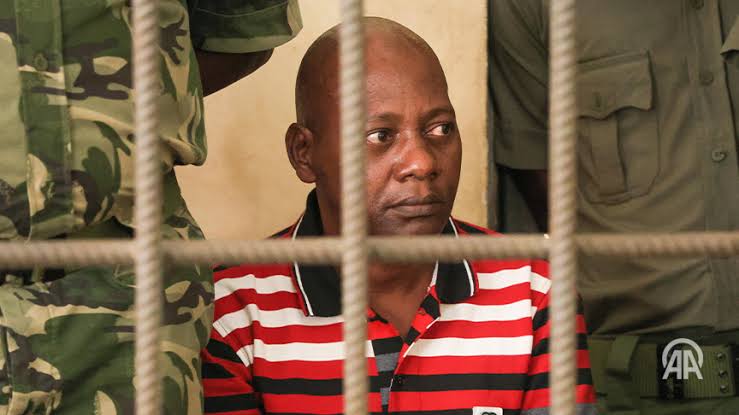
A Kenyan court has sentenced religious leader Paul Mackenzie to 200 years in prison for the murder of 191 people, including 190 children, in the Shakahola mass killings, in a landmark ruling that has renewed scrutiny of religious extremism and failures by authorities to prevent the tragedy.
The High Court in Mombasa handed down the sentence on Friday, November 6, after finding Mackenzie responsible for deaths linked to a religious group that encouraged followers to starve themselves and their children in the belief that they would reach heaven and meet Jesus.
Justice Diana Kavedza imposed two consecutive 100-year prison terms on Mackenzie, founder of the Good News International Church. One sentence relates to 183 murders by starvation, involving 182 children and one adult, while the other covers the direct killing of eight children.
The court found that Mackenzie bore primary responsibility for leading followers into an isolated settlement and directing them to undertake extreme fasting. Prosecutors said members of the group used threats, beatings and confinement to enforce the instructions against those who resisted.
Twenty-eight co-defendants were also convicted in October for their roles in the killings. They received prison sentences ranging from 10 to 160 years. Mackenzie’s lawyer said the defence would appeal the convictions and sentences.
The case came to international attention in April 2023, when police investigating reports of missing people began discovering bodies in Shakahola Forest, near the coastal town of Malindi. More than 400 bodies were eventually recovered from the area, exposing the scale of a religious movement whose followers had been living in an isolated settlement.
According to the Kenya National Commission on Human Rights, 448 bodies were recovered from Shakahola. Many victims were children, while the condition of some remains made identification difficult for investigators and relatives.
The murder convictions cover 191 deaths, but the investigation has extended beyond those cases. Mackenzie is separately facing proceedings linked to another 52 deaths at Kwa Binzaro, meaning the suspected death toll associated with the wider investigation could approach 500.
The court’s findings have also raised questions about institutional failures. Mackenzie had previously attracted the attention of authorities, but continued to operate and recruit followers before the mass graves were discovered.
The judge criticised failures by state institutions to act on earlier warning signs and called for measures to prevent similar incidents. The case has intensified debate in Kenya over how religious organisations should be monitored without undermining freedom of worship.
Despite the convictions, many families are still waiting to learn whether their missing relatives are among the bodies recovered from Shakahola. For some, the search for answers continues even after the court delivered its verdict.