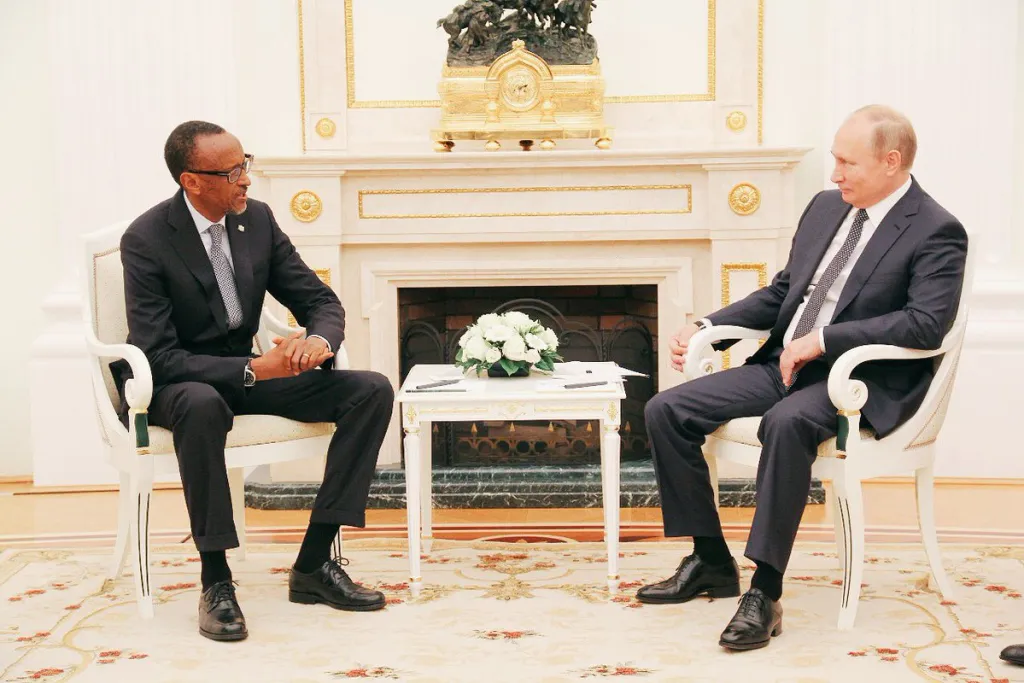
President Paul Kagame is expected to attend the third Russia-Africa Summit in Moscow later this month, where Rwanda and Russia plan to sign an agreement establishing a joint commission to strengthen political, social and economic cooperation.
The summit is scheduled for October 28–29, 2026, according to Rwanda’s ambassador to Russia, Major General Joseph Nzabamwita, who confirmed Kagame’s planned participation in an interview with Russian state news agency TASS.
Nzabamwita said the proposed commission would provide a formal framework for coordinating cooperation between the two countries across several sectors. The agreement is expected to be signed during the summit.
The ambassador made the remarks on the sidelines of the ninth international forum, “The North Caucasus: A Space for Dialogue, Traditions and Development,” where he discussed Rwanda’s priorities in its relationship with Moscow.
He said Rwanda wanted to move beyond broad diplomatic commitments towards cooperation that delivers practical results, including investment, trade agreements and joint industrial projects.
The two countries are exploring opportunities in areas including agriculture, healthcare, education, science and technology, tourism and security. Rwanda is also seeking investment from Russian companies in sectors such as mining and fertiliser production.
The proposed commission would give the two governments a structure for coordinating initiatives and following up on agreed areas of cooperation.
Rwanda and Russia have maintained diplomatic relations since 1963, with engagement expanding in recent years through high-level visits, education programmes and discussions on scientific and technological cooperation.
The upcoming summit will bring together African leaders and Russian officials to discuss political relations, trade, investment and other areas of development. It follows the first Russia-Africa Summit in Sochi in 2019 and the second in St Petersburg in 2023.
For Rwanda, Kagame’s expected participation comes as the government seeks to broaden its international partnerships and attract investment that can support economic development.
The outcome of the proposed commission agreement, alongside any further bilateral commitments announced in Moscow, will help determine how the two countries intend to translate their diplomatic relationship into practical cooperation.