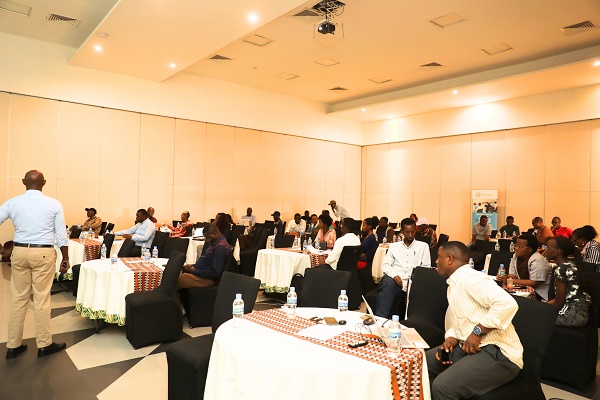
Seventy-five journalists completed a two-day training aimed at strengthening their understanding of the Universal Periodic Review (UPR) and improving the way human rights issues are reported in Rwanda.
The training, organised by the Legal Aid Forum (LAF) in collaboration with the Rwanda Media Commission (RMC) and the Association of Rwanda Journalists (ARJ), was held from August 26 to 27 at St Famille Hotel in Kigali.
The workshop focused on practical human rights reporting, including accuracy and impartiality, evidence-based journalism, protection of sources and vulnerable people, and ethical reporting.
But much of the discussion went beyond how journalists should report human rights issues. Participants were encouraged to look at the UPR as a source of story ideas, particularly by following what the government says it will do and checking what happens afterwards.
The UPR is a United Nations process through which the human rights records of all UN member states are reviewed by their peers. Countries receive recommendations from other member states and are expected to respond to them.
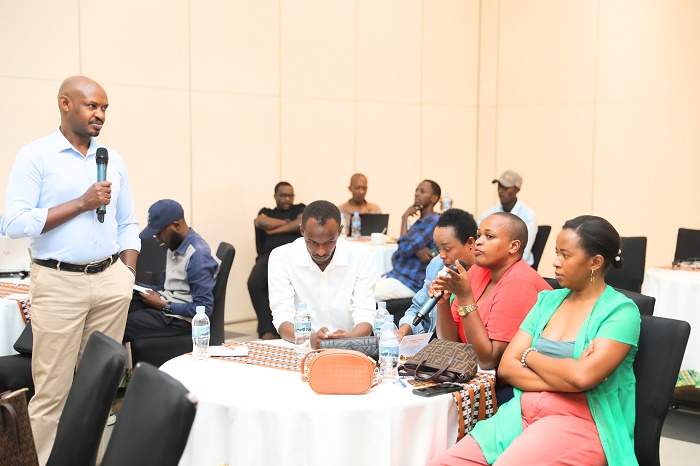
Mary Musoni, Senior Legal Empowerment Officer at the Legal Aid Forum and one of the trainers, said journalists need to understand the process because it gives them a framework for following government commitments.
“Understanding the process is important because it provides a framework for following up on commitments made by governments and assessing progress over time,” she told the journalists.
Emmanuel Mugisha, Executive Secretary of RMC, also urged journalists to understand the UPR as a universal process rather than something confined to lawyers, government officials or international organisations.
The mechanism, he said, is a peer-review process and not a court.
“Journalists need to understand the recommendations, responses, commitments and implementation made by member countries like Rwanda. In that way, journalists who are interested can understand what they are reporting about when it comes to public-interest journalism,” Mugisha said.
The training came after Rwanda completed its fourth UPR cycle in 2026. During the review in Geneva on January 21, 2026, Rwanda received 286 recommendations from other UN member states. When the outcome was formally adopted by the Human Rights Council on June 30, Rwanda said it supported 249 recommendations, representing 87 per cent, while taking note of 37.
A recommendation that Rwanda supports represents a commitment that can be followed over the coming years. A recommendation that is merely noted does not carry the same commitment to implementation.
Rwanda’s fourth-cycle UPR outcome is expected to guide the country’s human rights agenda over the next five years. The government has said preparations for national implementation, including awareness-raising on the recommendations, have already started.
The 2026 figures also provide journalists with a useful way of looking at Rwanda’s UPR history. During the third UPR cycle in 2021, Rwanda accepted 160 of 284 recommendations. In the second review in 2015, it accepted 50 recommendations.
For journalists, trainers said, the figures should not simply be reported as statistics. Each recommendation can be followed up to establish what has changed, what remains outstanding and whether commitments have made a difference in people’s lives.
The Mugish encouraged journalists to specialise in areas they already cover, then use the UPR to deepen their reporting.
He said the areas could include; the media, disability rights, health, gender, children’s rights, access to justice, security, independent institutions and public policy.
He pointed out that, a recommendation concerning access to information, for example, can lead a journalist to examine how the law is working in practice. A recommendation on disability rights can be used to investigate whether public services are accessible to people with disabilities. Recommendations relating to children, health or gender can similarly be followed through official records, interviews, field reporting and data.
The trainers told the journalist that, this approach allows journalists to move beyond reporting speeches and official statements.
Instead, a recommendation becomes a question: What was promised, who was supposed to act, what has been done and what has changed?
The RMC Executive Secretary also encouraged journalists to follow the UPR throughout the cycle rather than only when Rwanda appears before the Human Rights Council in Geneva.
He said the process provides journalists with a lens through which they can identify stories across a wide range of issues, from disability and health to gender, children’s rights and the media.
The training also examined Rwanda’s progress in strengthening its legal and institutional framework for human rights.
Trainers referred to reforms and laws covering areas such as media regulation, access to information and the Penal Code, while stressing that journalists should examine not only what laws say but also how they work in practice.
Practical examples were used to help participants understand the difference between a recommendation, a government response, a commitment and actual implementation.
That distinction matters because accepting a recommendation does not necessarily mean that the desired outcome has already been achieved.
Rwanda’s own fourth-cycle report says the country has been working to implement the 160 recommendations it accepted during its 2021 review, through policy reforms, stronger coordination and investment in public institutions and services.
For journalists, that creates an opportunity to ask a simple but important question: What happened to the commitments made five years ago?
John Mugisha, a Rwanda Dispatch journalist who attended the training, said the sessions changed how he views the UPR and showed him that the mechanism can provide leads for both public-interest and investigative stories.
“UPR is another area that I have developed an interest in, not only to inform the public but also to investigate the commitments made by the government. I also want to use what I have learned to guide and train fellow journalists on what the UPR means for journalists and how they can report on it,” he said.
Mugisha said one of his main takeaways was the need for journalists to keep tracking the process instead of treating the UPR as a once-every-five-years event.
“As a journalist, I have to keep following up on the UPR, especially what is discussed in Geneva. The training has changed the way I look at and report on the UPR,” he said.
He also urged the Rwanda Media Commission and other partners to provide journalists with more than training.
“RMC and other partners should also support journalists by helping them find resources to investigate UPR stories. Training gives us the knowledge, but we also need the resources to follow up on these commitments and produce meaningful stories,” Mugisha said.
The challenge now is whether journalists will turn the knowledge gained during the two-day workshop into sustained reporting.
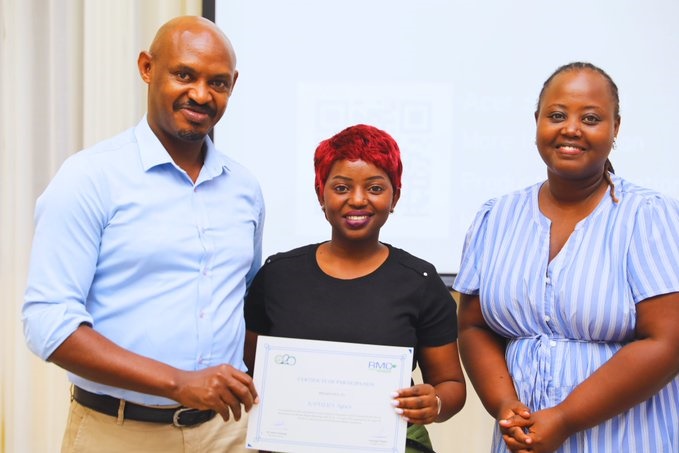
The workshop ended with participant reflections, a post-training assessment and the awarding of certificates.