French President Emmanuel Macron and his Rwandan counterpart, Paul Kagame, have unveiled the first permanent monument in Paris dedicated to the victims of the 1994 Genocide against the Tutsi.
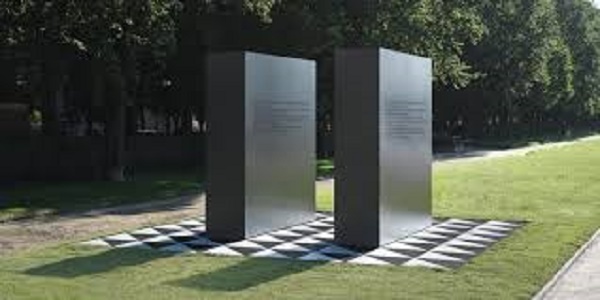
Titled “L’Archive” (“The Archive”), the monument now sits on the banks of the Seine River in the heart of the French capital. Designed by Berlin-based Portuguese artist Grada Kilomba, the memorial features two black brass steles engraved with a poignant tribute to the over one million men, women, and children systematically massacred over 100 days between April and July 1994.
“Here, like an archive, rest the voices and words, the memories and experiences, the feelings and hopes of the victims and the survivors,” the inscription reads.
For decades, Paris’s relationship with Kigali was frozen, heavily strained by France’s actions leading up to and during the genocide. But the new memorial represents a tangible shift in France’s efforts to take responsibility for its historical foreign policy failures and reset its diplomatic ties with Africa.
The breakthrough began in earnest in 2021 when a landmark historical commission, appointed by Macron and led by historian Vincent Duclert, concluded that France bore “heavy and overwhelming responsibilities” under then-President François Mitterrand for turning a blind eye to the impending slaughter. While the Duclert report found no evidence of direct French complicity in the killings, it heavily criticized Paris for its blindness to the radical regime orchestrating the genocide.
Later that same year, Macron traveled to Kigali, where he delivered a speech at the Kigali Genocide Memorial formally acknowledging France’s failure to heed the warnings of the impending massacres.
Reflecting on Tuesday’s ceremony, Duclert emphasized that the unveiling is far more than just a political gesture. It represents a permanent shift in the French national consciousness.
“The Genocide against the Tutsi is now fully part of France’s public history,” Duclert said.