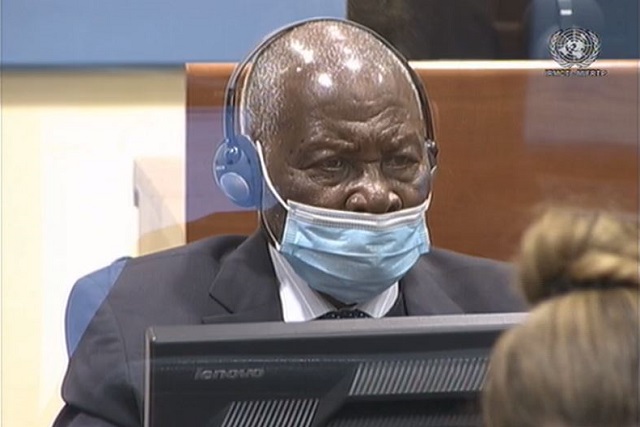
Félicien Kabuga, the Rwandan businessman accused of playing a central role in the 1994 Genocide against the Tutsi, has died while receiving medical treatment in The Hague, the Netherlands, according to the International Residual Mechanism for Criminal Tribunals (IRMCT).
The United Nations Detention Unit (UNDU) immediately notified Dutch authorities following his death, triggering the standard legal and medical procedures required under Dutch law.
In response, the President of the IRMCT, Judge Graciela Gatti Santana, ordered a full inquiry into the circumstances surrounding Kabuga’s death. Judge Alphons Orie has been appointed to lead the investigation.
Kabuga had long been regarded as one of the most wanted genocide suspects linked to the 1994 Genocide against the Tutsi in Rwanda. He faced charges including genocide, conspiracy to commit genocide, direct and public incitement to commit genocide, as well as crimes against humanity such as persecution, extermination, and murder.
An arrest warrant against Kabuga was first issued by the International Criminal Tribunal for Rwanda (ICTR) on 29 April 2013. After years on the run, he was arrested in France on 16 May 2020 and later transferred to The Hague branch of the IRMCT on 26 October 2020.
His trial officially opened on 29 September 2022. However, proceedings were halted after judges determined that Kabuga was no longer mentally and physically fit to stand trial.
On 8 September 2023, following a decision by the Appeals Chamber, the Trial Chamber indefinitely suspended the proceedings and ordered that Kabuga remain under detention at the UNDU while discussions continued over his possible provisional release to a country willing to host him.
At the time of his death, arrangements for his provisional release were still under consideration.
The IRMCT, which inherited the responsibilities of both the ICTR and the International Criminal Tribunal for the former Yugoslavia (ICTY), was established by the United Nations Security Council through Resolution 1966 adopted on 22 December 2010.
The Mechanism began operations in Arusha, Tanzania, on 1 July 2012 and later in The Hague on 1 July 2013. Following the closure of the ICTR in 2015 and the ICTY in 2017, it continued operating as a stand-alone international judicial institution tasked with completing remaining tribunal responsibilities.