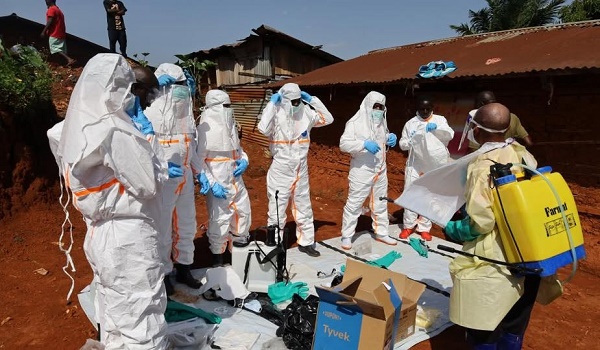
The Ebola outbreak in the Democratic Republic of Congo is showing signs of stabilization, but it is too early to say the situation is under control, the Africa Centres for Disease Control and Prevention (Africa CDC) said Thursday.
“We’re still early to say that we’re controlling the whole outbreak,” Africa CDC official Wessam Mankoula told an online press briefing, warning that the outbreak remains active and continues to evolve.
According to the latest government situation report published Thursday, the DRC had recorded 6,250 confirmed cases and 3,039 deaths as of September 1, giving a case fatality rate of 48.6%. A total of 1,439 patients had recovered.
The outbreak has affected 60 health zones across six provinces.
Four health zones have interrupted transmission after going more than 42 days without reporting a new case. However, transmission remains active in 51 health zones, Mankoula said.
“For the last two weeks, we are seeing a decline in the number of cases; we are almost at the plateau phase,” she said. But she cautioned that it was “very early to say we have sustained decline in this outbreak.”
The continued spread in eastern DRC, particularly in provinces bordering Uganda, also remains a concern because of the risk of cross-border transmission. Uganda recently declared its own Ebola outbreak over.
“The outbreak is still evolving,” Mankoula said. “Incremental measures are no longer effective. This is the time for scaling up all different responses to control the situation on the ground.”
Africa CDC Director-General Jean Kaseya also warned Wednesday that the outbreak remains serious.
“Despite the concerted efforts of the (DRC) government and its partners, we are not yet where we need to be,” Kaseya said.
The outbreak is caused by the Bundibugyo virus, for which there is currently no specifically approved vaccine or treatment. Health authorities are therefore relying on experimental and repurposed medical tools.
The Ervebo vaccine, which is licensed against Zaire ebolavirus, is being evaluated for possible cross-protection against the Bundibugyo strain through a field effectiveness study.
Under a compassionate-use protocol, which allows unapproved or partially studied medical interventions to be used during outbreaks, vaccination of frontline workers and other high-risk groups began on August 27.
By September 1, a total of 1,124 healthcare and frontline workers had been vaccinated, Mankoula said.
“We think that very soon we’ll be able to provide more details and a precise answer regarding the level of cross-protection using the Ervebo vaccine,” said Placide Mbale Kingbeni, Africa CDC’s director for research, clinical trials and innovation.