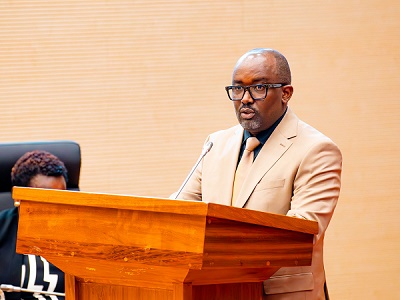
Auditor General Alexis Kamuhire has put public officials on notice over sluggish project implementation, even as the country celebrates a record 97% clean audit rate for the 2025 financial year.
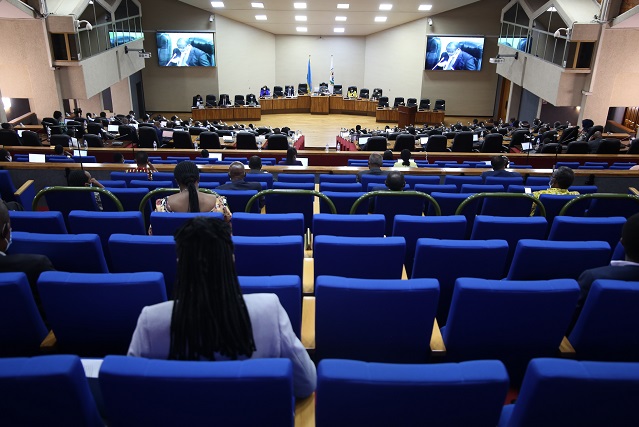
In a report tabled before a joint session of Parliament on Wednesday, the Office of the Auditors General (OAG) revealed it had frozen the potential loss of Frw 1.47 billion through “preventive audits”, a sharp drop from the Frw 9.3 billion intercepted last year.
While the dip suggests tightened loopholes, Mr. Kamuhire warned that “stumbling blocks” in contract management and idle assets continue to bleed the taxpayer.
While 252 entities boasted “unqualified” opinions on their books, the ground reality for service delivery remains a mixed bag. The Auditor General noted that while financial reporting has hit an all-time high, compliance with the law lags at 83%.
“We are seeing fewer cases of unlawful expenditure, which dropped from Frw 2.04 billion to Frw 600 million,” Kamuhire told lawmakers. “However, the delay in starting financed projects and the presence of idle assets remain a thorn in the side of national development.”
The report highlighted a rare win for the “common man” in Kirehe District. Following an audit that exposed shoddy housing for residents displaced by Rusumo hydropower project, the OAG forced a u-turn that saw 80modern houses built. By early May 2026, families had already occupied the units, proving that audit queries can, in fact, put roofs over heads.
Despite the celebratory figures, the statement from the Auditor General was blunt about three persistent failures:
Idle Assets: Millions in equipment and infrastructure sitting unused.
Stalled Contracts: Projects that have been funded but haven’t broken ground.
Service Delivery Gaps: A disconnect between “clean books” and the quality of services reaching the public.
The OAG’s report took a swipe at the “ghost projects” and idle machinery currently gathering dust. Despite the stellar financial reporting, the report reveals that millions remain tied up in assets that provide zero value to the public.
From construction projects that have failed to kick off to expensive equipment sitting in crates, the Auditor General was categorical: “Clean books are not enough if the machines are silent and the sites are empty.” He challenged accounting officers to move beyond mere bookkeeping and ensure that every franc authorized by Parliament translates into a functional project on the ground.
The report further exposes a soft underbelly in the country’s procurement processes. While the “big theft” has been largely curtailed through preventive audits, “low-level leakage” through poor contract management remains a persistent headache.
According to the OAG, 83% of entities complied with the law, a respectable figure by regional standards, but one that leaves a 17% “grey area” where rules were bent or ignored.
The Auditor General statement noted that weaknesses in service delivery and the slow disbursement of funds are slowing down the national development engine, calling for a more aggressive approach to clearing bureaucratic bottlenecks.
However, it was the “Kirehe Intervention” that provided the report’s most human moment. In a rare instance of an audit directly influencing civil engineering, the report’s flagging of sub-standard rehabilitation work led to a total overhaul.
Instead of the planned “patch-up” job for families displaced by the Rusumo hydropower project, the government was forced to construct 80 modern, permanent houses. “This is what happens when oversight works,” three sources interviewed told Rwanda Dispatch. “It’s not just about finding the missing money; it’s about ensuring that actually the money does what it was meant to do, and the public deserves the right under the law to know what happened.”
As the Auditor General concluded his address to the House, the message to the “big fish” in the public sector was clear: The era of hiding behind “unqualified opinions” while projects stall is over.