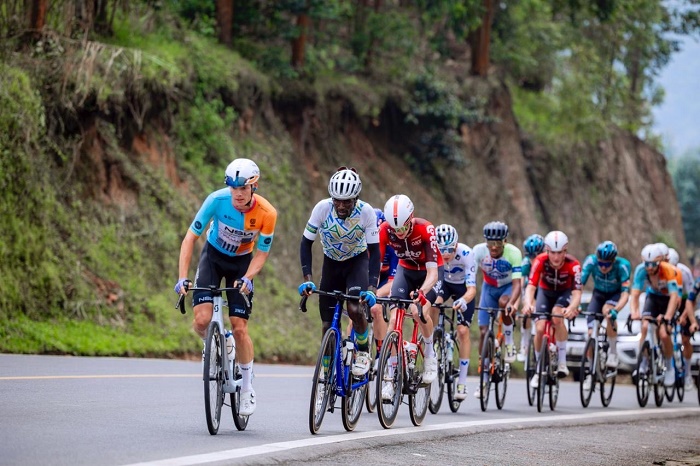
On Sunday March 1, the 2026 Tour du Rwanda rolled to its final stop at the Kigali Convention Centre. The peloton had done its work. The crowds had sung. Champions were crowned. As always, the Tour, Africa’s most prestigious cycling race, delivered spectacle, sweat, and pride.
But in cycling Tours, as in life, what happens away from the cameras often carries the heavier story.
Behind the podium lights and finishing sprints, one decision quietly appeared in an official Tour race report, a short communiqué that raised far bigger questions than its few lines suggested.
Now that the riders, team staff and mechanics have packed and gone. This story highlights one incident that led to the disqualification of a Directeur Sportif (DS) from the entire race.
The Decision That Shifted the Tour
According to communiqué Number. 4, released in the evening after Stage 4 from Karongi–Rubavu, the Jury of Commissaries’ Panel announced: Under Article 8.2.2 – improper conduct, insults, threats, or physical assault directed at another person outside the race.
The communiqué read: Director Sportif (DS) Muwonge Erukan Kibuuka of Uganda – African Mixed Team was fined 1,000 CHF (roughly Rwf 1.8 million or UGX 4.4million) and disqualified from the entire race.
The communiqué was signed by Nicolas Philippon from France.
That was it. Brief. Clinical. Official.
But make no mistake; this was not routine race housekeeping.
What This Actually Means
An expert in the world of cycling told this investigation that, professionally, exclusion is serious. Riders and team staff, DS, mechanic, etc. receive time penalties. Teams get warnings. Fines are common, however expulsion is serious,” She said.
And this was not a rider; it was the team’s DS. The person responsible for leadership, discipline, logistics, and race strategy during the race.
According to the UCI Cycling Regulations, Article 8.2.2 covers: aggressive conduct: intimidation, verbal abuse, threats, even physical confrontation. A DS disqualified in an event for dangerous or unsportsmanlike behavior is effectively disqualified from the entire competition.
“A 1,000 CHF fine, immediate removal from the event, that tells you this was not a misunderstanding over race radios. When someone accredited to the race; rider, team staff, DS, mechanic, etc., behaves in a way that violates professional standards.” A source said.
Race officials deemed the matter significant enough to remove a team director from Africa’s biggest cycling stage.
What the communiqué did not explain, however, was where the incident happened, or who the other person was.
And that silence raised a red flag.
Seeking Clarity
At 19:11 on February 27, this investigation made a mobile phone call to Nicolas Philippon, one of the race commissaries’ listed in the communiqué. The objective was clear, to understand what had happened behind the brief official wording that led to the DS’s expulsion.
Translated from French, Mr. Philppon responded: “I compile the Tour du Rwanda rankings, but I have absolutely nothing to do with the decisions made and mentioned in the communiqué of the jury of commissaries.”
Pressed further on who held responsibility, he wrote: “Il faudrait se rapprocher de l’UCI.” In other words: approach the Union Cycliste Internationale (UCI).
A formal inquiry was submitted to the UCI through its official channel the same day by this investigation seeking for clarity. Two days later, no response had been received.
This investigation then moved the trail off the race route.
The Incident in Rusizi
We contacted a couple of sources familiar with the matter, and confirmed accounts from the race security, told this investigation that the incident linked to the sanction did not occur during active race operations. It took place at the team hotel in Rusizi District the night before Stage 4.
The Tour’s Road Book was examined to better understand the race’s operational blueprint, including logistical details such as team allocations, transfer routes and official accommodation.
The Centre Diocésien de Pastoral in Rusizi was listed as the designated hotel for the CAC Mixed Team following Stage 3.
Bosco, 27, (not his real name) a staff member who asked to remain anonymous for fear of losing his job, told this investigation:
“An incident happened at the hotel involving a Ugandan team official. It escalated into a fight with a woman he brought into the room.”
Independent verification from hotel records confirmed that the team director from Uganda arrived on 24 February 2026 and departed the next day, spending the night in Room Vatican 5.
“What began as a private disagreement inside the room escalated beyond a routine disturbance.” The hotel staff said, adding, “We heard noise and shouting, that is when security was alerted.”
Centre Diocésien de Pastoral in Rusizi was listed as the designated hotel for the CAC Mixed Team following Stage 3
According to Mr. Florent Nsengumuremyi, Head of Safety and Security for the Tour, he was alerted to the dispute shortly after it began.
“At round 11:00 pm, the DS left the hotel earlier that evening,” Florent said. “He returned about an hour later with a lady. They entered the room. A few minutes later, there was an altercation. I intervened and took statements from both parties.”
He said the woman later left the premises.
Florent confirmed that the matter was reported to the Rwanda Investigation Bureau (RIB). Both parties were asked to provide statements.
“The DS apologized,” Florent said. “He provided a financial settlement of 50,000 Rwandan francs to cover the women’s hair salon bill. The case was considered resolved.”
Efforts to obtain the woman’s account were unsuccessful. This investigation was unable to access the security report or official statements referenced by hotel and Tour officials.
No criminal charges were filed, according to the account provided.
The hotel dispute, while described as settled locally, later formed the basis of the sporting sanction. The Jury of Commissaries’’ subsequently invoked Article 8.2.2 of the UCI regulations, improper conduct; imposing a 1,000 CHF fine and removing the DS from the remainder of the Tour.
And here is where the story widens.
Beyond the Hotel Room: Governance Questions
While the hotel incident was resolved, it raised broader questions about team oversight and governance in Confederation of African Cycling (CAC).
CAC Mixed Team was composed of riders from multiple countries, and Muwonge Erukan Kibuuka was appointed as DS.
To understand how the team was formed, this investigation team contacted Mr.Yao Allah, President of the African Cycling Confederation (CAC) in Ivory Coast.
CAC serves as the regional governing body for cycling across Africa, and acts as the official representative of the UCI at the African level.
International Cycling Headquarters Photo credit to UCI
Allah clarified that the team was not formally a CAC delegation. It was a temporary facilitative structure, created so that four riders from different countries could compete in the Tour du Rwanda race.
Allah further confirmed oversight of the team rested primarily with the race organizers and the appointed DS.
Crucially, he explained that Uganda’s inclusion followed consultation with the President of the Uganda Cycling Federation (UCA), Mr. Samson Muwonge, who had the capacity to support participation.
That detail matters.
According to the interview with Mr. Allah, this investigation concludes that the national federation leadership, in this case Uganda’s, was not just aware of the team’s participation. They played an active role in making it happen.
This involvement also provides context for Erukan Muwonge’s appointment as DS. This investigation managed to gather evidence from various reliable sources in Uganda including recorded calls and text messages from riders who confirmed that the DS is the son of the Uganda federation president Mr. Samson Muwonge.
At 20 years old, Erukan Muwonge Kibuuka was appointed DS, a role cycling experts think is typically reserved for seasoned professionals with years of experience in the sport.
On Friday, 27 February 2026, this investigation contacted UCA President Muwonge to discuss the direction of cycling in Uganda and its place within the rapidly evolving African scene.
He answered from the road.
“I’m traveling to your country, Rwanda. I’m on a bus heading to Kigali,” he said, his voice carrying the fatigue of an overnight journey.
Despite being in transit, Mr. Samson Muwonge expressed interest in speaking at length. He praised Rwanda’s growing stature in continental cycling and suggested the conversation would centre on progress rather than controversy.
“I’m on a bus traveling to Kigali. We will take time and discuss tomorrow,” he said. “I will give you more details about the team. All in all, we are happy to see cycling in Africa achieving bigger milestones. We cannot forget Rwanda Cycling Federation (FERWACY). As a country, they have done very good work to promote and develop cycling, not only in Rwanda but in neighboring countries. They have organized tours, even World Championships. We get good experience from them.”
He paused, and then added: “I’m on the bus right now. The rest I will talk about tomorrow. I’m with my son, Augustine Niyonzima, the DS of Cycling Academy Uganda.”
Niyonzima briefly took the phone to pass greetings to this investigation before returning it to Mr. Muwonge.
Independent confirmation obtained by this investigation verified that Muwonge was indeed traveling overnight to Kigali. However, multiple sources said the agent road trip carried an additional purpose, described by one insider as “damage control” following the disqualification of the CAC Mixed Team’s DS earlier in the race.
At the time, the CAC Mixed Team was competing without a DS during Stage 4 of the Tour. Evidence reviewed by this investigation indicates that Niyonzima was en route to replace the disqualified DS, Erukan Muwonge Kibuuka.
Formally, such an appointment is permissible under race regulations. The timing, however, raised questions.
The interview was initially scheduled for Saturday evening, 28 February, after Mr. Muwonge had settled in Kigali. But that meeting did not take place.
On Saturday, he sent a WhatsApp text message:
“Because of heavy rain today, we meet tomorrow [Sunday]. I’m in Nyamirambo.”
Sunday came and went. No interview took place. No further message followed. Despite the earlier commitment, this investigation received no response from UCA President Muwonge.
Despite repeated attempts, UCA President did not respond to further requests for comment.
Attention then shifted back to continental leadership.
When pressed on whether the disqualified DS would face additional sanctions, whether CAC had prior knowledge of his familial ties to the UCA President, who would ultimately settle the 1,000 CHF fine, and whether he would be eligible to serve again within a Mixed Team structure, CAC President Yao Allah ended the phone interview abruptly.
The line went silent before the questions were answered.
On Monday, 2 March, this investigation again reached out to Mr. Allah in West Africa. He replied to the WhatsApp call briefly. Speaking in French, later translated into English, he said: “I’m not available. Can you call me later?”
As of publication, neither CAC nor the UCA had provided detailed clarification on the broader governance questions raised by the incident, questions that go beyond one disciplinary decision and into the issue of oversight, accountability, and transparency within African cycling’s Mixed Team framework.
And so the Tour rolled on.
The podium was dismantled. The banners came down. Team buses pulled away from Kigali Convention Centre, engines humming into the Rwandan dusk. For the fans, it was another successful edition of the Tour du Rwanda, eight stages of grit, speed and spectacle.
But behind the applause, questions lingered.
A DS was fined 1,000 Swiss francs and expelled under Article 8.2.2, a rule reserved for serious misconduct. The official communiqué was clear about the sanction, but silent on the substance. What happened, who was involved, and whether further accountability would follow remain unanswered.
Attempts to secure clarification through calls, WhatsApp messages, and emails to President Samson Muwonge of the Uganda Cycling Federation, CAC President Yao Allah, and the Union Cycliste Internationale yielded little response.
The fine was issued. The race continued and ended. Replacement appointments were made within the regulations. On paper, the matter was “settled.”
Yet governance is not only about what is technically permissible. It is about transparency. It is about confidence. It is about ensuring that leadership, at national and continental cycling levels, operates above suspicion, especially in a sport still carving its institutional strength across Africa
Rwanda has worked tirelessly to position itself as a continental cycling hub. FERWACY’s organizational experience, its hosting of major events, and its steady investment in development has become a benchmark for others. The Tour du Rwanda 2026 has grown into more than a race; it is a symbol of African cycling’s ambition.
That is precisely why moments like this matter.
Not because of the scandal. Not because of personalities. But because cycling institutions are tested not when everything runs smoothly, but when pressure builds behind closed doors, in hotels, in team meetings, on the peloton, breakaways and in hurried phone calls across borders.
African cycling is rising. Its talent is undeniable. Its calendar is expanding. Its visibility is growing. But growth demands stronger governance, clearer lines of accountability, and leaders willing to answer difficult questions without hesitation.
In the end, this story is not about one disqualification. It is about systems. About oversight. About whether the structures guiding African cycling are evolving as quickly as the athletes who ride under their flags.
The race has finished. Riders, team staff, mechanics and organizers are packing to return home.
All rights reserved. This article or any portion thereof may not be reproduced or used in any manner whatsoever without the express permission of the publisher except for brief quotations in reviews.