As Africa accelerates efforts to industrialize and deepen intra-African trade, energy security has once again moved to the centre of the continent’s economic conversation.
Despite sitting on vast natural gas reserves and facing rapidly growing demand, many African countries still struggle to move energy across borders — from Nigeria and Libya to Egypt and beyond, leaving much of the continent dependent on expensive imports and unstable power supply.
That challenge dominated early discussions as the Africa CEO Forum Annual Summit 2026 opened in Kigali on Thursday, bringing together heads of state, investors, business leaders and policymakers to debate Africa’s economic future and the role of the private sector in driving growth.
At the heart of the conversation was a striking contradiction: Africa holds nearly 10 percent of the world’s proven gas reserves and could continue producing at current levels for the next 70 years, yet only 3 percent of that gas is traded within Africa itself.
That reality shaped the remarks by Acha Leke as the summit officially got underway on May 14 on energy.
According to Leke, Africa is now the fastest-growing gas demand region in the world, expanding at a pace five times higher than the global average. Demand from power generation and industry alone accounts for 85 percent of that growth.
The challenge, however, is not the availability of resources. It is the lack of infrastructure connecting supply to markets across the continent.
Seven African countries hold 90 percent of the continent’s gas reserves, but the networks needed to move that energy across borders remain limited. Instead, much of Africa’s gas continues to flow outward.
Today, 34 percent of African gas production is exported, mainly as liquefied natural gas (LNG) to Europe, where prices are stronger and buyers are considered more financially reliable. While 63 percent stays within domestic markets, that consumption is heavily concentrated in just four countries, Algeria, Nigeria, Egypt and Libya.
The debate over whether Africa should prioritise exports or domestic consumption also featured prominently during discussions at the summit.
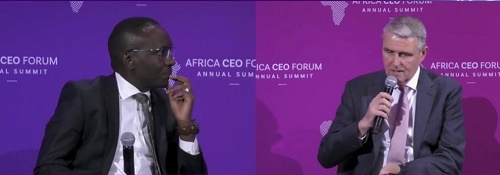
Speaking during an energy panel, Mike Sangster, the Senior Vice President for Africa at TotalEnergies, who oversees a large portion of the company’s oil and gas operations across the continent, argued that framing the issue as a choice between exports and local use misses the bigger picture.
“The right model is a deliberate mix where exports anchor the long-term financing that makes projects viable, while domestic supply powers industries, fertiliser production and electricity generation at home,” Sangster said.
He pointed to projects in Mozambique, Nigeria and Angola as examples of how export-driven investments can also support local energy needs. In Mozambique, for instance, part of the LNG production is reserved for domestic consumption despite the project being heavily export-oriented.
Sangster said export revenues often make it financially possible to build the infrastructure needed to serve local markets, especially in remote regions where large-scale energy projects require billions of dollars in upfront investment.
His remarks reinforced a broader message emerging from the forum: Africa’s energy challenge is no longer about resource availability, but about building the infrastructure needed to distribute and use those resources effectively across the continent.
“Since Renaissance took over key assets in Nigeria, we’ve been focused on restoring confidence and rebuilding operational performance,” said Tony Attah, CEO of Renaissance Energy Company in Nigeria. “Our ambition is to reach around 1 billion cubic feet of gas supply capacity by 2030 and possibly earlier, to help meet Nigeria’s growing energy needs.
But the real challenge in the domestic energy market is the disconnect between off takers and producers. One side is asking where the reliable supply and payment security is, while the other is asking where the firm contracts and guarantees are.
What’s missing is a trusted bridge in the middle. Renaissance is positioning itself as that link, de-risking both sides, strengthening confidence, and enabling the contracts and commitments needed to unlock real scale. The demand is already there; what has been missing is the structure to make it bankable. That’s what we intend to fix.” Tony added.
Looking at the continent’s pipeline network, the imbalance becomes clear. Much of Africa’s gas infrastructure was designed to export resources overseas rather than distribute them within Africa itself.
Leke argued that changing this reality will require a coordinated push involving governments, development finance institutions, private investors and regulators.
His recommendations aligned closely with the “New Deal” agenda being championed throughout the forum. The approach calls for stronger and more credible power-sector buyers, blended financing models involving both public and private capital, and greater regulatory harmonisation under the framework of the African Continental Free Trade Area.
He also stressed the need for long-term political commitment to support cross-border infrastructure projects, warning that Africa’s gas production costs — currently estimated to be 25 percent higher than the global average, will continue making exports more attractive unless structural reforms are implemented.
Throughout the discussions in Kigali, one question continued to dominate conversations: who will power Africa’s industries using African gas, and under what conditions?
The summit, held under the theme “The Scale Imperative: Why Africa Must Embrace Shared Ownership,” is focused on advancing private sector growth and strengthening Africa’s position in the global economy.
Top of Form