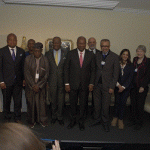
African governments, universities, industry and development partners have called for major changes to higher education, arguing that stronger links between education, research, investment and employment are needed to unlock the continent’s human capital.
The call came in Accra, Ghana, at the inaugural Higher Education Transformation Convening hosted by the Mastercard Foundation under the theme, “Reimagining Higher Education for Africa’s Human Capital Development.”
Participants said universities need to move beyond traditional teaching roles and become stronger contributors to research, innovation, job creation and economic development.
They called for curricula to be developed more closely with employers, stronger private-sector partnerships, improved research capacity, skills training for emerging technologies and greater movement of students and academics across African borders.
Mastercard Foundation President and CEO Sewit Ahderom said universities should ensure that what students learn reflects labour-market needs and that qualifications demonstrate graduates’ capabilities.
The Foundation’s Executive Director for Higher Education and Strategic Initiatives, Dr. John Nkengasong, said Africa’s young and growing population presented an opportunity that depended on institutions capable of retaining talent, supporting innovation and creating pathways to work.
African Union Department of Education, Science, Technology and Innovation Director Professor Saidou Madougou said higher education should be treated as a strategic investment. He said higher education spending averages less than 0.8% of GDP across the continent, while research and development receives less than 0.5% of national budgets.
The meeting also featured the inaugural Africa Higher Education for Transformation Prize, which recognised five institutions: Addis Ababa University, 2iE, Kwame Nkrumah University of Science and Technology, Muni University and the University of Rwanda.
The $500 million initiative is expected to recognise at least 150 institutions over the next decade, with each laureate receiving $3 million to scale programmes aimed at expanding opportunities for young people.
Participants called for governments, universities, industry, investors and development partners to pursue system-level changes by 2028, with stronger connections between education, employment, research and investment.