In Rwanda, artificial insemination of cattle has involved a fair amount of guesswork. Without visual guidance, veterinarians relied on touch to locate the cervix and determine the right angle for insemination. If a farmer noticed signs of fertility in the evening, for example, a veterinarian might only arrive the next day.
A missed timing could mean the procedure failed, leaving the farmer to pay more when the cow was ready for another attempt.
Rwanda-based agribusiness company KT Hub Ltd is helping to address this challenge with a dual- camera insemination tool that gives veterinarians something they previously lacked: visibility.
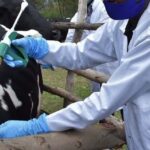
The Digital handheld device enables a veterinarian to see the reproductive tract while positioning the insemination instrument, helping improve accuracy and reduce unnecessary attempts.
“Vets used to inseminate cows without visual guidance, using their fingers to locate the cervix,” says Theoneste Kabahizi, Managing Director of KT Hub. “Now, the instrument goes in and you can see where it is heading.”

Theoneste Kabahizi, Managing Director of KT Hub
KT Hub, which works in partnership with the Rwanda Agriculture and Animal Resources Development Board (RAB), is involved in the cattle breeding value chain, including the importation and distribution of cattle semen to veterinary practitioners.
The technology was among the innovations KT Hub showcased at the 19th Agriculture Expo at Mulindi, where the company was recognised as Best Exhibitor for supplying modern animal production and reproduction equipment, as well as veterinary medicines.
For Kabahizi, the focus on practical solutions comes from experience. A veterinary graduate who previously worked as a veterinary officer, he saw first-hand some of the challenges facing farmers and began developing solutions around their needs.
Today, KT Hub is an integrated agribusiness platform owned by a consortium of established Rwandan companies with experience in areas including agricultural and crop production, livestock production, agro-processing, dairy, agro inputs & veterinary products, environment and renewable energy, fresh produce exports, infrastructure development & engineering, solar system and irrigation solutions; research , consultancy & skills development.
Its ambition extends beyond selling individual products. The company brings together technical expertise, productive assets, infrastructure, innovation and market access under one platform.
At the exhibition, that approach was visible in a range of technologies, including fodder-cutting machines, grain dryers, storage silos, solar- powered farm security systems and electric motorbikes equipped with refrigerated milk boxes to help reduce spoilage during transportation.
The company also showcased cattle semen imported from Brazil and solar systems that can support water pumping, lighting, security monitoring and internet connectivity on farms.
“We don’t build technology for its own sake,” Kabahizi says. “We look at what farmers are struggling with first, then find solutions that actually work.”
KT Hub also sees innovation and inclusion as part of its role in agriculture. In partnership with the Ministry of Agriculture and Animal Resources, the company has supported young innovators, including by awarding a youth winner of an agricultural innovation competition.
“We’re a business, but we also want to help young people and women in agriculture,” Kabahizi says. “When we encourage young people to innovate in agriculture, we are also encouraging them to see farming as an opportunity for jobs and enterprise.”
KT Hub’s broader vision is to become a leading integrated agricultural and agribusiness hub in Africa—using technology, value addition and market access to improve productivity, promote exports and contribute to food security.
For Rwanda’s farmers, that vision increasingly translates into one simple proposition: better tools can mean better farming.