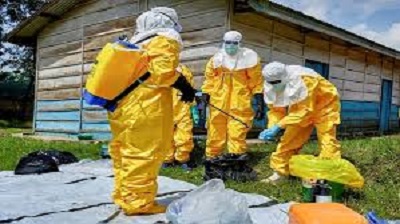
More than 250 people exposed to Ebola have joined a clinical trial in eastern Democratic Republic of Congo testing an experimental drug designed to prevent the disease from developing, as the country battles its deadliest outbreak of the virus.
The trial, being conducted in Ituri province, is testing obeldesivir, an antiviral developed by Gilead Sciences, among people who have recently had high-risk contact with someone infected with the Bundibugyo strain of Ebola. The drug is being studied as post-exposure prophylaxis, meaning it is given before symptoms appear.
The EBO-PEP trial began enrolling participants in July and aims to recruit 998 people aged 12 and above. Participants are randomly assigned to receive either obeldesivir or a placebo and are monitored closely for signs of illness.
The trial comes as Congo struggles to contain an outbreak that has spread across seven provinces. Government data reported more than 8,300 confirmed cases and 4,018 deaths by early October, making it the largest and deadliest Ebola outbreak recorded in the country.
The Bundibugyo virus is particularly challenging because there is currently no approved vaccine or treatment specifically for the strain. The World Health Organization declared the outbreak a public health emergency of international concern in May and has warned of the risk of further regional spread.
For people who have been exposed, the uncertainty can be especially difficult. One participant in the trial, whose identity was withheld for privacy, said she enrolled after her husband contracted Ebola and she had been in direct contact with him.
“I could have also passed on this contagious disease. I could have been contaminated,” she said.
Researchers say the trial could help determine whether an antiviral intervention can interrupt chains of transmission by protecting people before they become ill.
“If the pill proves effective, it could help break the infection chain,” said Dr. Guilavogui Jean Paul Yassa, a research coordinator with ALIMA, which is coordinating the study.
The research is being conducted with Congo’s National Institute of Biomedical Research and France’s ANRS Emerging Infectious Diseases.
Researchers face logistical and emotional challenges, including difficulty keeping participants engaged when relatives die from Ebola and reaching people who live far from the trial centre.
Despite those obstacles, investigators say the study could provide critical evidence for responding to future outbreaks of the Bundibugyo virus.