Rwanda’s inflation is climbing back toward levels last seen during the 2022–2023 price crisis, when annual headline inflation soared past 19 percent before crashing to under 2 percent in 2024.
For the seventh month in role, prices of goods and services in Rwanda have accelerated,, meaning the cost of living is not just high, it is rising faster each month.
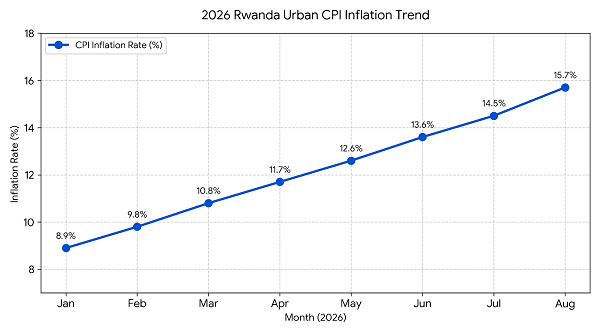
Inflation has climbed to 15.7 percent in August 2026, up from 14.5 percent in July, according to new data released by the National Institute of Statistics of Rwanda (NISR).
“Rwanda’s inflation is climbing back toward levels last seen during the 2022–2023 price crisis, when annual inflation soared past 19 percent before crashing to under 2 percent in 2024.”
NISR figures released on September 10, 2026 show inflation has been on a steady climb through 2026: from 8.9 percent in January, to 14.5 percent in July, to 15.7 percent in August.
The rise follows a sharp swing in recent years, when it spiked above 19 percent in 2023, and fell to fewer than 2 percent in 2024, then began climbing again through 2025 and into 2026.
Energy prices are the standout figure in this month’s report, rising 45.4 percent from a year earlier, by far the biggest increase among the categories tracked by NISR.
Transport costs rose 24.2 percent, while housing, water, electricity and gas increased 20.4 percent.
Petrol prices had already begun climbing earlier in the year, rising from Rwf1,989 to Rwf2,303 a litre in April 2026. That increase helps explain the sharp rise now showing up in the annual energy figure.
Read More: RURA Raises Fuel Prices, Transport Fares as Motorists Report Shortages at the Pump
Food and non-alcoholic beverages rose 16.3 percent over the year. Fresh produce, vegetables and fruit were also under pressure, rising 5.8 percent in a single month, the biggest monthly increase among the categories tracked by NISR.
In Kayonza District, market seller Eric Uwamungu said customers are already feeling the difference.
Cooking oil, he said, has risen from Rwf900 to Rwf1,200. Beans went from Rwf800–900 to about Rwf1,000 a kilogram, while plantains have also become more expensive as the dry season cuts into local supplies. Sugar is among the few staples whose price has remained fairly steady, at between Rwf1,500 and Rwf1,600.
For small retailers like Uwamungu, the pressure starts further up the supply chain.
“Those of us buying from wholesalers are feeling the squeeze because their prices went up too,” he said. “Wholesalers have to protect their margins, and they’re mostly passing down the higher transport costs caused by recent fuel price hikes at the pump.”
Prices of locally produced goods rose 17.4 percent over the year, compared with 10.8 percent for imported goods. That is notable because when a currency weakens, imported goods often feel the pressure first. The latest figures instead point to rising costs within Rwanda’s own food and production chains, rather than global prices alone.
Even after excluding fresh food and energy, two of the most volatile categories, underlying inflation stood at 11.5 percent. That suggests the increase is not limited entirely to fuel and food, although those categories are pushing the headline figure higher.
The central bank has already responded to the inflation pressure. On August 26, it raised its key interest rate to 8.75 percent, the third increase this year and the highest level since 2009.
Governor Soraya Hakuziyaremye said the rate increase was intended to curb inflationary pressures and help bring inflation back towards the bank’s target range.
The rate had also been raised in February and May, bringing the total increase since November 2025 to 175 basis points.
The bank expected inflation to ease gradually, with its earlier forecast putting average inflation at 13.1 percent for 2026 and about 7.9 percent in 2027.