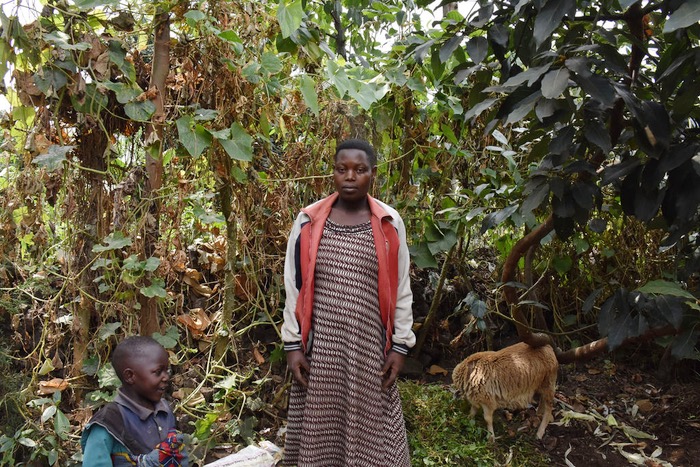
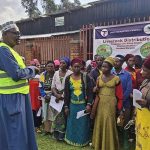
As a sheep and its young lamb entered her compound in Rugi Village, Kinigi Sector, Musanze District, Nyirambonega Leofirida could hardly believe what she was seeing.
An elderly widow whose husband died 32 years ago, Nyirambonega had watched several of her neighbors receive free livestock but local leaders had informed her that she was among the families selected in the next phase, she remained uncertain.
Her uncertainty turned into overwhelming joy one morning, when volunteers finally arrived at her doorstep. The livestock from Zakat Foundation of America were delivered by volunteers from Abdullah Kiromba Foundation (AKF).
Nyirambonega burst into laughter, clapped her hands repeatedly and tightly embraced everyone around her, unable to contain her emotions. For her, the sheep represent much more than livestock—they symbolized hope, dignity and the opportunity to rebuild her livelihood after decades of hardship.
“I don’t know what to say because I am overwhelmed by this compassionate act,” she said. “May God reward everyone who has given me these sheep. I will take good care of them, and when they produce, I will gladly pass one on to another family in need.”
Living alone after losing her husband, Nyirambonega has relied on occasional casual work to survive. She believes the animals will become the foundation of a more secure livelihood.
“I enjoy caring for livestock,” she says. “I know these sheep can change my life if I look after them well.”
Nyirambonega was among 100 vulnerable households that recently received sheep from AKF through the support of the Zakat Foundation of America during the second phase of the livestock distribution program in Kinigi Sector. The beneficiaries are additional to the families that received sheep’s during first distribution earlier this year, when 124 sheep were distributed to 62 households.
Rather than providing short-term relief, the initiative seeks to give vulnerable families productive assets capable of generating income, improving food security and strengthening household resilience. The sheep also provide manure that can increase agricultural productivity, particularly for households with kitchen gardens and small farms.
For Uwineza Beatrice, receiving two sheep marked the first time her young family had ever owned livestock.
Living with her husband, their five-year-old daughter and expecting another child, the family has struggled to make ends meet. Her husband earns a modest income transporting passengers and goods using a rented bicycle, while Uwineza grows vegetables around their home whenever conditions allow.
“We have never owned livestock before,” she said. “Life has not been easy because we have very little land and buying fertilizer is expensive. These sheep have given us hope.”
Uwineza plans to use manure from the sheep to improve her vegetable garden
“With organic manure, I believe our harvests will increase,” she explained. “If we produce more vegetables, we can eat better and sell the surplus to earn some income. When the sheep multiply, they will also help us meet other household needs.”
Another beneficiary, Uwizeyimana Marie Louise, sees the livestock as an investment in her children’s future.
The single mother, who is raising two children, said she intends to rear the sheep carefully so they can multiply over time.
“I like sheep very much,” she said with a smile. “I believe they will help me educate my children. Whenever financial challenges arise, I will have something valuable that can support my family.”
Uwizeyimana Marie Louise believes the sheep will support in the education of her children
The success of the program depends not only on the generosity of donors but also on strong community involvement.
According to Jean Damascene Munyarusisiro, a local leader in Rutindo Village in Kampanga Cell says they work closely with residents to identify the most vulnerable households.
Priority is given to widows, elderly people, persons living with disabilities and families experiencing extreme poverty. The proposed beneficiaries are first identified through community clusters (Isibo), before the names are reviewed by village, cell and sector authorities respectively.
“Our work continues even after the livestock has been distributed,” Munyarusisiro explained. “We monitor the animals, advise beneficiaries on proper care and work with veterinary officers from the sector office whenever treatment is needed. We also remind families about the importance of passing on the offspring so another household can benefit.”
The livestock are vaccinated before distribution, while beneficiaries continue receiving technical support from veterinary officers to ensure the animals remain healthy.
Speaking during the distribution exercise, Haji Higiro Issa, Guardian of the Abdullah Kiromba Foundation, encouraged beneficiaries to view the sheep as an opportunity to build lasting livelihoods rather than as a one-time donation.
“These sheep are meant to improve household income, strengthen food security and support farming through the use of organic manure,” he said. “When they reproduce, we ask beneficiaries to remember another vulnerable family by passing on the first female offspring. That is how this program continues to grow.”
The latest distribution in Kinigi Sector builds on the first phase implemented in January and reflects the foundation’s commitment to reaching more vulnerable households in Musanze District through sustainable, community-driven solutions.
For families like Nyirambonega’s, the arrival of two sheep represents more than an act of charity. It is the beginning of a journey toward greater independence, resilience and hope.
As she gently led her new animals into their shelter, she paused for a moment and smiled.
“These sheep have brought happiness into my home,” she said. “One day, I will be the person giving another family the same opportunity I have received today.”
Since the program began in 2021, the Abdullah Kiromba Foundation (AKF) has distributed more than 1,000 livestock—including sheep, goats and cows—to vulnerable families across Rwanda. Supported by the Zakat Foundation of America, the initiative continues to expand its reach across northern and western Rwanda, helping households build sustainable livelihoods through livestock ownership. Beyond livestock distribution, the partnership also supports orphaned and vulnerable children through education, provides vocational skills training, improves access to health care, and assists Muslim communities during the holy month of Ramadan—strengthening families and building more self-reliant communities, one household at a time.