The Kenyan government has unveiled a sweeping KES 1.08 trillion ($8.3 billion) plan to overhaul its agricultural sector, promising to create more than two million jobs and shield the country’s food supply from climate shocks over the next five years.
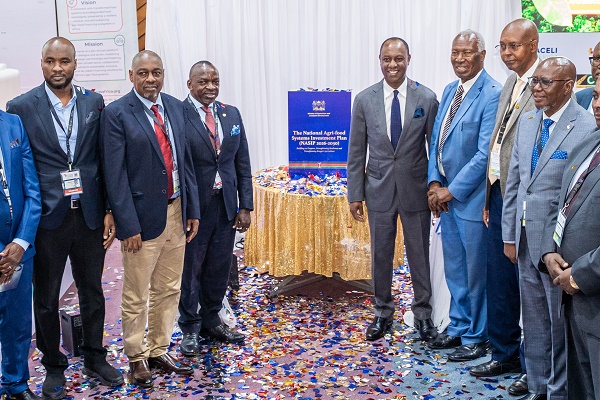
The National AGri-food Systems Investment Plan (NASIP 2026–2030) was launched at the Kenyatta International Convention Centre (KICC) in Nairobi during the opening of the third annual Financing AGRI-Food Systems Sustainably (FINAS) Summit.
Principal Secretary for Agriculture Jonathan Mueke, presenting the strategy on behalf of Cabinet Secretary Mutahi Kagwe, outlined a funding model that relies heavily on a mix of public and private capital.
Under the new framework, the Kenyan national government and county authorities will foot 35% of the bill. However, the success of the ambitious plan rests largely on the private sector, which is expected to provide 45% of the funding, with international development partners and bilateral donors making up the remaining 20%.
“At the heart of NASIP is a fully costed investment framework,” Mr. Mueke told delegates, before making a direct appeal to regional authorities. “I am calling on the commitment of the county governments, through the Council of Governors, to achieve this goal.”

Dr. Charity Mutegi (l) and Tharaka University Chancellor, Prof. Ratemo Michieka (c) presenting a gift to Livestock Development PS, Jonathan Mueke (r) during the opening ceremony of FINAS 2026 at KICC, Nairobi
A Pivotal Moment for African Agriculture
The launch coincides with a broader continental push to reform how Africa feeds itself. Delegates in Nairobi are grappling with how to implement the newly minted Kampala Strategy and Action Plan (2026–2035), an ambitious pan-African roadmap aimed at boosting sustainable food production, cutting trade barriers, and upgrading rural infrastructure.
For years, African agricultural policy has been criticized for producing high-minded declarations but little on-the-ground change. It is a frustration openly acknowledged by officials at the summit.
“Africa has no shortage of strategies or commitments,” said Prof. Hamadi Iddi Boga, Vice President for Programme Delivery at AGRA. “What is needed now is implementation at scale. We must move with urgency to translate the Kampala Declaration into practical investments, stronger institutions, and measurable outcomes.”
Historically, commercial banks have viewed small-scale farming as too risky for significant lending. The FINAS summit aims to change that by exploring “blended finance” models, using public funds or donor guarantees to de-risk private investment.
Diplomats and financial executives at the summit argued that any restructuring of agricultural finance must prioritize the smallholders who actually produce the bulk of the continent’s food.
“These systems should work for MSMEs and small-scale farmers to get financial support which works for them,” said Rashmi Pillai, CEO of FSD Kenya. “Together, let’s work towards building a system that truly works for Africa and let’s continue keeping farmers at the center of the conversations.”
International partners echoed the sentiment, noting that public money must be used to pave the way for private markets. Maren Kneller, Head of Development Cooperation at the German Embassy, emphasized that governments must focus on “creating enabling environments that reduce risk, attract capital, and accelerate innovation.” Meanwhile, Ireland’s Ambassador to Kenya, Caitríona Ingoldsby, reiterated Dublin’s commitment to funding inclusive partnerships across the sector.
Whether Kenya can successfully mobilize the trillion-shilling package remains to be seen, but organizers insist the tone of the conversation has fundamentally shifted.
According to Dr. Charity Mutegi, the Director of the FINAS Summit, the event’s focus has evolved from merely identifying systemic bottlenecks in 2024 to establishing a concrete, private-sector-led agricultural finance working group this year.
As the summit continues, delegates will use data tools from the World Bank and the UN’s Food and Agriculture Organization (FAO) to pinpoint exactly where current funding falls short, and where Kenya’s new trillion-shilling windfall needs to go first.
About FINAS
The Financing Agri-Food Systems Sustainably (FINAS) Summit is a leading continental platform focused on advancing sustainable financing solutions for Africa’s agri-food systems. Since its inception, FINAS has convened over 3,000 stakeholders across government, finance, development, and the private sector, evolving from identifying structural financing challenges (FINAS 2024) to aligning stakeholders around solutions (FINAS 2025), and now to driving implementation and investment outcomes (FINAS 2026).
Hosted in Nairobi, a strategic hub for policy, finance, and innovation in Africa, the summit serves as a catalyst for the partnerships, commitments, and systemic changes needed to transform how Africa’s food systems are financed. For more information, visit [https://finasafrica.org/].