Hundreds of Muslims from Kabarore Sector in Gatsibo District, gathered on Sunday to celebrate Eid al-Fitr, marking the end of the holy month of Ramadan, a time of fasting, prayer, and reflection.
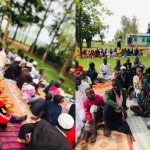
The colorful and festive occasion saw families, friends, and relatives travel long distances to attend prayers at grounds near the main Mosque in Kabarore town. Many had to come here as the only available place to hold the prayers, since mosques in the area were closed following due regulations introduced by government.
Throughout Ramadan, Muslims fast from dawn until dusk, abstaining from food and drink during daylight hours. They begin their fast with a pre-sunrise meal and break it at sunset with iftar.
Mustapha Muvunyi, the head Muslims in Gatsibo District leading the prayers said that, Eid Al-Fitr said is a special day for Muslim devotees, a blessed and peaceful day when we celebrate the day of breaking the fast.
He said that fasting also known as Sawm, is one of the Five Pillars of Islam and is observed by Muslims worldwide as an act of devotion, self-discipline, and spiritual purification.
“Fasting is not a punishment but commandment so that we can fear and be closer to Allah. Fasting also helps to fullfill the pillars of Islam,” Imam Muvunyi said.
The end of Ramadan is a moment of joy, gratitude, and community, and in Kabarore, worshippers marked the occasion with prayers, gift-giving, and shared meals. Elders distributed gifts to younger family members as a symbol of goodwill, while prayers were conducted in an open space around the mosque.
Many attendees walked for miles, while others used bicycles or motorbikes to reach Kabarore. Among them was Abdul Karim Ndahimana from Gatoki Village, who trekked 7 kilometers to join fellow worshippers.
“I came all the way from Gatoki Cell to pray and celebrate Eid al-Fitr,” he said, his face beaming with joy. “The journey was long, but it was worth it to join my fellow Muslims in prayer and give thanks to Allah for granting us the strength to complete Ramadan.”
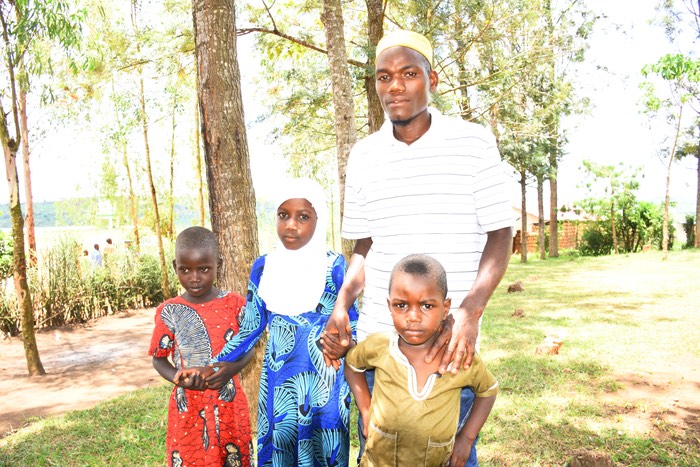
Abdul Karim Ndahimana with his children on Eid al-Fitr in Gatoki Village
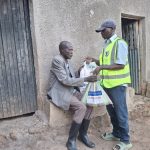
Ndahimana also expressed gratitude to the Abdullah Kiromba Foundation for supporting families, including his own with food rations and support his mosque to prepare meals throughout Ramadan. He emphasized the importance of community and togetherness, saying, “Eid is a time of unity and reflection. Coming together like this is a blessing, and it fills my heart with happiness.”
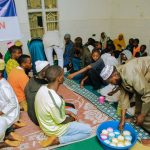
The Muslim community in Gatoki village prepared a communal Eid al-Fitr feast, ensuring that everyone could join in the joyous celebrations. This event was made possible with support from the Zakat Foundation of America through the Abdullah Kiromba Foundation.
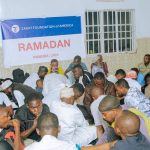
“We are grateful to the Abdullah Kiromba Foundation for their support throughout Ramadan,” said Ndahimana, the vice Imam, who is also a farmer, husband, and father. “They made arrangements for us to gather every evening for prayers and to break our fast together. Thanks to their assistance, our children also have the opportunity to come to the mosque and study the Quran.”
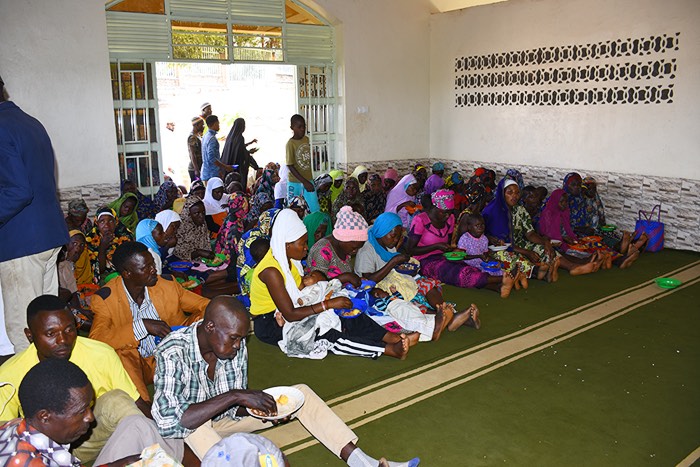
The Muslim community in Gatoki village prepared a communal Eid al-Fitr feast and everyone was invited to the joyous celebrations
However, Ndahimana highlighted a major challenge—the continued closure of the mosque in Gatoki village and other surrounding mosques. Authorities have only permitted the use of the facility for Quran studies and iftar gatherings during Ramadan.
Local Muslim officials have expressed concern over delays in evaluating the mosque’s compliance with regulatory requirements. They also pointed out that, despite being close to the district headquarters, the area lacks essential infrastructure such as electricity and water.
Across the country, Muslims gathered at various grounds for prayers to celebrate Eid al-Fitr. In a government announcement over the weekend, the Ministry of Public Service and Labour informed the public that due to Eid-al-Fitr held on Sunday, Monday 31, 2025 was declared a public holiday for both public employees and the private sector.