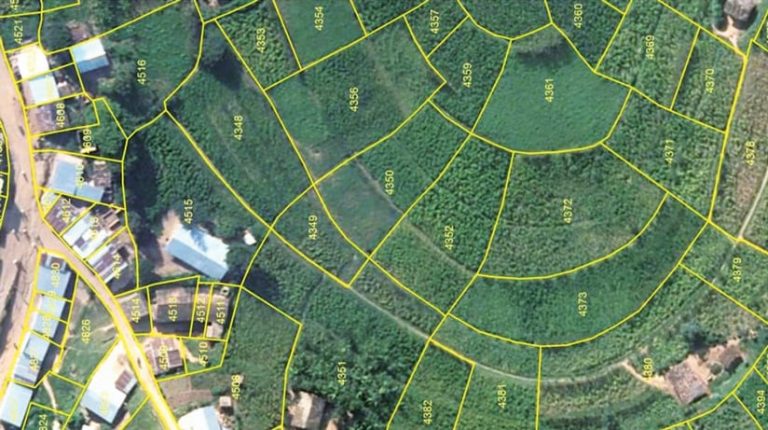
Rwanda’s National Land Authority (NLA) says a combination of staff shortages and recent land policy reforms has led to a backlog of more than 55,000 land service applications, but officials say the cases will be cleared within the first two months of 2026.
The delayed files involve land surveying, subdivision, registration and transfer services—key steps required for issuing land titles. NLA Director General and Chief Land Registrar Marie-Grâce Nishimwe said the authority has moved to boost capacity after demand outpaced available staff, particularly at the district level.
“We apologize to applicants for the delays they have experienced,” Nishimwe told reporters Monday. “We have taken concrete measures to strengthen service delivery and are confident that all pending files will be completed within the first two months of 2026.”
As part of the response, the NLA is deploying about 100 private-sector land notaries and survey professionals to work alongside government staff, in partnership with the Private Sector Federation. In many districts, land services are currently handled by only one or two public officers, officials said.
Despite the backlog, the authority said it processed 864,425 land-related files in 2025, including land transfers, registrations and surveys. Applicants can track the status of their files through the online Lands platform.
Some residents say the delays have affected personal and commercial plans. “The services were taking too long,” said Justin Bizimungu, who applied to subdivide land in July 2025. “We are encouraged to hear that the process is now being fast-tracked.”
Officials and private surveyors point to policy changes as a major driver of the surge in applications. Rwanda’s revised land law adopted in 2021 allows the subdivision of agricultural land, including plots smaller than one hectare. Under the previous 2013 law, such subdivisions were prohibited.
Janvier Bikorimana, a private land surveyor involved in clearing the backlog, said the reform led to a sharp rise in demand without a corresponding increase in public staffing. “People applied in large numbers to obtain land titles, especially for inherited land,” he said. “But in many districts there is only one officer handling these services, alongside other duties.”
The reforms followed the 2019 National Land Policy, which aimed to address long-standing demand related to inheritance and land transfers by allowing co-owners of agricultural land to obtain individual titles.
Nishimwe said the current law allows immediate registration of buyers of portions of agricultural land, but warned against subdividing farmland for construction purposes, which remains restricted.
Separately, the NLA has introduced new national guidelines for land surveying to improve boundary demarcation and reduce disputes. The government aims to fully resolve land boundary correction cases nationwide by 2027, with faster and more standardized surveying at the core of that effort.