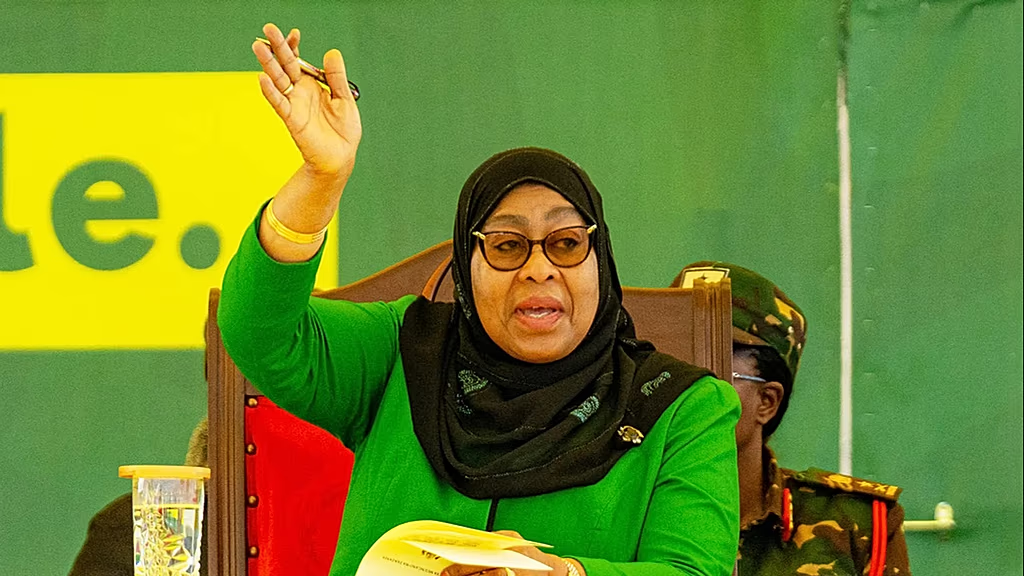
Tanzania’s electoral commission has declared on Saturday that President Samia Suluhu Hassan has won the country’s disputed election with nearly 98 per cent votes.
The result is likely to amplify the concerns of critics, and opposition groups who said the election in Tanzania was less a contest than a coronation after Ms Hassan’s two main rivals were barred or prevented from running.
She faced 16 candidates from smaller parties.
The October 29 election was marred by violence as demonstrators took to the streets of major cities on Wednesday, to protest against the vote and stop the counting of ballots. Others went as far as tearing down banners of Ms. Hassan, setting fire on government buildings and police fired tear gas and gunshots, according to eyewitnesses.
The military has been deployed to help police quell riots. Internet connectivity has been on and off, disrupting travel and other activities.
The protests have spread across Tanzania, and the government postponed the reopening of schools and universities, which had been set for November 3.
Eye witnesses said that there was a tense calm in the streets of Dar es Salaam, the commercial capital, on Saturday. Security forces manning roadblocks asked to see the identity cards of those who went out.
Tanzania main opposition party said on Friday that hundreds of people had been killed in the protest, while the UN human rights office, Seif Magango, told a UN briefing in Geneva by video from Kenya that credible reports of 10 deaths were reported in Dar es Salaam, alongside Shinyanga and Morogoro towns.
The government has dismissed the opposition death toll as “largely exaggerated” and has rejected criticism of its human rights record.
Tundu Lissu, leader of the Chadema opposition group, was jailed for months, charged with treason after he called for electoral reforms that he said were a prerequisite for free and fair elections.
Another opposition figure, Luhaga Mpina of the ACT-Wazalendo group, was barred from running.
Chama Cha Mapinduzi, or CCM, party has for decades-long maintained a firm grip on power despite the emergence of charismatic opposition figures who have sought to steer the country towards political change.
Tanzania’s political manoeuvring is drawing attention, even in a country where single-party dominance has been the norm since multi-party politics were introduced in 1992.
Critics say President Samia Suluhu Hassan has taken a more authoritarian approach than her predecessors, a contrast to youth-led democracy movements elsewhere in the region.
Yet Tanzania remains an outlier. The ruling Chama Cha Mapinduzi (CCM) party, which maintains links with China’s Communist Party, has been in power since independence from Britain in 1961. The party’s close ties to state institutions and a predictable leadership succession—new leaders emerge roughly every five to ten years—have helped secure its long-term influence.
Ms Hassan rose to the presidency smoothly following the sudden death of John Pombe Magufuli early in his second term, reinforcing Tanzania’s reputation for political stability. The orderly transition and CCM’s entrenched support, particularly in rural areas, continue to underpin its dominance across the country.