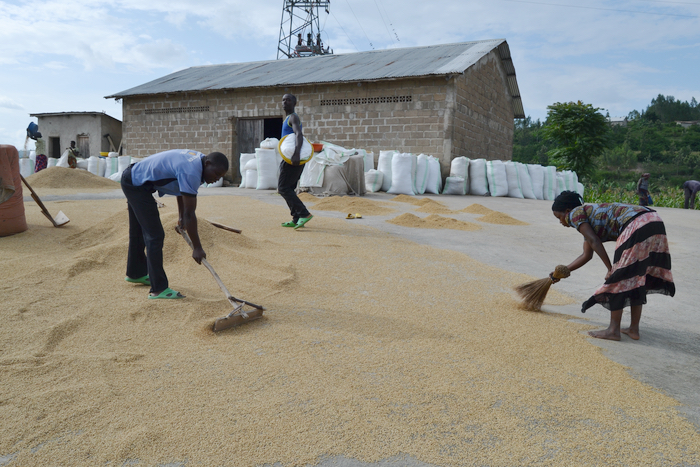
Rice farming is increasingly shaping rural prosperity, driven by a strong partnership between farmers and Kirehe Rice Company Ltd (KRC) in Rwanda’s Eastern Province. As national demand for rice continues to rise, the company is playing a central role in strengthening farmer incomes while contributing to the country’s food security ambitions.
Established in April 2012 by the Government of Rwanda, KRC was created to mill paddy produced in the marshlands of Kirehe and neighboring Ngoma district. The factory began operations in 2013 with a clear mandate: organize rice production, improve quality, and provide a reliable market for farmers cultivating the wetlands in the area as provided under the National Land Policy.
“The factory was built to support rice farmers with a guaranteed market and better incomes,” said Emmanuel Niyirora, Managing Director of Kirehe Rice Company. “Today, our biggest challenge is keeping up with demand rather than finding buyers.”
When government embarked on a broader privatization drive aimed at returning state-established enterprises to the people most directly involved in their operations, KRC was progressively opened to farmer cooperatives and other stakeholders. This ensured that farmers through their organizations became shareholders alongside institutional investors. This transition strengthened local ownership, accountability, and long-term sustainability.
Currently, ENAS (ETS Nkubiri Alfred & Sons) holds a 55 percent stake in the company, while the Agaciro Development Fund owns 30 percent. Farmer cooperatives collectively hold the remaining shares, led by COOPRIKI-CYUNUZI with a 10 percent stake. ISABANE and MUSHIKIRI Rice Growers Cooperatives each own two percent, while CORIMU Kirehe holds one percent—anchoring farmers directly within the rice value chain.
According to the Manager, farmer ownership marked a turning point. “Once cooperatives became shareholders, they became true partners—committed to improving efficiency, quality, and productivity.”
Today, KRC works with cooperatives representing about 8,000 rice farmers across Kirehe and Ngoma districts. Over two harvest seasons each year, these cooperatives earn an estimated 2 billion Rwandan francs per season, supporting household needs such as education, health insurance, and food security.
Beyond milling, KRC supports farmers through advance payments and input financing, enabling access to fertilizers and seeds without dependence on commercial bank loans. Repayments are made after harvest when paddy is delivered to the factory.
Annual production currently stands between 7,000 and 7,500 tonnes of paddy rice. Kirehe Rice supplies to local markets, major urban centers including Kigali, and government- supported school feeding programs across Kirehe, Ngoma, Kayonza and Bugesera districts.
Demand, however, continues to outpace supply. “Our rice is well accepted by consumers, and stocks often run out within weeks after each season,” Niyirora notes.
To bridge this gap, the company is working closely with agronomists and cooperatives to increase yields from an average of six to nine tonnes per hectare. Kirehe Rice is also collaborating with district authorities to secure an additional 250 hectares for cultivation and promote productive use of underutilized wetlands in line with national policy.
With Rwanda producing less than 40 percent of its domestic rice needs, expanding local production remains critical. Kirehe Rice Company mills both short-grain (kigori rice) and long-grain varieties, while ongoing research explores improved seed types comparable to imported rice.
Certified with Rwanda’s Standards Mark, the company plans to scale up production to 12,000 tonnes annually. Also, research into fast- maturing varieties could further enable three production cycles per year, boosting output and farmer incomes.
Looking ahead, Kirehe Rice Company is pursuing diversification projects to enhance sustainability and value addition, including recycling rice husks into modern charcoal and producing animal feed from rice by-products.
“For farmers in this region, rice is more than a crop—it is a reliable livelihood,” Niyirora said. “Our growth is anchored in partnership, ensuring farmers benefit first while helping Rwanda meet its growing rice demand.”