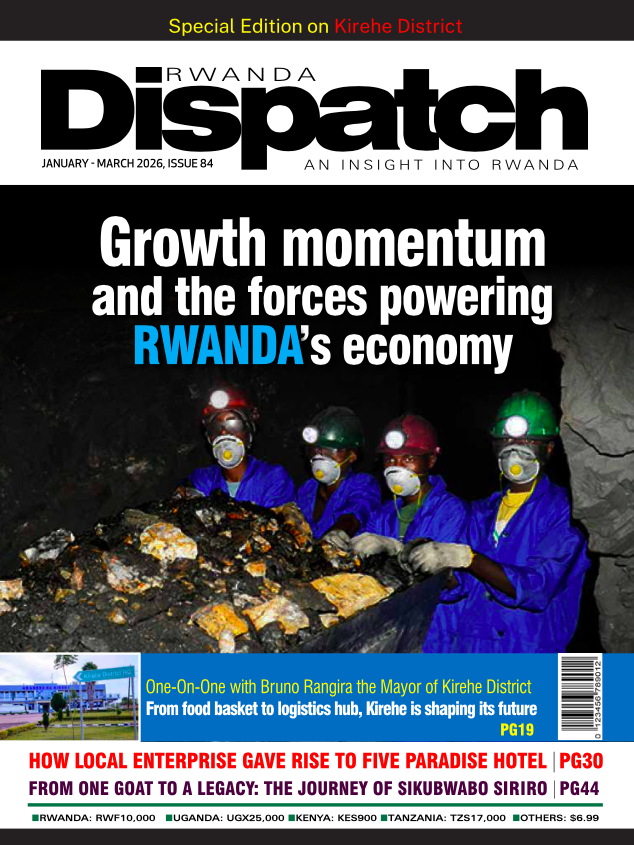
Notably, Rwanda’s strong economic performance in 2025 reflects a steadfast growth trajectory, rising from 6.5% in Q1 and 7.8% in Q2 to 11.8% in Q3. This momentum has kept the country in global headlines, maintaining its position among the ten fastest-growing economies in Africa.
Rwanda’s economic performance mostly in the services, industry and agriculture sectors has driven overall growth to nearly 12%, well above the 2025 projections of the African Development Bank (AfDB) of 7.1% for Rwanda and 5% for EAC member countries. The economy also outperformed the Ministry of Finance’s projections of 7.1% for 2025 and 7.5% for 2026.
These gains tell a compelling story of resilience and recovery, with GDP growth reaching 11.8% in Q3 2025, according to a report released by the National Institute of Statistics of Rwanda (NISR) in mid-December last year.
“In the third quarter of 2025, GDP grew by 11.8 per cent following growth of 7.8 per cent in Q2 and 6.5 per cent in Q1,” said Ivan Murenzi, Director General of NISR, during a press briefing in Kigali on December 16.
This accelerated growth is largely attributed to increased strategic investment over recent years, marked by renewed momentum across all sectors in the post-COVID-19 period. Rwanda’s economic development trajectory would be incomplete without acknowledging the impact of expanded infrastructure development and sustained policy reforms.
At current market prices, GDP in Q3 2025 was estimated at Rwf 5.53 trillion, up from Rwf 4.66 trillion in the same period a year before, NISR reported.
Other fast-growing African economies, according to AfDB’s Macroeconomic Performance and Outlook Report released early last year, include South Sudan (34.4%), Senegal (8.6%), Uganda (7.2%), Niger (6.9%), Djibouti and Togo (6.9%), Ethiopia (6.6%), Benin (6.6%) and Côte d’Ivoire (6.3%).
Rwandans send a strong message to the world by celebrating this economic milestone, as the performance strengthens investor confidence and enhances the country’s image on the global stage.
In 1994, Rwanda’s GDP fell to its lowest levels, with annual GDP estimated at US$1.418 million, representing a contraction of 41.9%, and GDP per capita at US$223, a decline of 31.4%. The 1994 Genocide against the Tutsi claimed over one million lives and left the economy in ruins.
Economic Pillars 2025
Across all sectors, services, industry and agriculture remained the key drivers of growth. Services contributed 57% of GDP, industry 22%, agriculture 15%, while net taxes accounted for about 6%.
Industry, services and agriculture expanded by 17%, 10% and 10% respectively, with services remaining the largest contributor, according to the country’s Statistics body. Agriculture contributed 1.5 percentage points to overall growth, supported by notable increases in export crops production and fishing.
“Within agriculture, food crops production increased by 4%. The export crops production increased by 35%, livestock increased by 6% while fishing increased by 34%,” said Ivan Murenzi.
This trend signals improving living standards. According to the Labour Force Survey released by NISR in April 2025, agriculture employs 43.7% of the national workforce. With 69.1% of Rwanda’s estimated 13.2 million people (2022) engaged in agriculture, the sector continues to anchor livelihoods while fueling growth.
Progress toward food security has been driven by increased productivity and expanded cultivated land. The rise in food production during last year’s Season A reflects government and development partner efforts, including adoption of improved agricultural practices, land consolidation, irrigation and climate-resilient approaches, alongside mass awareness campaigns on improved seeds and fertilizers.
Total food production reached 6.16 million metric tonnes in Season A, up from 5.95 million metric tonnes in 2024, a 3.6% increase. Cultivated land expanded by more than 50,000 hectares, with the total area under cultivation reaching 1.483 million hectares, up from 1.428 million hectares, representing a 3.9% increase, according to the Seasonal Agricultural Survey (SAS) published in 2025.
This momentum aligns with Rwanda’s Vision 2050 ambition to attain upper-middle-income status by 2035 and high-income status by 2050. It also provided the backdrop for hosting the 6th Eastern Africa Farmers Federation (EAFF) Congress and Exhibition in Kigali from September 30 to October 2, 2025. The event attracted over 200 delegates, more than 20 exhibitors and high-level stakeholders from around the world.
NISR ranked agriculture as the country’s top employer in the first quarter of 2025. National unemployment declined to 11.1% from 12.9% a year earlier, while the employment-to-population ratio rose to 56% and labour force participation increased by two percentage points.
In the Eastern Province, Kirehe District has benefited significantly from government initiatives, particularly solar-powered irrigation systems. Once plagued by drought and food shortages, the district has expanded cultivated land through new irrigation technologies, including the Pipe Flow system launched in February 2025. More than 2,000 farmers in Musaza, Nasho and Mpanga sectors have seen improved livelihoods following the development of Nasho Farm, which spans over 1,173 hectares.
Musaza now has over 80 hectares under irrigation, while Mpanga has reached 659 hectares. Vice Mayor for Economic Development Modeste Nzirabatinya says irrigation has reversed migration and poverty trends.
“In Musaza and Gicuma, where irrigation was previously lacking, there has been notable progress. Many families who had fled due to food shortages have returned after gaining access to irrigation. We plan to increase the irrigated area by at least 40 hectares to help residents thrive and prosper,” Nzirabatinya said.
District authorities also announced that two irrigation projects in Muhama Sector—Mahama I and Mahama II—covering a combined 3,000 hectares, are under construction and expected to be completed by the end of 2025.
Industry
Industry grew by 17%, contributing 3.7 percentage points to GDP growth. Manufacturing recorded a 44% increase, largely driven by higher cement production in non-metallic minerals. Metal products rose by 28%, chemicals by 25%, and food processing by 12%. The government attributes this growth to the country’s development drive and sustained demand for construction materials.
Services
The services sector grew by 10%, contributing 5.5 percentage points to GDP growth. Wholesale and retail trade expanded by 20%, while information and communication grew by 17%. Financial services, public administration, transport and education recorded growth of 10%, 7%, 9% and 5% respectively.
Health
Although health services declined by 16%, government intensified efforts to strengthen the sector. The Ministry of Health launched the fifth Health Sector Strategic Plan (HSSP V) earlier in 2025, aimed at accelerating progress toward universal health coverage by 2030.
Aligned with Vision 2050, the National Strategy for Transformation 2 and the UN Sustainable Development Goals, HSSP V is built on extensive sector analysis and lessons from the COVID-19 response.
“HSSP V is structured around five strategic pillars and two enabling factors, encompassing 24 strategic objectives, 138 interventions and 44 priority areas. Progress will be measured using 38 key performance indicators,” the Ministry said.
Overall, 2025 stood-out as a year of tangible progress, marked by strong performance across services, agriculture and industry, reinforcing Rwanda’s path toward sustained and inclusive economic growth.