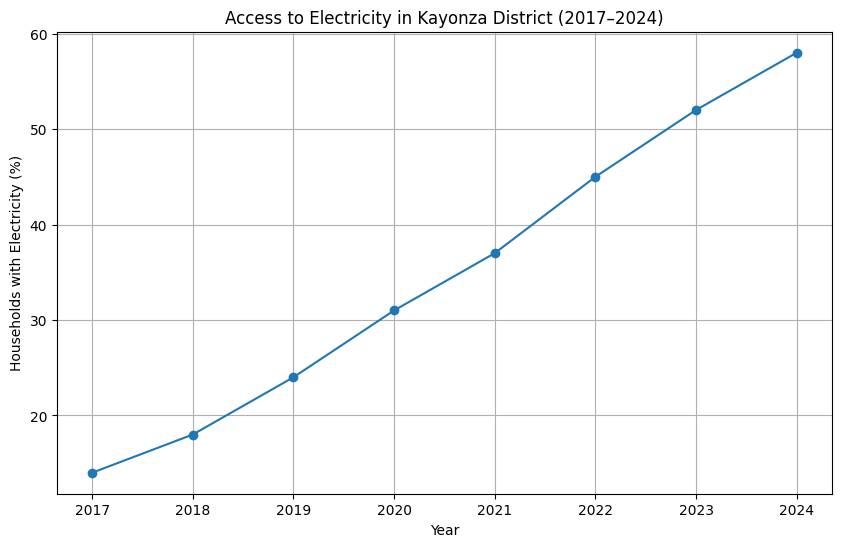
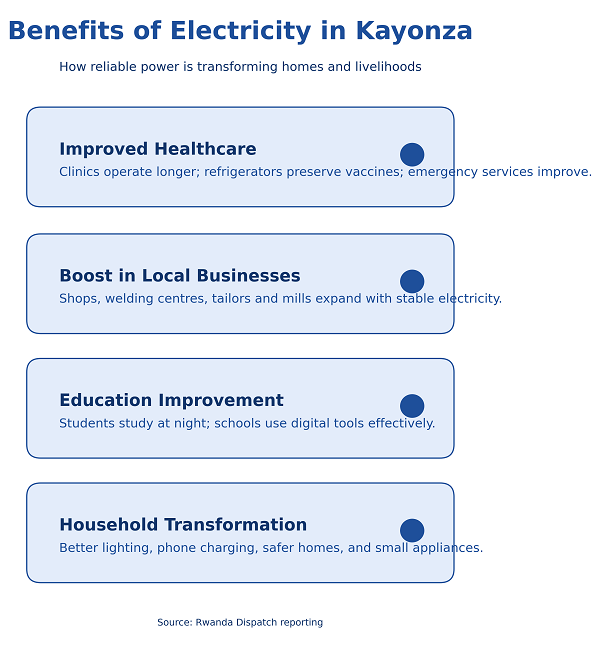
When the sun dips behind the Akagera hills, Kayonza’s rural landscape no longer falls into darkness. Today, faint glows from newly powered village centers, homes and shops stretch along the dusty paths of Mwiri, Ruramira and Ndego sectors, a quiet revolution powered by electricity that was once a distant dream.
Four years ago, most families in these villages relied on candles, kerosene lamps and charcoal stoves. Nights were short, children’s studies cut off by the flaming light, and small businesses closed at sunset. But thanks to Rwanda’s ambitious drive to expand rural electrification, which has begun to change dramatically.
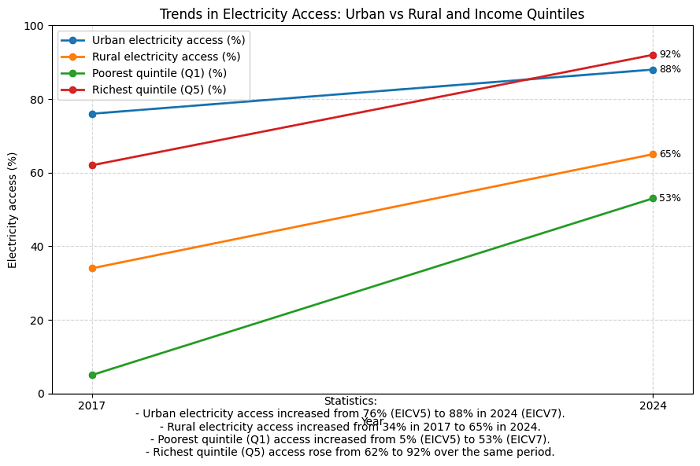
According to the Seventh Integrated Household Living Condition Survey (EICV7) released by the National Institute of Statistics of Rwanda (NISR), access to electricity has grown rapidly, jumping from 34 per cent in 2017 to 72 per cent in 2024.
Source: NISR EICV7 Report
This increase represents a significant increase in household electrification over the last seven years whereby 50 per cent were connected to national grid and 22 per cent relying on standalone solar systems.
According to the data from survey, 24 per cent of the rural households had electricity in 2017, by 2024, that figure had increased to 65 per cent indicating a substantial improvement in rural electrification efforts.
Additionally, access to electricity in poorest quartile increased from 9 per cent to 53 per cent, highlighting the inclusivity of electricity program.
Source:NISR EICV7 Report
EICV7 indicated that half of households are now connected to the national grid, while 22 per cent rely on standalone solar systems.
Electricity access in Rwanda more than quadrupled in the last 7 years as more household got connected.
Source:NISR EICV7 Report
In Byimana Cell, Ndego Sector in Kayonza District, 36-year-old shop owner Grace Mukashema remembers when her kiosk would close by 6 p.m. “We used candles to light the shop. Customers didn’t stay long because it was dark and smoky,” she recalls with a smile. “Now, with electricity, I can keep the shop open and make more sales in the evening, now its more than Rwf.10,000 a day.”
Her earnings have doubled since the power connection. With a small refrigerator humming in the corner, Grace now sells milk, soft drinks, and even phone charging services to her neighbors. “Electricity didn’t just change my business, it changed how we live, my children can read at night, do their homework and we can also watch television,” she told Rwanda Dispatch.
Just a few kilometers away in Kageyo sector, Jean Claude Ndengeyingoma, 26, is busy giving his customer a haircut. A small 14-iche television is entertaining other customers who are waiting on the bench.
“Electricity is not only about running economic opportunities, but security, health and education. As you can see in this trading center, life was different a few years ago, we used to be cut off from the rest of the world, but that has changed, everyone is busy, we can now charge our phones.,” He noted
“I can receive around 15 customer’s day, making around around Rwf.3,000 to Rwf.4,000 from my small saloon business, even my evening feels longer and more peaceful,” Ndengeyingoma said.
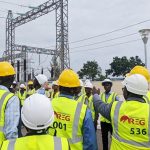
Rwanda Electricity Group worker performs installation work high on an electric poleo: Photo by REG
In these rural communities electricity has not only illuminated homes but also revived small scale enterprises. In Marama Sector, a cooperative of teen mothers and women tailors runs electric sewing machines, producing uniforms for nearby schools, and making “Ibitengi dresses”, from African wax print fabric for other village women.
Ingabire, a teen mother (prefers to use a single name) in her early 20’s says that, after dropping out of school due to motherhood, the future became hard, but she joined a tailoring course and learned to use both electric and mechanical sewing machines. For her it’s a way she is building life.
“Access to electricity has made my work easier and more productive, before the trading center was connected to the grid, we relied on hand operated sewing machines that slowed our work,” she explained.
“We’re now faster and even take on more orders,” she says proudly displaying a finished dress.
Apart from economic opportunities, electricity in such rural communities has also improved life. Health centers have also seen a change like Rwinkwavu Health Post, once dependent on solar panels and a generator four years ago, now operatives with a reliable power line.
Rwinkwavu Health Post: Courtesy photo
“Equipment sterilization, lighting during night deliveries, refrigeration’s for vaccines have become routine. Reliable electricity has improved patient safety and service delivery,” says head nurse Christine Umurerwa.
Access to electricity is one of the key targeted development boosters by the Government, according to Rwanda Energy Group (REG). The current target, dubbed 7-5-2, stipulates a 100 per cent access to electricity in Rwanda in 7 years.
REG adds that currently, 36.5 per cent of households in the Eastern Province have access to electricity, including 24.5 connected to the national grid and 12 per cent using off-grid solutions. Through a Tunisian contracting company, STEG, under BEEARP project, 8104 are currently being connected to electricity in Eastern Province. Stringing works are over preceding the last step to connect house by house.
At the REG office branch in Kayonza, Jane Masharazi, a customer service officer, explains how the connection process works for local homes and small businesses. “Once a household applies for an electricity connection, our technicians first conduct a site inspection to determine the nearest grid point,” she says.
“From there, cables are extended from the electric poles to the customer’s premises, and a cashpower meter box is installed to monitor usage.” She adds that residents can buy prepaid electricity, through mobile money or agents in their neighborhoods.
“Many families now purchase meters in small installments depending on their income,” she notes. “It gives them flexibility to manage their consumption and stay connected throughout the month.”
Residents in Ndego Sector access electricity in their households
Rwanda has achieved a remarkable increase in electricity access in the past 20 years from 6.2 per cent of the population in 2000, to approximately 82.2 percent in 2025. This shift is not just about convenience but part of a broader plan to boost rural productivity, education, and healthcare, which are key pillars in achieving the NST2 Vision 2050.
In July 2025, the African Development Bank Group approved €173.84 million for Rwanda’s Energy Sector Result-Based Financing (RBF II) program, with an extra €86.92 million from the Asian Infrastructure Investment Bank, bringing the total to €260.76 million. The project aims to modernize nation’s electricity network, expand access to clean energy, and strengthen institutional capacity under the Energy Sector Strategic Plan (2024–2029).
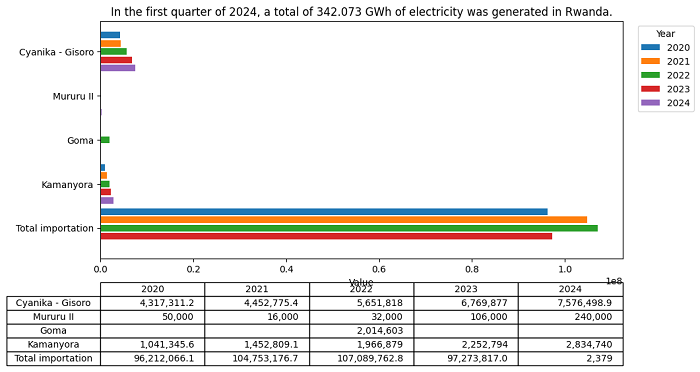
Compared to the similar quarter in 2023, the total electricity generated in the first quarter of 2024 had increased by 13.3%, reflecting the growth of the energy sector in Rwanda. Source: EICV7 Report
This initiative is expected to connect more 200,000 households and 850 businesses to the grid, add 50,000 off-grid connections, and provide clean cooking solutions to 100,000 households and 310 public institutions, alongside 200 km of new street lighting.
This aligns with the Bank’s High-5 priorities to “Light up and Power Africa” and contributes to the Mission 300 Initiative, which seeks to connect 300 million Africans to electricity by 2030.
However, energy experts warn that meeting future demand will require greater effort investments and generation capacity.
And yet, some challenges remain. Some families still struggle to afford connection fees, while others face occasional electricity outages and increase in electricity tariffs. That is affecting commodity prices and business budgets.
To bridge the gap, initiatives such as Ubudehe-based subsidies and community solar mini-grids were introduced to ensure that even the poorest households are not left in the dark.
According to Minister of Finance and Economic Planning Yusuf Muragwa, more than RWF 440 billion is needed in energy sector to meet the rising demand driven by the industrial sector.
“Government made investments in energy generation to increase supply but it’s not enough,” he noted adding, “In the next five years, we need to invest more to reach the universal access target for households to meet the growing demand.”
While government targets to reach 100 per cent household access by 2029, currently, about 400 megawatts of electricity is generated in the Rwanda, but in the next five years, it will need 1,000 megawatts to meet the energy demand for industries, an expansion estimated to cost around US$1billion.
The NISR Energy Access trend Report (2024) show that average household electricity consumption rose from 32kw per month in 2019 to 53kw in 2024., driven by increased household appliance ownership and small business activity, this has increased pressure on national generation capacity.”
Source: EICV 5 & 7 Report
Back in Kageyo sector, Ndengeyingoma like other residents, and shop owners in their villages are already feeling the difference. Homes glow well into the evening, children study under bright lights, and small businesses hum with activity long after sunset.
As Rwanda lights up its rural heartlands, it is not only wiring homes, it is powering hope, economic opportunities, and the promise of a brighter tomorrow.