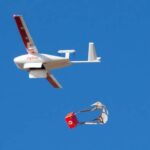
Uber Invests in Zipline to Bring Drone Deliveries to Uber Eats
American drone-delivery company Zipline has raised $1.5 billion at a valuation of $21.5 billion, nearly tripling its value from $7.6 billion about 10 months ago, as it expands its commercial operations in the United States.
But before the company secured major partnerships with Walmart and Uber, it established its first commercial delivery network in Rwanda, where it began transporting blood and other medical supplies to hospitals in October 2016.
Rwanda became the first country to operate Zipline’s national autonomous delivery service, providing the regulatory and healthcare environment that allowed the company to test its technology and build a commercial model at scale.
At the time, US aviation restrictions on flying drones beyond an operator’s visual line of sight made it difficult for Zipline to launch its commercial service in its home market. The California-based company therefore turned to overseas markets, with Rwanda becoming its first destination.
The partnership connected Zipline’s drone technology with Rwanda’s public healthcare system, allowing hospitals to order blood and other essential medical products for delivery, including to facilities that could be difficult to reach quickly by road.
Since then, the company has expanded its operations into Ghana, Nigeria, Kenya and Côte d’Ivoire, delivering blood, vaccines, medicines and other health products.
In February 2026, Rwanda and Zipline announced a further expansion of their partnership, aimed at achieving nationwide autonomous logistics coverage and establishing Africa’s first urban drone-delivery network.
The expansion includes plans for additional distribution infrastructure, an urban delivery network in Kigali and an autonomous delivery testing and research facility in Rwanda.
The company’s African operations have also received support through a separate $150 million US government pay-for-performance programme intended to expand its services on the continent. The funding is separate from the latest $1.5 billion investment round.
Zipline is now expanding beyond healthcare deliveries into food, retail products and other consumer purchases.
Walmart and Zipline have agreed to add 300 drone-delivery sites across the United States under an expanded multiyear partnership.
Uber has also invested in the latest funding round after agreeing to introduce Zipline’s autonomous delivery service to Uber Eats customers.
According to Zipline, Uber is targeting one million deliveries a day using its technology by 2029.
The latest funding round was led by Paradigm, WCM Investment Management and Layer Global, with participation from JPMorgan, Fidelity Management & Research, Tiger Global, ARK Invest and Salesforce Ventures.
Zipline plans to use the investment to expand its US manufacturing capacity, recruit more workers and develop a nationwide drone-delivery network.
The expansion puts the company in competition with Amazon and Alphabet’s Wing, which are also developing commercial drone-delivery services.
Zipline says it has completed 150 million autonomous commercial miles without a safety incident and that its medical deliveries help save more than 14,000 lives annually across several continents.
Despite its growing ambitions in the United States, Zipline continues to expand its African healthcare operations.
In September 2026, Côte d’Ivoire approved an eight-year public-private partnership to expand the company’s network from one distribution centre to 10.
The expanded network is expected to serve more than 2,200 health facilities and approximately 12 million people.
Zipline says its operations in the country have already delivered about two million vaccine doses and 20,500 units of blood products.
The company also maintains operations in Rwanda, Ghana, Nigeria and Kenya