Rwanda now lets girls as young as 15 get contraceptives without parental consent. In Kayonza, Gatsibo and Nyagatare, teenagers say paperwork and judgment from health workers are keeping them away.
But in Kayonza, Gatisbo and Nyagatare teenages say judgmental attitudes among health workers are keeping them away from these services.
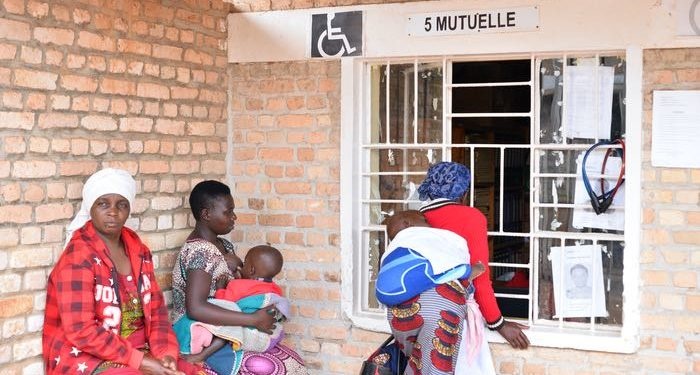
Women at one of the family planning units paying for services in SHOGWE Muhanga photoy by Rwanda Dispatch
Sumaya, Solange, Shadia and Jeanne asked to be identified by one name each to protect their privacy.
By 6 a.m. in Kayonza District, Eastern Province, Sumaya is already heading to the garden, her five-month-old baby tied strapped on her back.
At 16, she spends six hours a day digging under the morning sun for Rwf 1,500 makes her look 22. Not long ago, her mornings began with a school uniform and a walk to class. Then she became pregnant.
He used to give me snacks, bought me clothes, shoes and often gave me money,. That is how we become friends. He even bought me a smartphone so that we could always talk,” she says.
Sumany, 16 the father of her child was a 27-year-old shopkeeper who owned a boutique at the trading centre, a few kilometres from school.
“After some time, he asked me to visit him at his place after school. That was my first time to have sex, and he never used a condom. I went to see him everyday before going home. Over the weekends, we would go out to ride on his motorbike.”
For two months she did not understand what was happening to her body.
“At first I thought it was normal. After I missed my periods, a friend advised me to take a pregnancy test at a private clinic. That is when I discovered I was pregnant.”
“When I told him, he panicked and stopped calling. Then he disappeared to Uganda. That is when I dropped out of school,” she says.
Abortion is legal in Rwanda on limited grounds, including when the pregnant person is a child, rape, forced marriage, incest, or a risk to her health, and generally up to 22 weeks.
For girls under 18, lawyer Jean Claude Kayirange advocate told Rwanda Dispatch, a termination needs her legal representative to [apply for it / consent].
Sumaya is one of hundreds of teenagers in Kayonza who fall victim to sexual exploitation each year. Her account establishes the human cost of teenage pregnancy.
Solange’s story is similar. Now 17 and living in Kabarore, Gatsibo District, she was 15 when she became pregnant.
“I had an acquaintance in Gatsibo. He moved between Kayonza and Gatsibo, working as a foreman in construction. We slept together for a while. I did not think I needed to protect myself. After three months, I discovered I was pregnant. My parents, who are devout Christians, did not take the news well. It was a harrowing experience, and I could not go to school.”
Her elder sister, Shadia, who had her first child at 24, calls it an “accident.”
“After the delivery, we discovered the man was already married with two children. Life became hard. He stopped sending money for the baby. I had to look after my sister and her baby, on top of my two children,” Shadia says. whose account establishes the human cost of teenage pregnancy.
More than 23,000 teenage girls become pregnant in Rwanda every year—an average of roughly 60 each day. According to a report by the National Institute of Statistics of Rwanda (NISR), contraceptive use remains low among youth aged 15–19, with injectables favored over condoms (see graph below).
2025 RDHS: Contraceptive Use by Age Group & Method Type
Source: National Institute of Statistics of Rwanda (NISR)
Across East Africa, 92 of every 1,000 girls give birth as teenagers, twice the global average, according to the United Nations sexual and reproductive health agency-UNFPA,
Uganda and Tanzania rank among the highest in the region with rates up to 34 per cent respectively.
But Rwanda stands out from many of its neighbors, says Dr. Betty Cathy Mwendwa, a regional expert and educator in Sexual and Reproductive Health Education.
In her view, Rwanda has taken extra mile in fighting teenage pregnancy and gender-based violence (GBV) against women and girls.
Dr Clarisse Mutimukeye, a renowned SRHE doctor, has spoken out at several conferences on a contradiction in Rwanda’s law. In March 2025 she told Health Policy Watch that a girl under 18 could seek a safe abortion but could not get contraception without a parent. “This is a problem,”
In September 2025, Parliament passed health law No. 026/2025. It lowers from 18 to 15 the age at which girls can get sexual and reproductive health services, including contraceptives, condoms and implants, without parental consent.
When the bill was tabled in 2022, it drew criticism from conservative religious groups and mixed reactions from the public and legislators
This is a crisis, comparable to an epidemic,” said Memeber of Parliament Lydia Mushimiyimana during a parliamentary [debate on the health bill.]
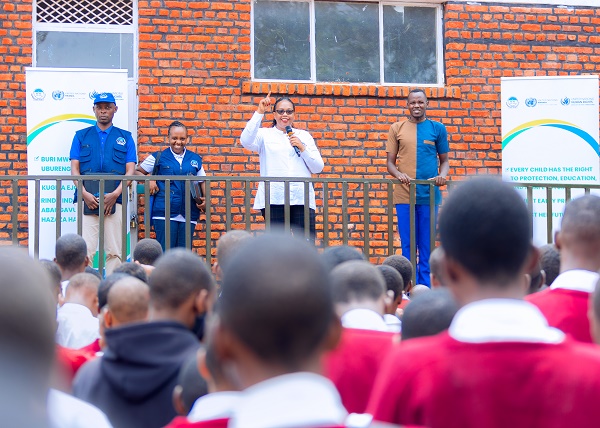
Lawmakers split over the health bill. Courtesy photo
MP Marie Ingrid Izere said the figures show action is needed, but contraception must come with behavioural education. “Providing family planning services without guidance could expose young people to diseases that threaten their future,” she said.
MP Jean René Niyorurema said prevention campaigns had lost momentum and should be revived first. “We are rushing to adopt what works elsewhere without assessing if it fits here,” he said. He wanted parents notified if it passed.
More than 23,000 girls get pregnant in Rwanda every year, an average of over 60 a day, Health Minister Sabin Nsanzimana says.
Minister Sabin Nsanzimana said girls under 19 remain among the most vulnerable, facing higher risks of childbirth complications, including maternal deaths. The minister added that about one in three children born prematurely or affected by stunting are delivered by teenage mothers.
The Ministry of Gender and Family Promotion recorded 22,454 teenage pregnancies in 2024, compared with 22,055 in 2023 and 24,472 in 2022.
“Having 23,000 teenage pregnancies a year in a small country like Rwanda is a concern,” Dr. Mwendwa says. “Many involve sexual abuse, rape and infections like HIV or STIs. It is a growing concern that has to be tackled.
Three years later, Parliament passed the bill on 4 August 2025, and it took effect on 18 September.
Evariste Murwanashyaka of the human rights group CRADHO welcomed the law, calling it a victory for girls who have suffered from stigma and lack of access to services.
For the Catholic Church, the outcome went the other way. Cardinal Antoine Kambanda, who opposes the law, argues that letting 15-year-olds use family planning gives them an excuse to be sexually active, and that a 15-year-old is not ready to be a parent.
He urged families and the government to promote abstinence. “We are not pleased with this decision,” he said.
The law came too late for Sumaya. She conceived months after it passed.
Shadia, who has watched her younger sister raise a child, welcomes the law. “It is a crisis,” she says. “Many young girls like Sumaya have unplanned pregnancies because they have unprotected sex. Whether we like it or not, they are sexually active and vulnerable. Teenagers need access to contraceptives and condoms.”
About one in three children born prematurely or affected by stunting are delivered by teenage mothers. Photo Courtesy
Parents who were once silent are now speaking up. Nadia Mukasafari, a mother of three in Kayonza, recently visited the family planning unit in her sector in Rukara, and what she saw stayed with her.
“Teen pregnancy is a worry, I strongly welcome the law.” she says. “I looked at those girls, and they were still babies themselves. Yet they were the ones carrying babies. It touched me deeply.”
“As a Muslim, we can’t reject the law,” we instead embrace it,” says Aisha Mukabiyizi of Kabarore. “But I will still advise my daughters to use protection. If it means carrying a pack of condoms to school that is fine wIth me. My religion opposes abortion, and protection prevents diseases, not just pregnancy.”
“We send our children to school, only for them to come back pregnant,” adds Mukabayizi, “It means what the education system is doing is not enough. As parents, we need to step up, because in the end we are the ones facing these challenges.”
Beyond the law, the government and civil society partners have launched several interventions. The Network of Rwandan Parliamentarians on Population and Development (RPRPD) has toured all 30 districts to educate local leaders.
The Ministry of Gender and Family Promotion spent nearly Rwf 1 billion translating UNESCO’s Parent-Child Communication toolkit into Kinyarwanda, to break family taboos.iotlines such as 8011 are linked to youth clinics and have drawn over 2,500 inquiries. At youth-friendly centres and Isange One Stop Centres, GBV survivors get medical care, counselling and free contraceptives without parental involvement.
Minister of State for Health Dr. Yvan Butera says the clinic response is essential. About 38 percent of children born to teenage mothers suffer chronic stunting, he notes, and adolescent mothers face a higher risk of postpartum depression and dropping out of school.
Even when the law establishes a right to autonomous care at 15, frontline health providers frequently default to demanding parental consent out of caution or habit.
“Removing barriers at the clinic level is both a public health necessity and an economic de-risking tool,” he says.
At the Gahini family planning unit, nurses ask teenage girls for identification and a parent’s signature before giving routine contraceptives.
“The girls are required to have identification, plus a parent’s or guardian’s signature, if they are not raped or abused,” says nurse Vestine Niyonsaba.
Dr. Bwiza, head of the Gahini One Stop Centre, adds that teenagers can seek contraceptives and information, but they must present identification and a parent’s or guardian’s Mutuelle de Santé card.
“Even though parental consent is no longer required, a doctor or healthcare professional must still evaluate and prescribe the appropriate method,” Dr. Bwiza says.
Judgment from health workers can keep girls away even more than paperwork, says Marie Louise Ahishekiye, a youth volunteer in Kayonza. “I remember how difficult it was when I went to get pills. The nurses were whispering. The same happens to teenagers today.”
Keza, 20, from Kiramurozi sector, says the health centre made her feel small. She went to ask for condoms for her boyfriend. A health worker turned to a colleague and said:
—Reba nkuyu mwana, “which means ” Look at this child.
“I felt ashamed,” she says. “They did not give me family planning. They told me to abstain from sex.” A month later, she was pregnant.
Jeanne, 17, from Kabarore sector, remembers her first antenatal visit as the day she wanted to disappear. The nurse raised her voice and asked why girls “go around sleeping with men.”
“I wanted to hide,” Jeanne says. She did not return to the clinic until she gave birth.
Dr. Mwendwe warns that legal gains across East Africa are being undermined by funding cuts, such as the closure of USAID-supported school programmes that delivered frontline reproductive education.
“In 2025, President Donald Trump shut down USAID. Across Africa, nearly two-thirds of all USAID-supported contraceptives were halted. Over $9.7 million worth of contraceptives originally destined for African nations ended up stranded in European transit hubs rather than being distributed,” Dr. Mwendwe notes.
The US gave Rwanda about $198 million in aid in 2024, according to US government data, and local NGOs felt it quickly. Some laid off staff, and others stopped work in villages.
For girls like Sumaya, the effect is hard to see, but it matters in places like Kayonza, Gatsibo, Nyagatare and Bugesera, where teenage pregnancy remains high.
A report by the National Commission for Human Rights found that 69 percent of teenage victims of sexual abuse never report it, usually because families settle the matter privately or because they fear social ostracism.
Dr. Mwendwa says passing the law removes the legal risk for health workers who serve teenagers, but this is only the first step. The second is putting the law into practice.
From Kigali to Gakenke, NCHR is taking child rights into classrooms.”
Back in Kayonza, Sumaya finishes her six hours of digging. She ties her baby to her back and heads home.
Rwanda has put the law in place to protect the next generation of girls. What remains is the harder part: the nurse at the clinic desk must open the door, the community health worker must make the long walk to the village, and parents must do their part.
One question remains: in an age when information is a tap away, why are teenagers still struggling to protect themselves?
Data tracking rates for this report was provided by the family planning units of the districts in Eastern Province, which are tracked annually in family planning units.