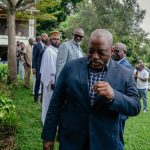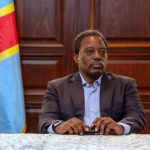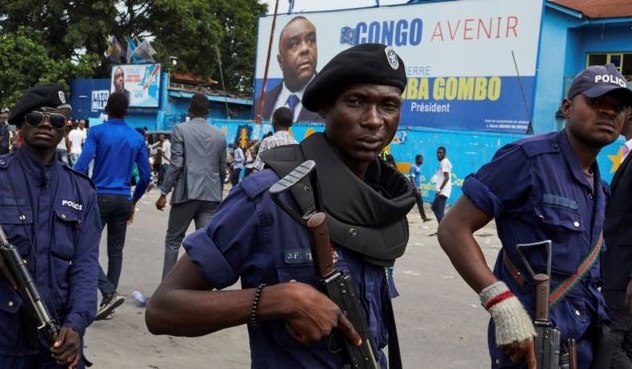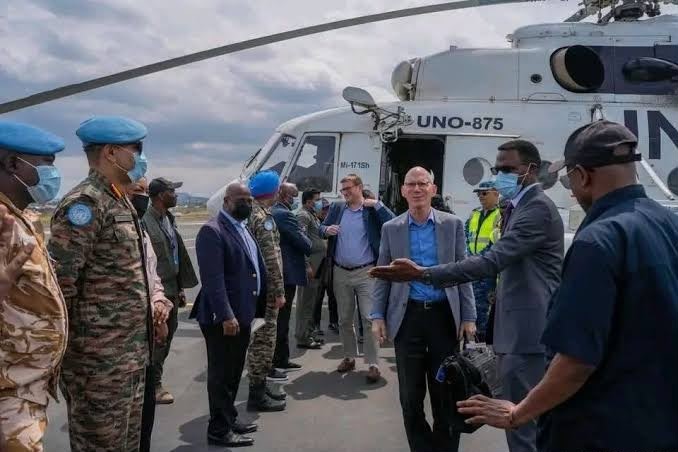
The head of the UN mission in the Democratic Republic of Congo (DR Congo), James Swan, met former president Joseph Kabila in Goma on Tuesday, marking their first meeting since Kabila assumed leadership of the newly formed Front for the Refoundation of the Nation (FRN).
The FRN emerged on October 12, replacing the AFC/M23 coalition under a new political structure.
Swan, who heads the UN Organization Stabilization Mission in the Democratic Republic of the Congo (MONUSCO) and serves as the UN Secretary-General’s Special Representative to the country, arrived in Goma on Monday.
Kabila was accompanied at the meeting by FRN vice-presidents Corneille Nangaa and Bertrand Bisimwa, as well as military officers. Swan’s delegation included Brigadier General Givenz Kishombe Sichali and adviser Walter Lotze.
MONUSCO described the meeting as part of its ongoing engagement with the AFC/M23, saying discussions focused on civilian protection, humanitarian access and support for ceasefire monitoring, including through the Expanded Joint Verification Mechanism Plus.
The UN has maintained that engaging armed groups is necessary to facilitate humanitarian access and protect civilians. It says such contacts do not amount to political recognition of those groups.
Following the meeting, Bisimwa described the FRN on social media as a “national agenda” and a response to what he called tyranny.
He said the movement had inherited both the “assets and liabilities” of the AFC/M23 and remained committed to the Doha peace process.
Bisimwa accused the government in Kinshasa of failing to honour its commitments under the negotiations. He argued that the Doha agreements are grounded in the current Congolese Constitution and warned that any attempt by President Félix Tshisekedi to change it could cause “the entire peace process to collapse.”
He also criticised the renewal of MONUSCO’s mandate, describing the mission as a “total failure”. Bisimwa questioned its planned redeployment to South Kivu and accused government forces and their allies of launching attacks on several fronts, particularly in Minembwe, which he said was under blockade.
He warned that the FRN “will not tolerate these attacks.”
The meeting took place days after the International Contact Group for the Great Lakes issued a joint statement on October 30. Chaired by France, the group includes the United States, the European Union and several European countries.
The group rejected what it described as attempts to pursue political objectives through violence, a position directed at the FRN’s stated approach. It instead called for an inclusive dialogue among Congolese.
According to AFP, the FRN has pledged to end what it calls tyranny “by any means, including force.”
The movement operates from Goma, which M23 fighters captured in January 2025.
Kabila’s involvement in the new movement has further complicated his already strained relationship with the government in Kinshasa. Authorities have accused him of supporting the rebellion. In September 2025, a military court sentenced him to death in absentia. The United States imposed sanctions on him in April 2026.
The ruling coalition in Kinshasa has described his decision to lead an armed movement as high treason. The African Union has also warned against unconstitutional changes of government.
The conflict has also strained relations between Rwanda and the Democratic Republic of Congo. Kinshasa and several Western governments accuse Rwanda of supporting M23, allegations Kigali denies. Rwanda maintains that its security concerns are linked to the Democratic Forces for the Liberation of Rwanda (FDLR), an armed group founded by former Rwandan Hutu officers.
Last week, the US Treasury sanctioned Rwanda’s Ministry of Defence over alleged support for M23.
The FRN maintains that it has taken over the AFC/M23’s place in the Doha peace process, which produced a declaration of principles in July 2025 and a framework for a peace agreement in November 2025.