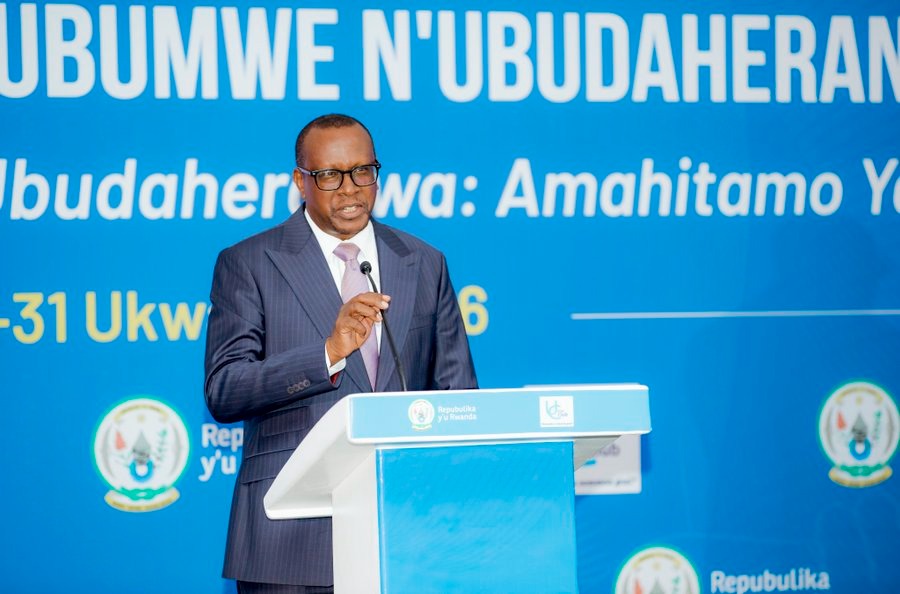
A primary school classroom became an early lesson in discrimination for Ambassador Théoneste Mutsindashyaka, who recalled Tuesday how a teacher separated pupils by ethnicity in 1973.
The teacher first asked Hutu pupils to stand, followed by Tutsi pupils. Mutsindashyaka said he remained seated, prompting the teacher to hit him on the head with an elbow and call him “Inzoka, mwabaye mute?”
He was too young to understand the meaning of the incident at the time. After returning home, he asked his grandfather: “How does a person become a snake?”
Mutsindashyaka later encountered discrimination in education as well. When he scored well in an examination for university but was denied admission while some students with lower marks were accepted. He was later imprisoned.
He was speaking as Rwanda began a month-long series of discussions on Unity and Resilience, bringing together people with different experiences of the country’s history of discrimination and division.
The sessions include testimonies from people who suffered discrimination as well as others who took part in activities linked to divisive politics.
Maj. Gen. (Demob) Félicien Nsanzubukire, a former member of the FDLR, said he had been involved in an ideology that promoted the return of political power to what was described as the “other side” of Rwanda’s divisions.
He later returned to Rwanda, where he was arrested, tried and sentenced to five years in prison.
“When I returned and was arrested, I thought it was the end for me, but that arrest ended up giving me a life,” Nsanzubukire said.
He said the experience changed his outlook and gave him an opportunity to rebuild his life and contribute to efforts to prevent a recurrence of the country’s past.
Mutsindashyaka said Rwanda also chose a different path after the 1994 Genocide against the Tutsi, focusing on rebuilding unity instead of allowing the country’s history to continue defining its future.
The 2025 National Unity and Reconciliation Barometer put the unity and reconciliation index at 95.3%, up from 82.3% in 2010.
Minister of National Unity and Civic Engagement Jean Damascène Bizimana urged participants to carry the discussions beyond the venues where they are held.
He called on them to become “ambassadors of Unity and Resilience” by taking the message to their families, workplaces, religious communities and other organisations. He also urged religious leaders and civil society organisations to hold similar discussions.
The month-long programme will continue in different parts of the country throughout October.