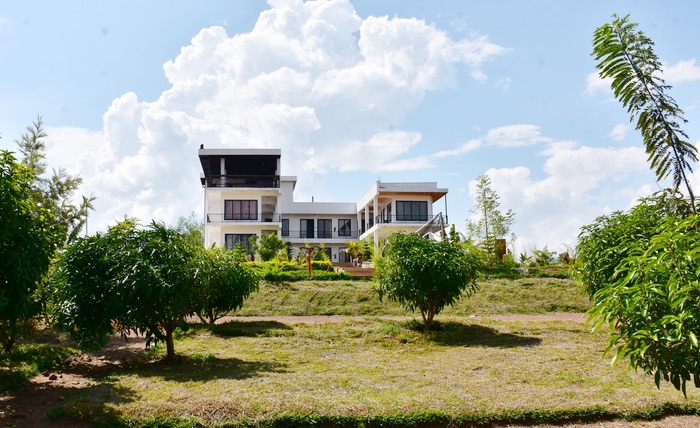
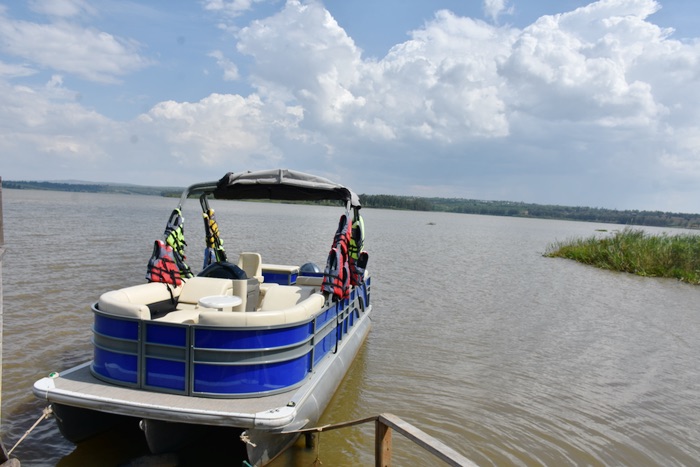
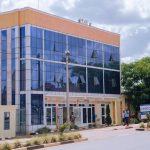
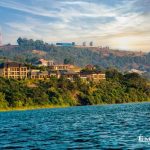
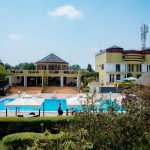
As the late afternoon sun casts golden reflections across Lake Mirayi, visitors wander through the grounds of Ubumuntu Resort in Bugesera, Gashora Sector. Some relax on the resort’s sandy beach, the only one of its kind in the district, while others take in the sweeping lake views from a corporate boat powered by a 150-horsepower engine.
Ubumuntu Resort, the simple, beautiful tourism destination in Bugesera
To casual travellers, Ubumuntu Resort is a simple, beautiful tourism destination. But for its founder, Rogers Nziza Kimuli, the resort represents something much bigger. It isn’t just a business; it’s the engine driving a deeply personal mission to uplift and transform the surrounding community.
The resort is only one piece of what he calls the Ubumuntu ecosystem, a network of initiatives spanning education, nutrition, sports, agriculture, tourism, culture and healthcare. Together, they are designed to uplift local communities, beginning with the youngest generation.
“The question should never be what the country will do for you,” Nziza says. “The question is what you can do for your country.”
That belief has guided his work for nearly two decades.
At the heart of everything he does is the concept of Ubumuntu, a Kinyarwanda word that embodies humanity, empathy and kindness. For Nziza, Rwanda itself provides the strongest example of that principle.
“When you look at what happened during the Genocide against the Tutsi and then see people choosing forgiveness and reconciliation, I believe Rwandans bear the true meaning of Ubumuntu.”
It is this philosophy that inspired him to dedicate his life to community transformation.
Nziza’s first visit to Bugesera was in 2006 while participating in a peace-building programme as a student. He encountered a district facing significant challenges, including food insecurity, limited infrastructure and few opportunities.
Many saw hardship. Nziza saw a possibility.
Among the places that captured his imagination was Rugunga Village in Gashora, where he would eventually lay the foundations of what has become the Ubumuntu movement.
Determined to find homegrown solutions, he studied agriculture and water engineering at the University of Rwanda’s Busogo Campus, believing that improved food production and access to water were essential building blocks for development.
His first major intervention focused on combating malnutrition through kitchen gardens. The initiative encouraged families to grow nutritious vegetables next to their homes, improving both food security and health outcomes.
His interest and research into the project gained momentum. They attracted international attention, leading to his travelling to Japan and later earning him an opportunity to further his studies and research in the United States at Georgetown University.
For some young Africans, such opportunities become a permanent ticket abroad. Friends and colleagues encouraged him to stay.
He refused.
“I always knew I would come back home,” he says. “My dream was what I can do for my country.”
Upon completing his programme, he secured financial support that helped him expand his vision back home.
His conviction was simple: if communities are to develop, education must come first.
“To engineer real change, invest in the young,” he says.
That philosophy led him to establish Real Moon FC, a football academy offering free training opportunities to young players. Supported by experienced coaches and local partnerships, the academy aims not only to develop athletes but also to create future leaders and role models.
Starting the academy led him to realise the need to feed the young, while simultaneously establishing a school in Rugunga Village, providing young children with access to quality early learning opportunities.
That reality reinforced his belief that education, nutrition and sports must work together rather than as separate interventions.
Today, the Ubumuntu ecosystem includes three Early Childhood Development Centres (ECDs) serving more than 600 children. The centres provide education, nutrition and care at no cost to families.
Milk supplied to the centres comes directly from Ubumuntu’s dairy farm, established as a sustainable solution to the project.
His commitment to child welfare extends beyond the academy. Over the years, he launched feeding programmes to support vulnerable children and, at one point, was caring for approximately 40 children under his own roof.
As the number of beneficiaries increased, so did the financial burden.
Rather than scaling back, he turned to fundraising, mobilising support from friends, partners and international networks who believed in the vision.
The result is an integrated development model that continues to grow.
His ambition extends beyond identifying athletic talent. He wants to accompany young athletes throughout their journey until they can compete professionally.
The Ubumuntu ecosystem now extends into culture as well. Through the Ubumuntu Art Gallery, local creativity is showcased while preserving cultural identity and creating opportunities for artists.
Healthcare is next.
Construction of the Ubumuntu Clinic is expected to begin in August, adding another critical service to the growing network. The clinic is intended to complement the existing investments in education, nutrition and youth development.
Turning Hospitality into a Force for Development
Everything at Ubumuntu is designed to strengthen the community from the roots upward. The most visible part of this work today is tourism.
Ubumuntu Resort was never intended to be merely a hospitality business. It was built to generate revenue to sustain Real Moon Football Academy, ECD centres, and other community programmes.
“All the money we mobilize is meant to support the children and community,” Nziza notes.
The strategy reflects his commitment to creating sustainable solutions rather than relying indefinitely on donors.
The resort is a proof of concept for Gashora’s raw tourism potential. Gashora is uniquely positioned within Rwanda’s geography. Nziza points out that Gashora is the only sector in the country surrounded by five lakes, eight marshlands and wetlands, and two rivers, including the Akagera River.
Factor in Bugesera’s rapidly improving infrastructure and proximity to the future international airport, and he believes the area is poised for remarkable growth.
To capitalise on this, Nziza is planning new tourism attractions, including Rwanda’s first over-lake zipline.
The goal is not only to attract visitors but to establish Gashora as a destination in its own right.
“My aim is to build the city of Gashora,” he says.
To move beyond tourism, Nziza and a group of partners registered Gashora Region Investment Group, an initiative intended to mobilise capital for strategic investments throughout the area.
With shares valued at Rwf50 million each, the group is aggressively targeting investors willing to capitalise on long-term regional development.
For Nziza, the timing is ideal.
Road infrastructure now connects Bugesera more effectively to Kigali, Eastern Province and Southern Province, while major national investments continue to transform the district.
“This region was overlooked for a long time despite its enormous potential,” he says. “Now is the time to invest.”
The impact of his work is already visible.
Across the various Ubumuntu initiatives, an estimated 2,000 people benefit directly or indirectly every day.
The ECD centres serve hundreds of children. The football academy supports young athletes. Some students receive sponsorship opportunities within Rwanda and abroad.
Employment opportunities have also expanded significantly.
More than 30 people work at the resort. Around 70 are employed in cattle farming operations, while others work in piggery, poultry, vegetable farming, and related activities. Casual labour opportunities and home renovation support for vulnerable families further extend the initiative’s reach.
The breadth of the ecosystem reflects the lessons Nziza accumulated throughout his career.
Before focusing fully on Ubumuntu, he worked on peace-building and national unity initiatives, contributed to programmes under Imbuto Foundation’s Rwanda Speaks platform, and later worked with health-focused initiatives that promoted access to healthcare services for vulnerable communities.
Those experiences reinforced his understanding that sustainable development requires interconnected solutions rather than isolated projects.
Sitting on the shores of Lake Mirayi today, it is easy to focus on the visible achievements: the resort, the farms, the schools and the growing tourism infrastructure.
But for Rogers Nziza Kimuli, the true measure of success lies elsewhere.
It lies in a child receiving an education, a young footballer pursuing a dream, a family gaining access to nutritious food, water or a community discovering new opportunities for prosperity. It lies in Ubumuntu.