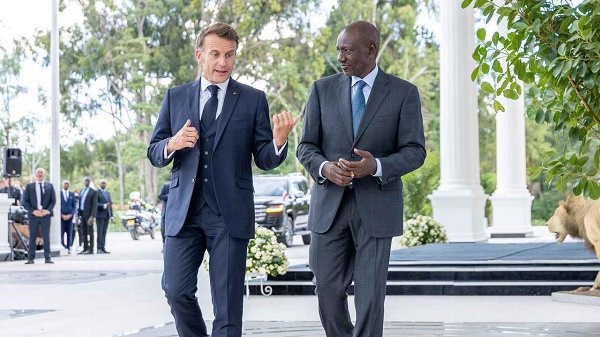
French President Emmanuel Macron on Tuesday defended France’s decision not to support broad sanctions against Rwanda over the conflict in eastern Democratic Republic of the Congo, arguing that dialogue remains more effective than isolation.
Speaking on the sidelines of the Africa Forward Summit in Nairobi, Macron said pushing Kigali to the margins could undermine chances for cooperation and a lasting political solution. Instead, he called for diplomacy led under the framework of the African Union and continued engagement with both Congolese President Félix Tshisekedi and Rwandan President Paul Kagame.
In an unprecedented escalation of economic and diplomatic pressure, the United States Department of the Treasury’s Office of Foreign Assets Control (OFAC) imposed sanctions on the Rwanda Defence Force (RDF) and four of its top military commanders on March 2, 2026.
The U.S. State Department explicitly tied this aggressive measure to “blatant violations” of the signed Washington Accords for Peace and Prosperity, a historic peace agreement brokered by the Trump administration and signed just months prior on December 4, 2025, by Rwandan President Paul Kagame and DRC President Félix Tshisekedi. Washington’s punitive action followed a massive offensive by the Rwanda-backed M23 rebel group that resulted in the capture of the Congolese city of Uvira, a direct defiance of the agreed-upon ceasefires. Rwanda however denies the allegations.
Also, a new bill has been tabled in the U.S. Senate specifically aimed at reinforcing the peace process through strict visa penalties. The proposed legislation mandates comprehensive travel bans and the revocation of existing visas to enter the United States for any foreign government officials, military commanders, or non-state actors determined to have actively defied or undermined the ceasefire and troop withdrawal agreements.
Macron’s remarks came as France also tried to strengthen its broader partnership with Africa through major economic commitments announced during the summit. The French leader unveiled a €23 billion investment package for the continent, including €14 billion from French public and private investors, and €9 billion ($10.5 billion) from African investors.
According to the Élysée Palace, the funding will focus heavily on energy transition projects, digital technology and artificial intelligence, the blue economy, agriculture, healthcare, industrialization and banking. Business leaders attending the summit, including executives from major companies operating across Africa, pushed for greater economic stability and more predictable tax systems to encourage long-term investment.
The Nairobi summit, attended by more than 30 African and French CEOs alongside dozens of heads of state and government officials, highlighted France’s attempt to redefine its role on the continent after years of strained relations in parts of West Africa.
Discussions also focused on reforming the global financial system to better reflect the needs of developing countries, an initiative jointly backed by France and Kenya. Still, the absence of leaders from Mali, Burkina Faso and Niger, countries that have cut diplomatic ties with Paris, served as another reminder of the challenges France faces as it tries to rebuild influence across Africa.