When Finance Minister Yusuf Murangwa delivers the National Budget Framework Paper (BFP) before Parliament on Monday May 11, 2026, traders and businesses alike will be watching with a keen eye on how government intends to steady the franc, as the local currency continues to remain under pressure against the US dollar.
Traders will be watching Monday’s Budget Framework Paper closely, treating it as an early indication of how government intends to manage fiscal pressure and stabilise the franc ahead of the full budget presentation later this year.
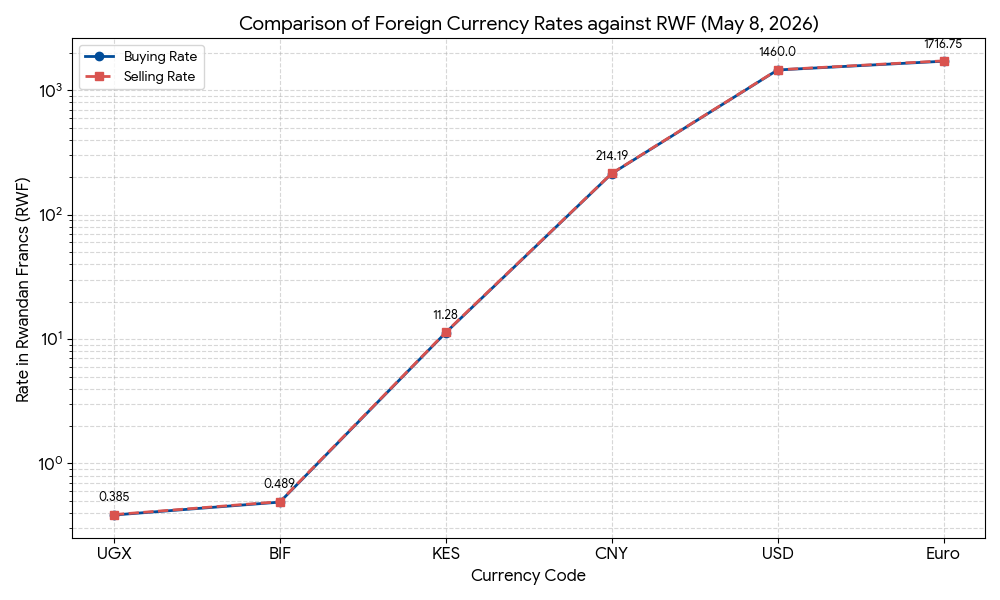
The franc has weakened steadily since April, with the USD/RWF pair trading between 1,460 and 1,465 in recent sessions and briefly touching 1,465.94, close to record lows for the local currency.
Spot rates from forex bureaus indicate the pair has continued to oscillate within the 1,460–1,465 range, a heightened volatility in daily trading.
Despite the pressure, the National Bank of Rwanda (BNR) has maintained a tight monetary stance.
In a bid to anchor inflation expectations and defend the local currency, the BNR maintained a hawkish position in February by keeping the Central Bank Rate (CBR) at 7.25%.
Read More: Rwandan Franc Weakens as BNR Maintains MPC Rate
This aggressive monetary positioning comes as headline inflation (Urban CPI) touched 9.2% earlier this year, driven largely by a 20% surge in energy costs.
By keeping rates high, the central bank is attempting to mop up excess liquidity and support the franc, even as external pressures from a strengthening US dollar continue to test Rwanda’s foreign exchange reserves.
For Rwandan businesses, the key question now is whether Monday’s BFP will provide the fiscal discipline needed to ease pressure on dollar demand, or whether the franc will continue sliding deeper into uncharted territory.
That pressure is already being felt directly by import-dependent businesses, with investors and traders closely watching Monday’s BFP presentation.
Ronald Mugarura, an importer based in Giporoso-Remera, said businesses are increasingly struggling with the weakening franc.
“Our margins now depend entirely on the stability of the franc, but seeing the rate hit 1,465 just days before the budget is making everyone nervous. We are looking to Minister Murangwa to provide some breathing room. If the dollar keeps climbing, the cost of doing business will simply become unsustainable for many of us,” Mugarura said.
Jean Claude Manashimwe, a cross-border trader based in Kirehe at Rusumo border, said the weakening franc has squeezed businesses that depend heavily on imports and regional trade.
“Every time the dollar climbs, transport costs, stock prices and supplier payments all go up at once. For traders like us in border districts, the pressure is immediate because most of our business depends on regional transactions. Right now, many people are waiting to see whether the government’s budget direction can restore confidence in the franc and calm the market,” Manashimwe noted.
On September 17, 2025, the BNR tightened foreign exchange rules through a new directive, strictly reinforcing the Rwandan franc as the sole legal tender for domestic transactions.
The rule limits foreign currency pricing to specific authorized entities, such as high-end tourism and international schools, targeting reduced dollarization, with steep fines for violations.
Read More: BNR Uncovers Illegal Use of Foreign Currency in Over 860 Contracts
According to the National Bank of Rwanda’s Monetary Policy Report published in February 2024, the franc had depreciated by 18.05% year-on-year against the US dollar by the end of December 2023.
One of the major reasons at the time was the US Federal Reserve’s interest rate hikes, which strengthened the dollar globally.
Speaking during the IMF Regional Economic Outlook launch in Kigali on May 6, Murangwa said that although Rwanda’s economy continues to post strong growth of 9.4%, regional progress remains fragile due to persistent external shocks.
Unlike the reactive approach of previous years, the government’s 2026 strategy is focused on private-sector-led growth and fiscal discipline in an effort to shield the economy from continued global uncertainty.
More: Rwanda among Africa’s fastest-growing economies in 2026, IMF says
The BNR and the Ministry of Finance are also working closely to maintain macroeconomic stability. Analysts expect the new budget to prioritize tighter spending measures, with government already cutting Rwf198 billion in non-essential recurrent expenditure to help contain inflationary pressure.
The strategy is aimed at slowing price increases and preventing further depreciation of the franc against the US dollar.
With the franc under pressure and import costs continuing to rise, Monday’s BFP presentation will likely serve as an early test of how far government can balance strong economic growth with mounting global uncertainty.
Disclaimer: Exchange rates are volatile and subject to immediate change at any time