Around 20 Rwandan Journalists have undergone specialized training in budget analysis, policy interpretation and accountability reporting, with facilitators urging deeper verification standards in public finance coverage.
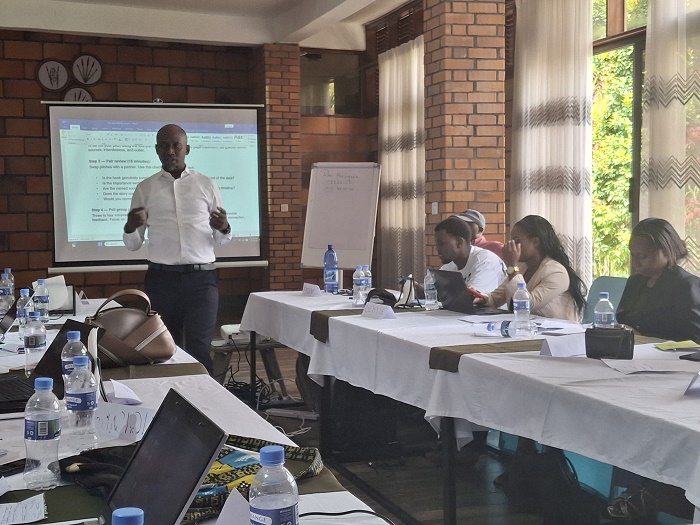
The workshop was convened by FOJO Media Institute/ Rwanda Media Programme, in partnership with AFRI-MEDIA Ltd, a local capacity building implementer from May 4th to May 7th at Ruyenzi, Kamonyi District, to aid the trainees on public finance, and budget negotiation stimulations.
Solange Ayanone, AFRI-MEDIA Ltd trainer expert, opened the session by emphasizing the media’s civic duty to translate complex national budget process, sources of funding, and how to interpret key concepts in public finance into information that the public can easily understand.
She highlighted the role of the media’s responsibility to demystifying the national budget, as why East African nations, such as Uganda and Kenya, synchronize their budget releases, citing the importance of harmonization across the region.
She further stressed to hold any institution accountable; journalist must first understand the finance policy, distinct sector allocation, as well as key institutions in the budget process, which include; the Ministry of Finance and Economic Planning (MINECOFIN), Local Government, and the Office of the Auditor General.
Beyond theory, the group sessions were held to provide hands on training in financial literacy, the trainees were equipped to analyze complex budget allocations, that allowed them to question the strategic reasoning behind sector priorities, so that they can understand how public finance is reported, moving from simple announcements to deep dive investigations that hold institutions accountable for every franc spent.
Ruziga Emmanuel Masantura Specialized trainer shared his experience with participants on role of media in budget reporting, specifically on turning data into credible stories.
For the participants, the impact was immediate. Twizeyimana David, one of the trainees, admitted that he used to struggle with the overlapping stages of the national budget process.
“This training has given me a clearer understanding of how priority sectors are identified,” Twizeyimana said. “It’s equipped me to avoid sensationalism and stick to high verification standards, especially when we’re covering parliamentary proceedings.”
The workshop arrives at a critical time, as the Office of the Auditor General continues to call for more rigorous scrutiny over how public money is managed and spent. Read More: Auditor General blames weak contract management for costly project delays