In Rwanda’s Eastern Province, where rolling hills meet the hum of new industry, opportunity often begins with a single spark of determination. For Celestin Mahirane, that spark came from a hammer’s tap and the smell of freshly cut wood. Once a small-scale farmer in Kirehe District, he traded his hoe for a saw — and in doing so, built one of the area’s most respected furniture businesses.
In a dusty workshop in Kirehe District, the rhythmic tap of hammers and the scent of freshly cut timber mark the start of Celestin Mahirane’s day. Every table, chair, or bed he crafts carries a story — of patience, persistence, and a keen eye for opportunity in a district once seen as purely rural.
Mahirane’s journey began far from the workshop benches. He started as a small-scale farmer in Kigina Sector, tending crops on his modest plot of land. But when Kirehe began to develop — with new roads, electricity, and markets — he saw a chance to reinvent himself.
“When power was installed in our community and Agakiriro (center of carpentry, metalwork, and trade) was built, I realized people needed good, affordable furniture,” he recalls. “That’s when I decided to take the risk and start my own carpentry business.”
Celestin Mahirane at his workshop in Nyakarambi, Kirehe
At first, Mahirane’s workshop was simple, crafting basic household furniture for friends and neighbors. But the demand grew quickly. In 2013, after working long hours in Nyakarambi in a customer service job, he saved enough to buy space at the Agakiriro complex, joining other carpenters under one roof. He says the decision changed everything.
“When carpenters work in one area, it’s easy to share ideas, tools, and customers,” he explains. “We learn from each other and improve our products.”
In a short period of time Mahirane had expanded, buying new equipment and hiring his first employees. In 2016, he officially registered Celi Company Ltd, marking his transition from a self-taught craftsman to a business owner. He also revived his small welding business, which he had previously operated in Kigali — now made possible by Kirehe’s new access to electricity.
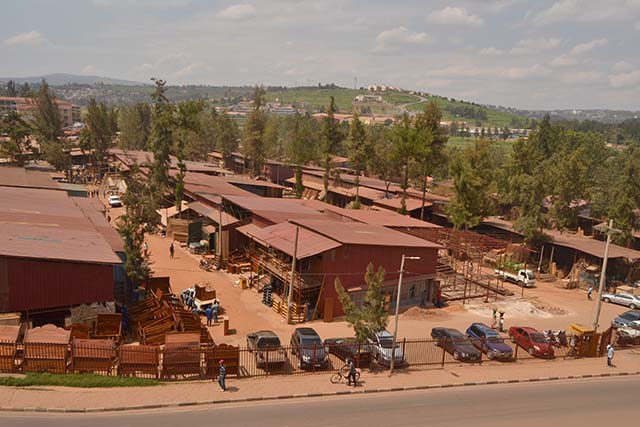
The Agakiriro model, he says, has been transformative. It allows small carpenters to share machines, storage, and transport, reducing costs while ensuring their products are secure and dust-free. It also serves as a one-stop center for buyers. “Customers coming here can find everything in one place — from sofas to wardrobes,” he says proudly. “It’s easier for them, and better for us.”
The growth of Mahirane’s business is closely tied to Kirehe District’s efforts to create a conducive environment for artisans. The district pioneered the establishment a shared industrial space designed to support carpenters, welders, tailors, and other craftsmen. The government’s broader policy of promoting Technical and Vocational Education and Training (TVET) and small- and medium-enterprise (SME) development has also played a vital role in nurturing such local talent.
Within Agakiriro — a bustling hub of craft, trade, and innovation — artisans pool resources, share machines, and collectively attract buyers. “Customers visiting Agakiriro can find a variety of furniture in one place,” Mahirane explains. “As a company owner, it’s easier to supervise my employees, maintain quality, and even train new recruits.”
For Mahirane, this condusive working space offered both visibility and credibility. “Before, it was hard for customers to find us,” he says. “Now they know exactly where to go.” His reliable service and timely deliveries have earned him loyal clients and expanded his market beyond Kirehe.
Still, he believes there is room for more progress. He calls on the district to help artisans access local machinery and find new markets for their furniture, reducing dependence on supplies from Kigali.
Crafting Growth through Carpentry
As his operations grew, Mahirane began employing 15 full-time workers and recently hired more to handle increasing orders. His business supplies furniture to households, schools, and institutions across the Eastern Province. His reliable and quality services has built a reputation that keeps clients returning.
His biggest breakthrough came in 2017 when his Company Celi Ltd won a contract with the Ministry of Defense to supply building materials and timber. “That contract gave my business stability,” he says. “It proved that even those of us from small towns can meet national standards.”
Today, Mahirane’s workshop produces a wide range of quality furniture — from beds and wardrobes to dining sets and office desks. Prices remain competitive, with a finely crafted bed selling at Rwf 500,000 and full living-room sets going for around Rwf 1 million.
Looking ahead, he plans to diversify. As Kirehe plans to build a modern market in Nyakarambi, Mahirane intends to invest up to 20% in shares to grow his reach and visibility. He also urges local authorities to help carpenters access machinery locally instead of traveling to Kigali for purchases.
Beyond personal success, Mahirane believes carpentry is a tool for empowerment. “Young people should study vocational skills,” he says. “They are practical and can lead to self-employment. You can start small — even with nothing — and grow.”
From the soft whir of saws in his workshop to the polished furniture filling homes across Kirehe, Mahirane’s story is proof that with persistence, creativity, and community, even the humblest trade can carve out success in Rwanda’s growing economy.
As Kirehe town continues to grow from a rural outpost into a bustling commercial centre, entrepreneurs like Celestin Mahirane are shaping its new identity — one crafted from wood, hard work, and vision. His story is more than a tale of personal success; it’s a reflection of Rwanda’s broader transformation, where vocational skills and local enterprise are creating jobs, building dignity, and proving that opportunity can take root anywhere — even in the sound of a carpenter’s hammer.